Hair Color Genetics: How Melanin and Genes Decide Your Color
How eumelanin and pheomelanin make your hair color, which genes such as MC1R and KITLG shape it, why a Punnett square falls short, why color changes with age and whether transplanted hair keeps it.
11sources
11in PubMed
9min read
Written by Nazmi Güldeş, Certified Trichologist · Medically reviewed by Dr. Teuku Adifitrian, Sp.BP-RE (Dr. Tompi), Plastic, Reconstructive and Aesthetic Surgeon · Last reviewed 31 October 2026
Reading level
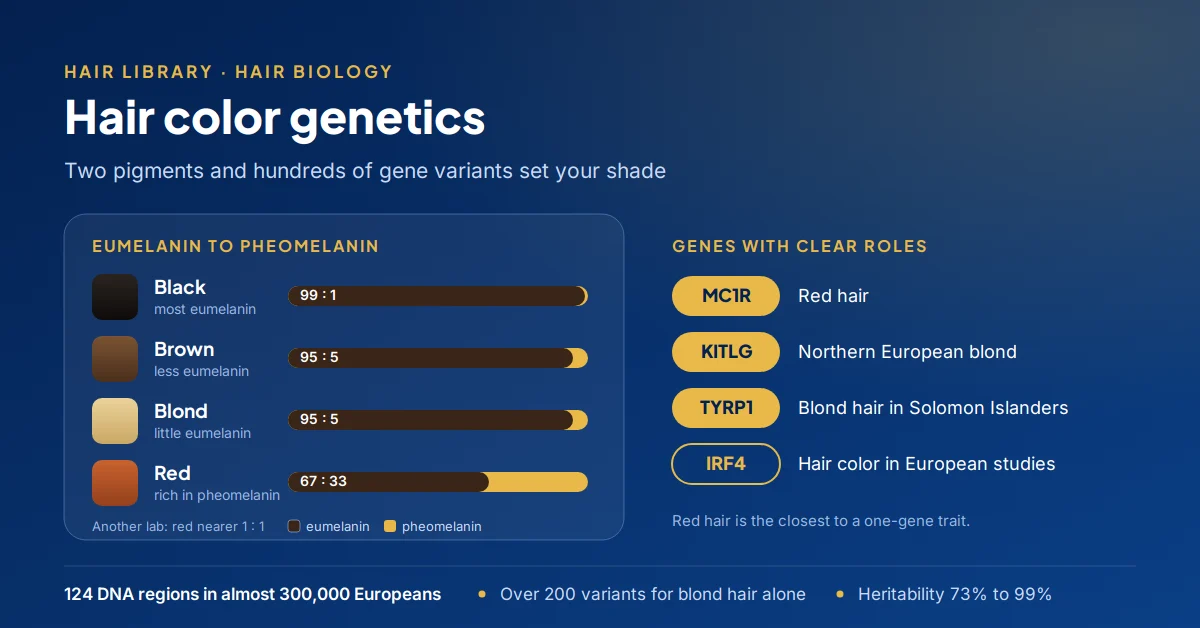
Hair color genetics comes down to two pigments and the many genes that control them. Your follicles mix dark eumelanin with reddish pheomelanin, and hundreds of small genetic differences decide the recipe, so hair color runs in families as a complex trait rather than by the one-gene rules of a school genetics chart.
Red hair comes closest to a one-gene trait, so it is a good place to start.
1Quick answerThe short answer, in a few sentences
What Determines Hair Color?
Hair color depends on how much melanin your follicles make and which kind: dark eumelanin or reddish pheomelanin. Black, brown and blond hair differ mainly in the amount of eumelanin, while red hair carries far more pheomelanin. Genes set most of the mix, with heritability estimated at 73% to 99%.[1]
2Complete guideFrom pigments and genes to graying and grafts
Eumelanin and Pheomelanin: The Two Hair Pigments
Eumelanin is the black to dark brown pigment and pheomelanin the reddish-brown one. Every natural shade mixes the two; the last column is our plain-English reading.
MelanocytesGlossaryMelanocytes are pigment cells that live among the matrix cells of the hair bulb. They make less melanin over time, and age-related graying cannot be stopped. Open in the glossary → in the follicle's pigment unit make the pigment and pass it to the matrix cells that will form the hair's cortexGlossaryThe cortex is the thick middle layer of the hair shaft and makes up most of the hair. It also holds the melanin granules that give hair its natural colour, so dyes and bleach have to reach it to change the shade. Open in the glossary →. Color changes can show only while the hair grows, and the pigment unit comes apart in catagen, the short phase that ends growth in the hair growth cycle.[4] The hair bulb and hair shaft anatomy guides go deeper.
How Hair Color Genetics Works
Hair color is polygenic: many genes are involved. A study of almost 300,000 people of European descent tied 124 DNA regions to it, and together they explained 24.8% to 34.6% of its heritability, depending on the shade.[5] Blond hair alone was linked to over 200 variants.[6]
Genes with clear roles:
MC1R: the main genetic cause of red hair.
KITLG and IRF4: tied to blond, brown and light versus dark hair in Dutch twin families.[1]
HERC2 and SLC24A4: two more genes with clear signals in the same families.
TYRP1: one amino acid change causes blond hair in Solomon Islanders and is absent outside Oceania.[7]
MC1R and Red Hair
MC1R is the gene that regulates red hair. Its variants predict the balance of dark eumelanin to reddish pheomelanin in hair, with a dose effect: each extra variant shifts the mix further.[3] The same variants are common in people with fair skin and also affect freckling, which is why red hair so often comes with both.[8]
Red hair is the closest thing to a one-gene trait: MC1R variants are its principal genetic cause. Even so, most people in UK Biobank with two MC1R variants had blonde or light brown hair, so MC1R isn't the whole story.[6]
In large families with many redheads, red hair usually behaved as a recessive trait, yet one copy of certain variants still raised the odds and changed the shade.[8]
Why a Punnett Square Falls Short
A Punnett square follows one gene with two versions. Hair color runs as a continuum from black through brown to blonde, shaped by hundreds of variants, so a square can't capture it. Part of the genetic effect is also non-additive, meaning some variants interact rather than simply adding up.
How Parents Pass On Hair Color
Almost all known hair color regions sit on chromosomes you get from both parents. Because red hair and the TYRP1 blond are usually recessive, a dark-haired parent can carry them without showing them. Here is how we'd read a family's colors:
Your family
What to expect
Why
Two dark-haired parents
Usually dark, but a red or blond child is possible
Recessive variants, such as those for red hair, can be carried unseen
One red-haired parent
Red becomes possible if the other parent also carries a red-hair MC1R variant
Red hair usually behaves as recessive
Two red-haired parents
Red or light hair is likely, not certain
Most people with two MC1R variants have blonde or light brown hair
A blond toddler
The hair may darken by school age
Childhood darkening is common in blond children
How Hair Color Changes, and What Grafts Keep
Childhood Darkening
Many children who start out blond grow darker hair, so a toddler's shade says little about later color. In one study, 70.8% of children who were blond at 2 to 3 had brown hair by 6 to 13, and their DNA often still predicted blond.[9]
Graying
Graying is a loss of pigment, not a new one: melanin production falls, less of it reaches the growing hair, and the pigment cells in the bulb are eventually used up. White hair lacks melanin altogether.
Graying becomes permanent only once the pigment stem cells higher up in the follicle are used up as well. Genes play a part, including variation in IRF4, one of the hair color genes above.[4] Our guide to what causes gray hair covers the other causes.
Illness can lower what the follicle makes. Malnutrition, trace-metal deficiency and conditions such as Menkes disease and Hermansky-Pudlak syndrome are among the disorders that reduce hair pigment.[3]
Does Transplanted Hair Keep Its Color?
Yes. A moved hair keeps the traits of the follicle it came from: beard and body hairs moved to the scalp in 35 men kept their color, curl and calibre for up to 2 years.[10] So the choice of donor hair needs proper planning.
When a Transplant Is the Wrong Answer
White hair lowers the contrast between hair and scalp, so the scalp can look thinner even when density hasn't changed.[11] If more scalp shows only because your hair has turned white, a transplant is the wrong answer. Planning for light hair is in our blonde hair transplant guide.
Hair Color Myths, Checked
"Blond hair has no dark pigment." It is still mostly eumelanin, just much less of it.
"Two brown-haired parents can't have a blond child." They can: some blond variants, such as the TYRP1 change in the Solomon Islands, are recessive and can be carried unseen.
"Gray is its own pigment." Graying comes from falling melanin production, and white hair has no melanin at all.
"Transplanted hair takes on the color of its new spot." It keeps its donor color.
Frequently Asked Questions
Is hair color genetic or environmental?
Mostly genetic: heritability in Dutch twin families ran from 73% to 99%. Over a lifetime, age changes it through childhood darkening and graying, and some illnesses lower pigment.
Is hair color inherited from mom or dad?
From both. Almost all of the 124 regions tied to hair color sit on chromosomes you inherit from each parent; just one is on the X chromosome.
Do hair color genes mix?
In effect, yes. Shades form a continuum, and even one MC1R variant can change the shade of red hair.
Can you predict a baby's hair color?
Only roughly. A DNA model scored 0.97 out of 1 for red hair but 0.64 for blond and brown, partly because blond children darken.[9]
Which hair color genes are dominant?
Dark hair is polygenic: the known variants explain only part of the heritability of black hair. Red hair usually behaves as recessive, and so does the TYRP1 blond of the Solomon Islands.
Is hair color a genetic mutation?
Yes, in the plain sense of a DNA change, but many are common variants rather than rare mutations. The TYRP1 change behind blond hair in the Solomon Islands, for example, has a frequency of 26% there.
When Hair Color Matters for Your Hair Plan
White hair changes how much scalp shows, and grafts keep their donor color. Lighter hair on its own is not a reason for surgery; a density check shows whether the hair is really thinning.
Send us three photos for a free hair analysis: the medical team will tell you whether you are losing hair or just seeing scalp through lighter hair, and whether a transplant fits. Or message us on WhatsApp.
About the Author
Written by: Nazmi Güldeş, Certified Trichologist. Nazmi Güldeş focuses on patient education around androgenetic alopecia, evaluating miniaturization through dermoscopy, and assessing candidates for medical treatments and hair transplants.
Editorial Policy & Trust
This entry was drafted with the help of AI writing tools and edited by our team, then medically reviewed by Dr. Teuku Adifitrian, Sp.BP-RE (Dr. Tompi) on 31 October 2026. AI is never used as a source: every study cited here was checked against PubMed on 31 October 2026. Key figures are marked with their source, and every source is listed at the end of this entry. Read how we work in our editorial policy.
3 questions
Test yourself
Check what you remember from this entry. Each answer links back to the section that explains it.
Which pigment is found in high levels only in red hair?
Pheomelanin is the reddish pigment. Black, brown and blond hair are mostly eumelanin, while red hair carries far more pheomelanin. Read the section
Which gene is most closely tied to red hair?
MC1R variants are the principal genetic cause of red hair, and red hair usually behaves as a recessive trait. Read the section
Does transplanted hair keep its original color?
Moved hair keeps the traits of the follicle it came from; beard and body hairs moved to the scalp kept their color for up to 2 years. Read the section
3Scientific evidenceStudy types, references and how to cite this entry
11sources
Evidence behind this entry: 11 publications indexed in PubMed (2000 to 2026): 7 clinical studies, 3 reviews and 1 lab study. 6 sources have free full text. 1 article has a published correction, shown in the references.
Reviewsummarises many studies
Clinical studya study in people without random groups
Lab studytested on cells or hair follicles in the lab
Lin BD, Mbarek H, Willemsen G, et al. Heritability and Genome-Wide Association Studies for Hair Color in a Dutch Twin Family Based Sample. Genes. 2015;6(3):559-576.Clinical studyPubMedDOIFree full text
Borges CR, Roberts JC, Wilkins DG, et al. Relationship of melanin degradation products to actual melanin content: application to human hair. Analytical Biochemistry. 2001;290(1):116-125.Lab studyPubMedDOI
Ito S, Wakamatsu K. Diversity of human hair pigmentation as studied by chemical analysis of eumelanin and pheomelanin. Journal of the European Academy of Dermatology and Venereology. 2011;25(12):1369-1380.ReviewPubMedDOI
Paus R, Sevilla A, Grichnik JM. Human Hair Graying Revisited: Principles, Misconceptions, and Key Research Frontiers. The Journal of Investigative Dermatology. 2024;144(3):474-491.ReviewPubMedDOI
Hysi PG, Valdes AM, Liu F, et al. Genome-wide association meta-analysis of individuals of European ancestry identifies new loci explaining a substantial fraction of hair color variation and heritability. Nature Genetics. 2018;50(5):652-656.Clinical studyPubMedDOIFree full textA correction to this article was published: Nat Genet. 2019 Jul;51(7):1190. doi: 10.1038/s41588-019-0446-3. (PubMed).
Morgan MD, Pairo-Castineira E, Rawlik K, et al. Genome-wide study of hair colour in UK Biobank explains most of the SNP heritability. Nature Communications. 2018;9(1):5271.Clinical studyPubMedDOIFree full text
Kenny EE, Timpson NJ, Sikora M, et al. Melanesian blond hair is caused by an amino acid change in TYRP1. Science (New York, N.Y.). 2012;336(6081):554.Clinical studyPubMedDOIFree full text
Flanagan N, Healy E, Ray A, et al. Pleiotropic effects of the melanocortin 1 receptor (MC1R) gene on human pigmentation. Human Molecular Genetics. 2000;9(17):2531-2537.Clinical studyPubMedDOI
Kukla-Bartoszek M, Pośpiech E, Spólnicka M, et al. Investigating the impact of age-depended hair colour darkening during childhood on DNA-based hair colour prediction with the HIrisPlex system. Forensic Science International Genetics. 2018;36:26-33.Clinical studyPubMedDOI
Poswal A. Use of body and beard donor hair in surgical treatment of androgenic alopecia. Indian Journal of Plastic Surgery. 2013;46(1):117-120.Clinical studyPubMedDOIFree full text
Park JH. White Hair-Induced Increased Scalp Visibility: Clinical Implications for Hair Loss Evaluation and Hair Transplantation. Clinical, Cosmetic and Investigational Dermatology. 2026;19:602144.ReviewPubMedDOIFree full text
Güldeş, N. (2026, October 31). Hair color genetics: How melanin and genes decide your color. Turkey Hair Center Hair Library. https://turkeyhaircenter.com/hair-color-genetics/
@misc{guldes2026haircolorgenetics,
  author       = {Güldeş, Nazmi},
  title        = {Hair color genetics: How melanin and genes decide your color},
  howpublished = {Turkey Hair Center Hair Library},
  year         = {2026},
  month        = oct,
  url          = {https://turkeyhaircenter.com/hair-color-genetics/},
  note         = {Last updated 31 October 2026}
}
TY  - ELEC
AU  - Güldeş, Nazmi
TI  - Hair color genetics: How melanin and genes decide your color
T2  - Turkey Hair Center Hair Library
PY  - 2026
DA  - 2026/10/31
UR  - https://turkeyhaircenter.com/hair-color-genetics/
N1  - Last updated 31 October 2026
ER  -
Send three photos: front, top and sides. You get a technique recommendation, a graft range and a straight answer about what is achievable, before anyone talks about price.
Your details are with the team
A patient coordinator will get back to you shortly. If you would like to send your photos now, WhatsApp is the fastest way to do it.