Hair Cloning and Stem Cell Hair Transplants: What Exists Today
What hair cloning would involve, how far lab and human studies have gone, what is sold as stem cell hair treatment and why your donor supply is still the limit.
12sources
12in PubMed
13min read
Written by Nazmi Güldeş, Certified Trichologist · Medically reviewed by Dr. Teuku Adifitrian, Sp.BP-RE (Dr. Tompi), Plastic, Reconstructive and Aesthetic Surgeon · Last reviewed 31 October 2026
Reading level
Hair cloning would take a few of your own follicles, multiply their cells in a lab and implant them to grow new hair, so your donor supply would stop being the limit. It doesn't exist as a treatment yet. Researchers have grown follicles in mice and in lab-made human skin, and one human trial of injected cultured cells gave a gain that faded after 9 months.
That gap between the lab and the clinic is where most of the confusion, and most of the marketing, sits. We explain the science in plain terms, then what is actually sold today and what a transplant can do while you wait.
1Quick answerThe short answer, in a few sentences
Is Hair Cloning Available Yet?
No. Hair cloning means growing new hair follicles from a small sample of your own cells, and no such treatment is in clinical use. It has worked in mice and in lab-grown human skin grafted onto mice. In people, the closest trial injected cultured follicle cells, and the gain in hair density lasted only until 9 months.[1]
A hair transplant is something else: it moves follicles you already have, and they keep their original traits in the new spot. Platelet-rich plasma (PRP) isn't cloning either, because it is prepared from your own blood rather than from cells multiplied in a lab.
2Complete guideFrom the lab science to what you can do today
How Hair Cloning Would Work, and Where It Stalls
Hair Cloning, Hair Multiplication and Stem Cell Therapy: The Terms
These terms are often used as if they meant the same thing. They sit at very different stages, and the last column is our summary of where each one stands.
Term
What it means
Where it stands
Hair transplant (FUE or strip)
What it means
Moves your own follicles from the donor area to thinning areas
Where it stands
Available; standard surgery
Hair cloning or multiplication
What it means
Grows new follicles from a few cells, then implants them
Where it stands
Mice and lab-grown skin only
Cultured follicle cell injection
What it means
Injects your own follicle cells after growing them in a lab
Where it stands
One randomized trial; the gain was temporary
Fat-derived cells (SVF)
What it means
Stem cells isolated from fat, given by injection
Where it stands
Small studies; density gains, little long-term data
Conditioned media
What it means
Substances that fat-derived stem cells secrete
Where it stands
The most studied of these injections in a 2026 review, still early
PRP
What it means
Plasma prepared from your own blood
Where it stands
Not a stem cell treatment
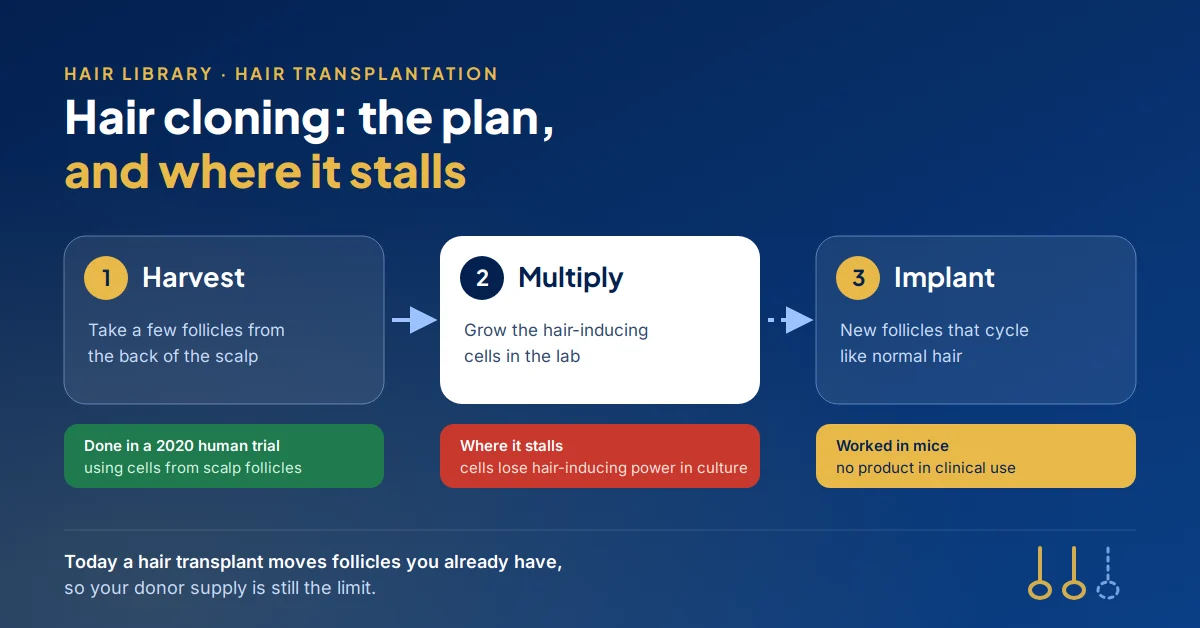
Harvest, Multiply, Implant: The Plan on Paper
On paper, the method gets around the main limit of hair surgery, the finite supply of donor hair. It has three steps:
Harvest. A few follicles are taken from the back of the scalp, as the 2020 human trial did.
Multiply. The cells are grown in the lab. This is where it stalls, because human papilla cells lose their hair-inducing power in flat culture.
Implant. The cells, or a lab-built follicle germ, go back into the skin to form follicles that cycle like normal hair. That has worked in mice.
The hurdles were clear by 2004: which cells to use, how to keep them hair-inducing while they multiply, and how to get a safe product past regulators.[2] In 2020, a review still traced the delay to problems with how cultured human hair cells function.[3]
The Dermal Papilla Problem
The dermal papillaGlossaryThe dermal papilla is a cluster of cells at the centre of the hair bulb. It signals the bulb and helps decide how thick, how long and what colour each hair grows. Open in the glossary → is a small cluster of cells at the base of the follicle that tells it to make hair. In rodents, cells like these can trigger brand new follicles, even in hairless skin. Human cells are harder, and repeated attempts with cultured human papilla cells in human skin failed.
The reason is the dish. Moved from their natural 3D setting to a flat surface, the cells change fast and lose their hair-inducing ability early. Growing them as small balls of cells, called spheroids, restored that ability in part, enough to induce new follicles in human skin.[4]
Animals have done better than people so far. Bioengineered follicle germs implanted in mice grew into complete follicles, linked up with nerves and the tiny muscle that lifts each hair, and went through normal hair cycles.[5]
Human follicles followed, built inside lab-made human skin with 3D-printed moulds. Once blood vessels were added, the grafts grew human hair on mice with weakened immune systems.[6]
Other teams now grow hair-bearing skin from stem cells in the lab, and "hair-on-a-chip" devices copy the follicle's surroundings. For now these are mainly tools for studying human hair growth, not treatments.
Cultured Follicle Cells in a Human Trial
The closest test in people used dermal sheath cup cells, taken from follicles at the back of the scalp and grown in a lab. In a randomized, placebo-controlled trial, 50 men and 15 women each had single injections of different doses in separate patches of scalp.[1]
At one dose, hair density and thickness rose against placebo at 6 and 9 months, in men and women alike, with no serious side effects. The authors call the effect temporary. The trial measured hair density and thickness, not new follicles, so it isn't hair cloning in the full sense.
Where Research Stands: A Timeline
The milestones below come from the studies on this page; the right-hand column is our reading of what each one means for you.
Year
Milestone
What it means for you
2004
Milestone
Animal work sound, human results inconsistent
What it means for you
The idea works in principle
2012
Milestone
Bioengineered follicles grow and cycle in mice
What it means for you
A whole follicle can be rebuilt, in animals
2013
Milestone
Human papilla cells grown as spheroids induce new follicles
What it means for you
The culture problem is partly solvable
2018
Milestone
Human follicles built in lab skin grow hair on mice
What it means for you
Human cells can make hair, outside a person
2020
Milestone
Cultured cell injections in 65 people
What it means for you
Safe in a trial, but the gain wore off
2025
Milestone
Follicle cloning listed as a future direction for surgery
What it means for you
Still a future option
2026
Milestone
No dependable therapy to regenerate human follicles
What it means for you
No treatment to wait for on a timetable
What Clinics Sell as Stem Cell Hair Treatment Today
Fat-Derived Cells, Conditioned Media and PRP
None of these grows a follicle in a lab first. They are injections meant to restore the function of follicles you still have, which is a different job from making new ones, and no cell-based product is clinically available for hair regeneration.[3]
Stromal vascular fraction (SVF) is one way to isolate fat-derived stem cells: fat removed by liposuction is broken down with enzymes. Conditioned media contain what these stem cells secrete, and commercial versions have reached the market as a cheaper option.[8] In a 2026 review, conditioned media were the most studied of these regenerative injections.
PRP is made from your own blood rather than from cells, so it isn't a stem cell treatment, whatever an offer calls it. Our PRP for hair loss entry weighs up its evidence.
Do Stem Cell Hair Treatments Work?
For thicker hair, there are early signs. A 2026 systematic review of 20 clinical studies with 724 patients found gains in density and thickness across five regenerative approaches, with only mild, temporary side effects.[9] It also flagged mixed study designs and little long-term data.
For new follicles, no. A second 2026 review says no dependable therapy to regenerate human hair follicles has been identified.[7] The two reviews don't really clash: the first counts gains in existing hair, the second asks whether new follicles can be made.
How to Read a Stem Cell Hair Offer
Unproven cell products are sold straight to consumers around the world, with unknown safety and effectiveness. The International Society for Cell & Gene Therapy warns that sellers use "tokens of scientific legitimacy" to look credible.[10] Before you pay for anything sold as stem cell or cloning hair therapy, ask:
What exactly goes into my scalp: living cells, a cell-free product or plasma from my blood?
Has a national regulator approved this product for hair loss?
Which randomized trial supports it, and how long were patients followed?
What happens to my result if I stop?
Four Myths About Hair Cloning
"Hair cloning is available abroad." The reviews we read report no cloning product in clinical use anywhere.
"A stem cell hair transplant is cloning." What is sold under that name is an injection of cells or cell products, not lab-grown follicles.
"PRP is a stem cell treatment." It is prepared from your blood, not from cells grown in a lab.
"Cloning is only a few years away." No review we read gives a date.
Hair Cloning vs Hair Transplant: What Surgery Can Do Today
A Transplant Moves Hair; It Does Not Make More
A transplant relies on donor dominance: moved follicles keep their genetic traits in their new place. FUEGlossaryFUE (Follicular Unit Extraction) moves hair follicles one by one from the back and sides of the scalp to thinning areas, without the linear scar of the older strip method. Open in the glossary → and strip excision are both current methods, and both redistribute follicles you already have.[11] Our FUE hair transplant guide explains how grafts are harvested.
Your donor areaGlossaryThe donor area is the back and sides of the head, where follicles resist DHT. An extracted follicle does not grow back in that spot, so extractions are spread out, and the donor supply is the limit of every plan. Open in the glossary → is finite, and the hope of an unlimited supply is what drives cloning research. To estimate your own numbers, see how many grafts you may need at each Norwood stage.
When the Donor Supply Runs Short
The gap shows most in advanced loss. The scalp donor area can't supply enough follicles for Norwood VI and VII baldness, so surgeons add beard, chest or abdominal hair to extend coverage.[12] Our Norwood 7 hair transplant guide shows how grafts are prioritised at that stage.
Body hair helps, and our body hair transplant guide covers those extra donor sites. Large sessions are possible too, as our hair transplant world record page shows, but every graft still comes from the same limited supply.
When a Transplant Is the Wrong Answer
You want surgery to stop your hair loss. It won't, which is why medical treatment to maintain density is part of modern transplant care.[11]
Your goal is bigger than your donor area. No proven method adds follicles beyond it today, and body hair is the extra source surgeons turn to.
Protecting the hair you still have, for example with finasteride if you're a man, is the part you can start now.
Frequently Asked Questions
Is hair cloning real?
As research, yes: follicles have been bioengineered in mice and built from human cells in lab skin. As a treatment, no cell-based product is clinically available.
When will hair cloning be available?
No review we read gives a date. A 2025 review lists follicle cloning among future directions for transplant surgery, and a 2026 review says no dependable therapy to regenerate human follicles exists yet.
Has hair cloning reached human trials?
Not in the full sense. In the nearest trial, 65 people received their own lab-grown follicle cells; density rose at 6 and 9 months at one dose, then the effect faded.
What is the hair cloning research in Japan?
Two studies on this page come from Japanese institutions, according to their PubMed records: Tokyo University of Science (2012, bioengineered follicles in mice) and Tokyo Medical University (2020, the cell injection trial).
Can you clone your own hair?
Not yet. Your follicle cells can be taken and grown, but human papilla cells lose much of their hair-inducing power in flat culture, and 3D spheroids restore it only in part.
Does a stem cell hair transplant work?
No transplant of lab-grown follicles is on the market. Injections sold under stem cell labels show density gains in small studies, with varied methods and little long-term data.
Hair transplant or stem cell treatment: which fits my hair loss?
A transplant moves permanent follicles into bald or thin areas. Cell-based injections have been studied for density in thinning hair, with short follow-up. Bare scalp needs follicles, and today only surgery supplies them.
Can I get hair cloning abroad today?
No. The reviews we read report no hair cloning product in clinical use. Unproven cell products are sold worldwide, so ask any clinic abroad what is injected and which regulator approved it.
Who Should Wait for Hair Cloning, and Who Should Not
Hair cloning suits no one yet, because it isn't available. Find your situation below; the middle column is our advice.
Your situation
What makes sense today
Why
Early thinning, no bare areas
What makes sense today
Protect the hair you have with medicine
Why
There is nothing to move yet, and medicine helps maintain density
Bare areas and a healthy donor area
What makes sense today
A transplant
Why
It is the only option that places follicles in bare areas today
Advanced loss and a limited donor area
What makes sense today
A transplant planned for coverage, perhaps with body hair
Why
The scalp donor area alone can't cover the top grades
Offered "stem cell" injections
What makes sense today
Ask the four questions above first
Why
Many such products are sold unproven
Send us three photos for a free hair analysis, and the medical team will tell you whether your donor area can cover your goals. You can also message us on WhatsApp.
About the Author
Written by: Nazmi Güldeş, Certified Trichologist. Nazmi Güldeş focuses on patient education around androgenetic alopecia, evaluating miniaturization through dermoscopy, and assessing candidates for medical treatments and hair transplants.
Editorial Policy & Trust
This entry was medically reviewed by Dr. Teuku Adifitrian, Sp.BP-RE (Dr. Tompi) on 31 October 2026. Every study cited here was checked against PubMed on 31 October 2026. Key figures are marked with their source, and every source is listed at the end of this entry. Read how we work in our editorial policy.
3 questions
Test yourself
Check what you remember from this entry. Each answer links back to the section that explains it.
Why have cultured human dermal papilla cells failed to grow new hair?
Moved from their natural 3D setting to a flat dish, the cells change fast and lose their hair-inducing ability; spheroids restore it only in part. Read the section
How long did the gain last in the 2020 trial of injected cultured follicle cells?
Density rose against placebo at 6 and 9 months, and the authors call the effect temporary. Read the section
What does a hair transplant do with your follicles?
It redistributes your own follicles, which is why the donor supply sets the limit. Read the section
3Scientific evidenceStudy types, references and how to cite this entry
12sources
Evidence behind this entry: 12 publications indexed in PubMed (2004 to 2026): 4 reviews, 2 lab studies, 2 systematic reviews, 1 randomized trial, 1 animal study, 1 guideline and 1 clinical study. 7 sources have free full text.
Randomized trialpeople assigned to treatments by chance
Reviewsummarises many studies
Clinical studya study in people without random groups
Lab studytested on cells or hair follicles in the lab
Guideline or labela professional body, or the official drug label
Tsuboi R, Niiyama S, Irisawa R, et al. Autologous cell-based therapy for male and female pattern hair loss using dermal sheath cup cells: A randomized placebo-controlled double-blinded dose-finding clinical study. Journal of the American Academy of Dermatology. 2020;83(1):109-116.Randomized trialPubMedDOI
Cooley J. Follicular cell implantation: an update on "hair follicle cloning". Facial Plastic Surgery Clinics of North America. 2004;12(2):219-224.ReviewPubMedDOI
Castro AR, Logarinho E. Tissue engineering strategies for human hair follicle regeneration: How far from a hairy goal?. Stem Cells Translational Medicine. 2020;9(3):342-350.ReviewPubMedDOIFree full text
Higgins CA, Chen JC, Cerise JE, et al. Microenvironmental reprogramming by three-dimensional culture enables dermal papilla cells to induce de novo human hair-follicle growth. Proceedings of the National Academy of Sciences of the United States of America. 2013;110(49):19679-19688.Lab studyPubMedDOIFree full text
Toyoshima KE, Asakawa K, Ishibashi N, et al. Fully functional hair follicle regeneration through the rearrangement of stem cells and their niches. Nature Communications. 2012;3:784.Animal studyPubMedDOIFree full text
Abaci HE, Coffman A, Doucet Y, et al. Tissue engineering of human hair follicles using a biomimetic developmental approach. Nature Communications. 2018;9(1):5301.Lab studyPubMedDOIFree full text
Ahmed IA, Shafiee A. Human hair regeneration using organoids and hair-on-chip technologies. Lab on a Chip. 2026;26(9):2634-2645.ReviewPubMedDOI
Ortega-Cuartiella A. Therapeutic Potential of Adipose-Derived Stem Cells and Their Secretome in Reversible Alopecias: A Systematic Review. International Journal of Trichology. 2023;15(5):173-182.Systematic reviewPubMedDOIFree full text
Behrangi E, Amiri S, Zeinali R, et al. A systematic review of clinical evidence on the efficacy and safety of conditioned media, platelet-rich fibrin, stromal vascular fraction, extracellular vesicles, and stem cells in androgenetic alopecia. Stem Cell Research & Therapy. 2026;17(1).Systematic reviewPubMedDOIFree full text
Ikonomou L, Cuende N, Forte M, et al. International Society for Cell & Gene Therapy Position Paper: Key considerations to support evidence-based cell and gene therapies and oppose marketing of unproven products. Cytotherapy. 2023;25(9):920-929.GuidelinePubMedDOI
Queen D, Avram MR. Hair Transplantation: State of the Art. Dermatologic Surgery. 2025;51(9):874-881.ReviewPubMedDOI
Garg AK, Garg S. "Combination Grafting" of Scalp and Body Hair to Enhance the Visual Density of Hair Transplant and Coverage of Higher Grade of Baldness. Journal of Cutaneous and Aesthetic Surgery. 2020;13(2):163-169.Clinical studyPubMedDOIFree full text
Güldeş, N. (2026, October 31). Hair cloning and stem cell hair transplants: What exists today. Turkey Hair Center Hair Library. https://turkeyhaircenter.com/hair-cloning/
@misc{guldes2026haircloning,
  author       = {Güldeş, Nazmi},
  title        = {Hair cloning and stem cell hair transplants: What exists today},
  howpublished = {Turkey Hair Center Hair Library},
  year         = {2026},
  month        = oct,
  url          = {https://turkeyhaircenter.com/hair-cloning/},
  note         = {Last updated 31 October 2026}
}
TY  - ELEC
AU  - Güldeş, Nazmi
TI  - Hair cloning and stem cell hair transplants: What exists today
T2  - Turkey Hair Center Hair Library
PY  - 2026
DA  - 2026/10/31
UR  - https://turkeyhaircenter.com/hair-cloning/
N1  - Last updated 31 October 2026
ER  -
Talk to our hair team on a free video call, in your language. You receive a written plan with your technique, estimated grafts and all-inclusive price. If a hair transplant isn't right for you, we tell you honestly.
Your information is 100% confidential.
Real People Real Support
Send your photos on WhatsApp
Front, top and both sides, reviewed by the medical team.