Performed at authorized partner hospitals Turkey Hair Center is a Ministry of Health authorized health-tourism intermediary, not a clinic.
A Norwood 6 hair transplant restores hair to a scalp where the frontal bald area and the bald crown have joined into one large zone, with hair left only in a band around the sides and back. It is possible for many men at this stage, but it is planned around one hard fact: the donor area has less hair to give than the bald area would need for full density.
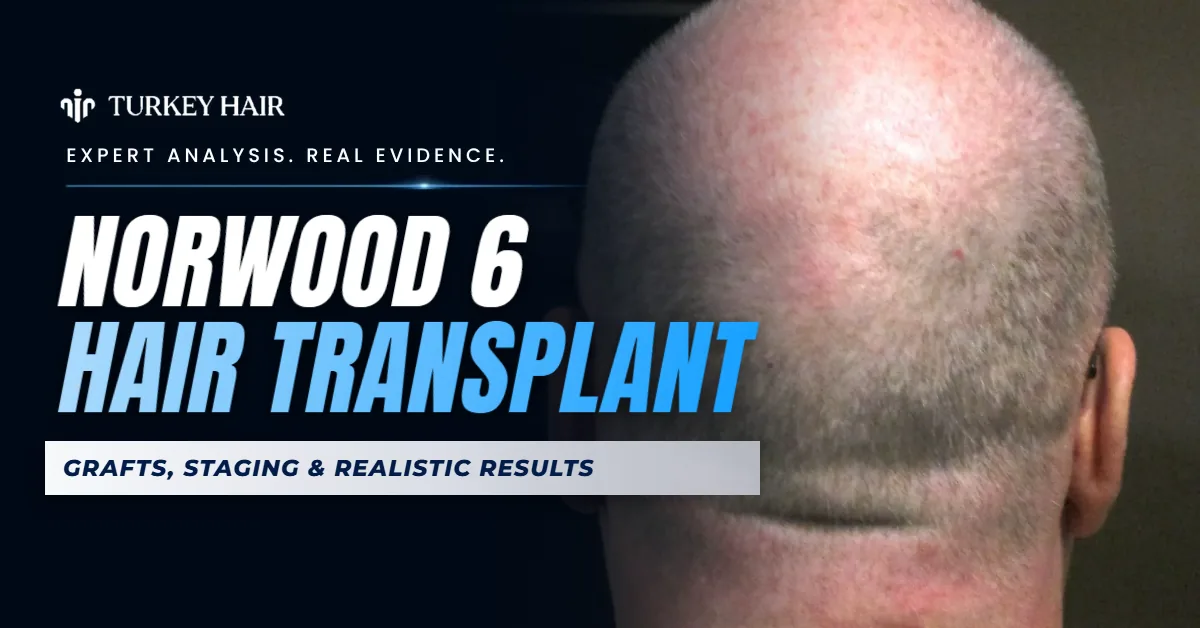
Cover built on the back of a man's head with a bare crown and a band of hair at the sides. Photo: Beyond My Ken, CC BY-SA 3.0, via Wikimedia Commons, cropped, text and logo added.
If you are asking whether it can work for you, these are the short answers:
Can a Norwood 6 get a transplant? Often yes, if the donor band is dense enough and the cause is pattern hair loss.
How many grafts? In the medical team's planning ranges, about 5,000 to 6,500 grafts or more for the full top, usually split over two sessions.
Can it all be done at once? Rarely. A large study put the safe one-sitting supply of most donor areas well below that figure.
What comes first? The front and the hairline, because they frame the face. The crown follows if supply allows.
Is it reversible with medicine? No. Medicine protects the hair you still have but does not regrow a bare top.
This guide covers the procedure. If you are still working out your stage, start with our guide to the Norwood scale.
This man is not one of our patients and not a transplant result. His crown is bare and a band of short hair runs around the back and sides. Every graft in a Norwood 6 plan comes from that band.
At Norwood 5 a thin strip of hair still runs across the middle and separates the front from the crown. At Norwood 6 that strip is gone, so the whole top becomes one area to plan.
What Is Norwood 6 Hair Loss?
Norwood 6 is the second most advanced stage of the Norwood scale, the classification of male pattern baldness that O'Tar Norwood published in 1975. At this stage the bridge of hair that once crossed the top of the head has gone, leaving only sparse hairs. The frontal and temple loss meets the bald crown, and hair remains on the sides and the back.
Three features are easy to check in a mirror and in pictures taken from above:
No bridge. There is no band of denser hair between the front and the crown.
One bald zone. The bare area runs from the forehead to the back of the top of the head.
A wider rim. The hair on the sides and back still forms a fairly full band, wider and higher than at stage 7.
How Is Norwood 6 Different From Norwood 5 and Norwood 7?
The three stages are close, and photos are often labelled wrongly online. The table shows what to look for.
Stage
Top of the head
Sides and back
What it means for a transplant
Norwood 5
Bald front and crown, still separated by a thin bridge
Full band
The bridge adds existing hair to the plan
Norwood 6
Bridge gone, front and crown joined
Full but narrower band
Large area; front first, crown in a later session
Norwood 7
Same as 6, often larger
Narrow horseshoe, set lower, hair can be fine
Donor supply is at its tightest
The jump from 5 to 6 matters more than the number suggests. The area to cover grows, while the donor band starts to narrow.
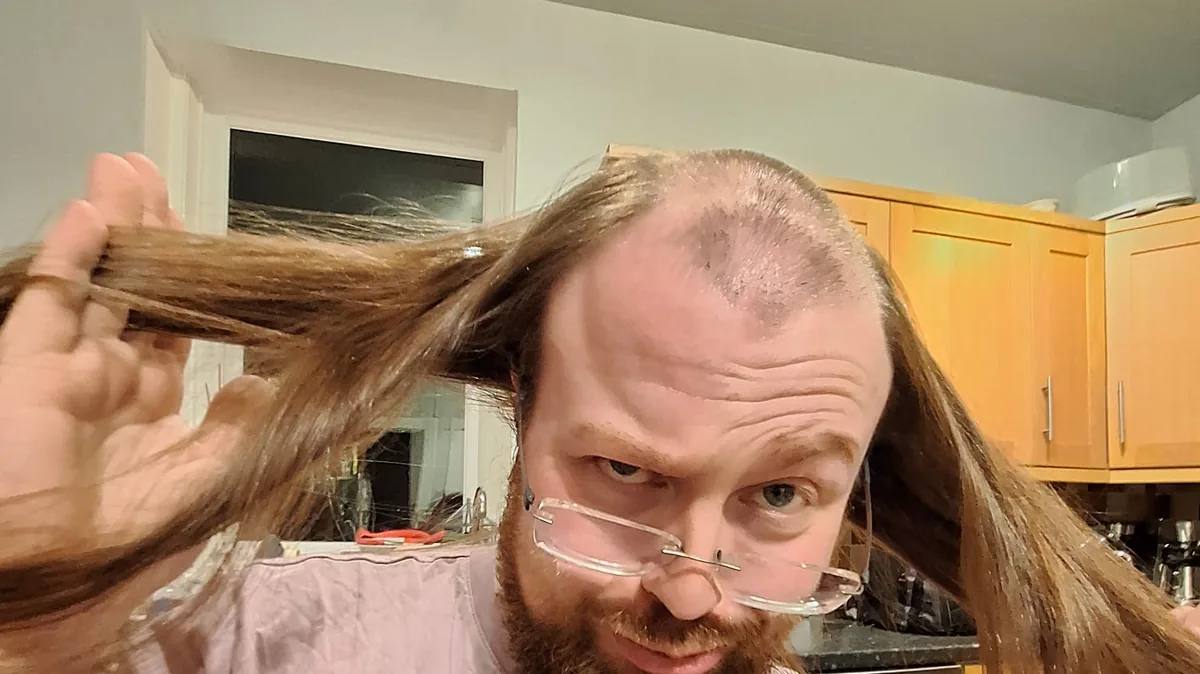
Long hair grown out from the sides, held up beside a thin and mostly bare top. Photo: Sister of necronwarrior, uploaded by necronwarrior, CC BY-SA 4.0, via Wikimedia Commons, cropped.
This man has not had a transplant, and one photo cannot stage him. His side hair keeps growing long and healthy while the top has thinned to a few fine hairs, which is why the sides can serve as a donor area.
Is Norwood 6 Reversible?
Not with medicine alone. The American Academy of Dermatology says minoxidil can help early hair loss but cannot regrow an entire head of hair. At Norwood 6 most of the follicles on top have been inactive for years, so the realistic aims of medicine are to keep the hair you still have, including the donor band and any thin hair on top. Adding hair to the bald zone takes surgery.
Can a Norwood 6 Get a Hair Transplant?
Yes, many men at this stage are candidates, but not all. The StatPearls review of hair transplantation lists the traits of an ideal candidate: a clear and stable pattern of loss, a healthy scalp, donor hair of good quality and quantity, good general health and realistic expectations. At Norwood 6, two of those decide almost everything.
Who Is a Good Candidate at Norwood 6?
These points weigh most at this stage:
Donor density. The safe donor zone usually holds about 65 to 85 follicular units per square centimetre. Above 80 is excellent, and below 40 is less suitable.
A stable pattern. A man in his fifties who has been at stage 6 for years is easier to plan for than a man in his twenties who reached it fast.
Hair character. Thick, wavy or curly hair and low contrast between hair and skin colour give more visual coverage from the same number of grafts.
Expectations. The aim is a natural frame and coverage, not the density of a full head of hair at 18.
Health. Diabetes, blood thinners, smoking and scalp conditions are discussed before any plan is made.
A doctor makes this decision from photos and an examination. Our medical team gives a first opinion from your pictures, free of charge, and the surgeon who will operate makes the final call.
Is Norwood 6 Too Late for a Hair Transplant?
It is late for full density, not late for a transplant. Rose names a lack of donor hair as a major challenge in hair restoration surgery, and Norwood 6 is where that challenge becomes visible. What the stage changes is the goal: instead of copying a full head of hair, the plan spends a limited supply where it changes your appearance most.
Two groups are more often told to wait or to reconsider:
young men who reached stage 6 quickly, because their final pattern may be larger still
men whose donor band is already thin or shows signs of the same loss
Is Norwood 6 Too Late for Finasteride?
For regrowing the top, mostly yes. For protecting the rest, no. MedlinePlus says finasteride blocks a male hormone in the scalp, results take at least 3 months, and regrown hair is usually lost within 12 months of stopping. At stage 6 that makes it a drug for keeping hair, not for filling a bald zone.
That role still matters after surgery. The 2021 hair transplant practice guidelines say patients should keep up medical management after surgery, naming topical minoxidil 2 to 5% and oral finasteride 1 mg a day. Rose calls finasteride the most effective drug for reducing male pattern loss and puts sexual side effects at about 2 to 5%. Neither drug is started without a doctor's advice.
How Many Grafts Does a Norwood 6 Need?
In the medical team's planning ranges, covering the hairline, mid-scalp and crown at Norwood 6 needs about 5,000 to 6,500 grafts or more. This is the same range our guide to how many grafts you need gives for every stage. The final figure depends on the size of the bald zone, your hair character and, above all, what the donor area can give.
The donor side of that sum is measurable. Chouhan and colleagues (2019) studied 580 men with androgenetic alopecia and calculated how many follicular units could be taken at 25 percent extraction from donor zones of different sizes:
Donor zone (580-man study)
One sitting
Two sittings
Limited
2,064
3,612
Standard
3,097
5,420
Extended
3,612
6,321
Read against the Norwood 6 range, the table explains most of what follows in this guide:
One sitting falls short. Even the extended zone gave about 3,600 units in one sitting, little more than half of a full Norwood 6 plan.
Two sittings can reach it. The standard and extended zones over two sittings reach the lower end of the range.
Above that, extra sources are needed. A plan beyond about 6,300 grafts goes past what the extended scalp zone gave in that study.
These are group figures from one population, not a promise for any one person. Donor density and the size of the safe zone vary a lot from man to man, which is why the count is set after an examination. For what a single large session covers, our guide to a 6,000 graft hair transplant goes into detail.
Can a Norwood 6 Be Done in One Session?
Rarely, for two reasons. The first is the donor area. Mohmand and Ahmad advised taking less than 35 percent of donor density in a first session and only 10 to 20 percent in a second, and noted that a donor area left with 20 to 30 percent of its original density looks odd. Taking a full Norwood 6 plan at once would break those limits for most men.
The second is time. Dua and Dua describe the number of grafts extracted in a day as limited, with large cases spread over several days. A careful first session that frames the face and leaves the donor area looking natural is a better result than one session that empties it.
How Is a Norwood 6 Transplant Planned?
Planning at this stage is a question of order. The supply is fixed, so every graft goes where it does the most for the face you see in the mirror and in photos.
Why Does the Front Come First?
The front frames the face, and people look at it first. A dense front with a lighter crown looks natural, while a dense crown with a bare front does not. The 2021 guideline also calls the vertex a "black hole" for grafts, because the crown consumes more of them than the front for the same visual result. For both reasons, the first session usually goes to:
the hairline
the frontal third of the top
the mid-scalp, as far back as the supply allows
Where Should the Hairline Sit?
Higher and softer than at stage 2 or 3. A low, straight hairline uses a lot of grafts, and it can look out of place on a man whose sides and back show advanced loss. A conservative, slightly higher line that suits your age leaves grafts for the top and still looks right in ten years. Our guide to the mature hairline shows what a natural adult hairline looks like.
What Happens to the Crown?
The crown is usually treated in a second session, at a lower density, or left lighter on purpose. Hair at the crown grows in a spiral and the bare area there is wider than it looks, so it takes many grafts for a modest change. Our guide to the crown hair transplant explains how the whorl is rebuilt when the crown is treated.
When Is the Second Session Planned?
The studies we read give no fixed gap between sessions, so this guide does not state one. The first result has to grow out before it can be judged, and the donor area has to heal before it is checked again. The NHS puts the full result of a transplant at 10 to 18 months. The second session is then smaller, because the donor area can give less the second time.
Can Beard or Body Hair Help a Norwood 6?
Yes, as an addition, not as the main source. The 2021 guideline notes that when donor hair is short, surgeons may combine methods or harvest beard and body hair, which means longer operating hours and a higher anaesthetic dose. The 580-man study counted about 824 beard units in its group.
Donor source
What it adds
Limit
Scalp (back and sides)
The main supply; hair matches the scalp
Fixed; most plans stay within it
Beard
Thick hairs that add bulk, often to the crown or behind the hairline
Not suitable for the hairline itself
Body hair
Extra supply for very large plans
Hair is finer and can grow differently
Dua and Dua note that body hair can only be taken with FUE. Our guides to beard transplant and body hair transplant cover these sources in detail. Whether you need them is decided only after your scalp donor area has been measured.
Which Technique Suits a Norwood 6?
No technique adds hair to the donor area, so the choice changes how the grafts are taken and placed, not how many exist. The American Academy of Dermatology notes that most surgeons now transplant hairs a few at a time. FUE takes single follicular units and is the route to beard and body hair. DHI places grafts with an implanter pen and is mainly a placement method. The 2021 guideline also describes combining methods when donor supply is short.
For a Norwood 6, the more useful questions are how the grafts are spread, how dense the front is and how much is held back for later. Our comparison of FUE vs DHI explains the differences between the two methods.
What Results Are Realistic at Norwood 6?
A good Norwood 6 result looks natural from normal distance: a hairline that frames the face, hair on top that covers the scalp in everyday light and styling, and a crown that is lighter or treated later. What it does not usually look like is the hair of a man who never lost any.
Results from a Norwood 6 plan are judged from a normal distance and in everyday light. Under a bright light from above, a transplanted top will always show more scalp than a full natural head of hair.
How Do You Read Norwood 6 Before and After Photos?
Before and after photos are the most searched part of this topic, and the easiest to misread. Check these points before you compare:
Is it really stage 6? Look for a missing bridge in the before photo. Many "Norwood 6" galleries show stage 5.
Same angle and light? A front view in soft light hides what a top view under bright light shows.
Wet or dry, styled or not? Dry, styled hair covers more scalp.
How long after surgery? A result before 12 months is not final.
One session or two? Ask how many sessions and grafts the result took.
Is the crown shown? A gallery that only shows the front may hide a lighter crown.
When Do You See Growth?
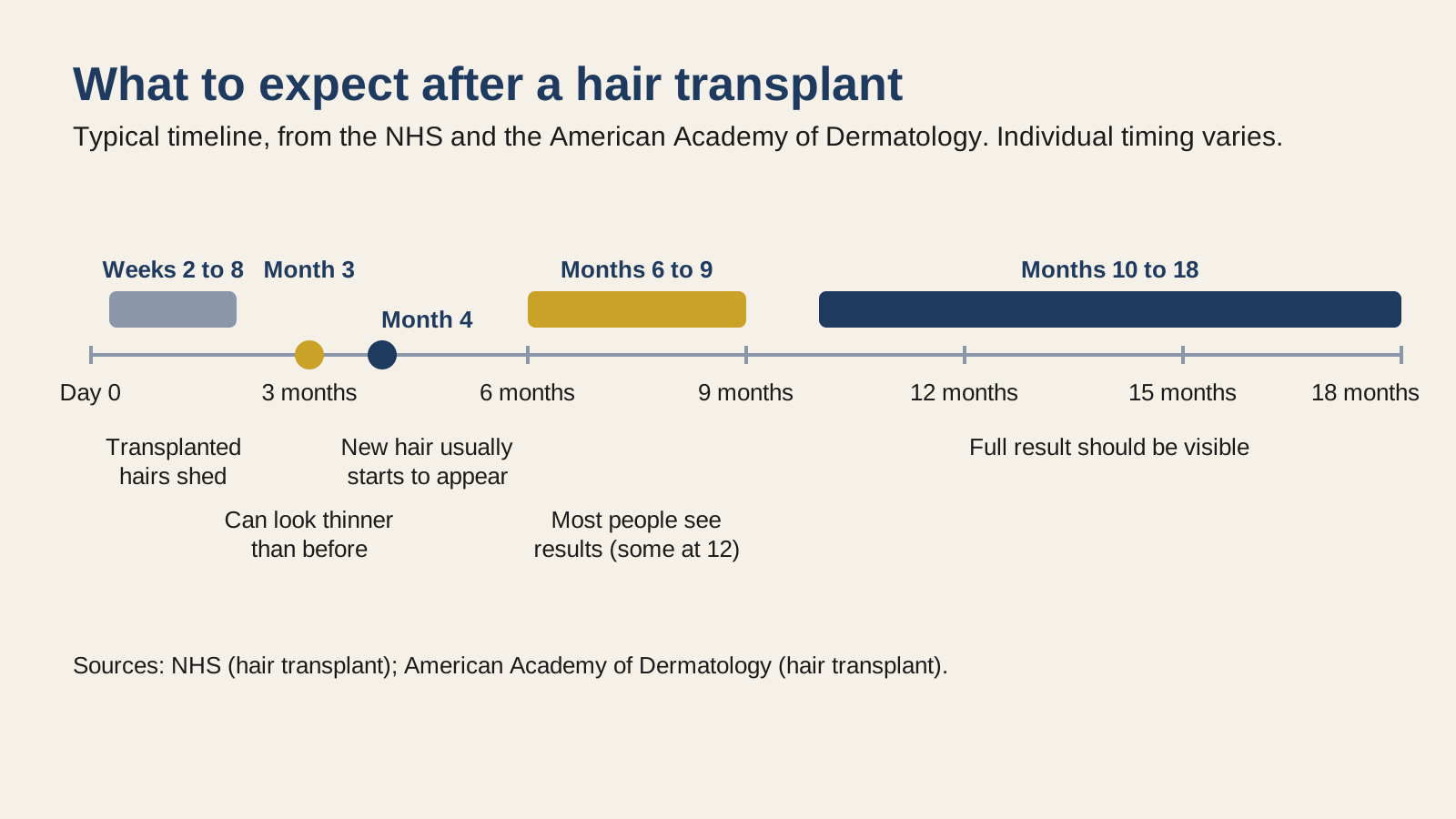
Growth follows the same slow pattern as any transplant. The NHS says transplanted hair often falls out after a few weeks, with new hair usually appearing after 4 months and the full result visible after 10 to 18 months.
Typical growth timeline after a hair transplant, from NHS and American Academy of Dermatology information.
The American Academy of Dermatology describes shedding at 2 to 8 weeks and results at 6 to 9 months, sometimes 12. With two sessions, the full Norwood 6 result takes longer still, because the second session starts its own timeline. Our recovery timeline guide covers each stage week by week.
What Happens 10 Years After a Norwood 6 Transplant?
Transplanted hair comes from the donor area, where hair resists the hormone that shrinks hair in pattern loss. StatPearls notes that transplanted hairs keep the traits of the donor hair, which is why a transplant is expected to last. The hair that was already there keeps its own course: the 2021 guideline describes androgenetic alopecia as continuous and progressive.
At Norwood 6 there is little native hair left on top to lose, so the main long-term questions are different from those of a young man at stage 3:
The donor band. It can thin or narrow with age, which is one reason a plan should not empty it.
Any thin hair on top. Medicine helps to keep it.
The crown. If it was left lighter, it stays lighter unless more grafts are added.
The risks are the same as for any hair transplant, with one that matters more at this stage. The reviews by Kerure and Patwardhan and by Garg and Garg list these:
Swelling, redness and itching. Common and usually short.
Shock loss. Temporary loss of existing hair near the grafts.
Folliculitis and infection. Inflammation around hairs; infection is uncommon.
Numbness in the donor or recipient area.
Poor density or an unnatural look. Usually a planning problem.
Overharvesting. Taking too much from the donor area leaves it thin and patchy. At Norwood 6, where the pressure to take more is greatest, this is the risk to ask about first.
Tell the team about any health conditions and medicines before surgery. Contact the hospital if you have fever, spreading redness, pus or severe pain.
Transplant, Medicine or Neither?
A transplant is one choice among several at this stage, and the right one depends on what you want to change.
The cost depends on the number of grafts, the number of sessions, the technique and what the package includes. No price is quoted here, because a Norwood 6 plan is set only after your photos and donor area are reviewed. Our hair transplant cost page lists the packages and what each one covers.
Frequently Asked Questions
Can a Norwood 6 get a hair transplant?
Often yes. The deciding factors are donor density, a stable pattern and realistic expectations. A doctor confirms candidacy from photos and an examination.
Is Norwood 6 too late?
It is too late for full density on the whole top, but not for a natural result that frames the face. The plan puts the limited donor supply where it shows most.
How many grafts does a Norwood 6 need?
About 5,000 to 6,500 grafts or more for the hairline, mid-scalp and crown, in the medical team's planning ranges. Most donor areas can give that only over two sessions.
Is Norwood 6 reversible?
No. Medicine can protect remaining hair, but it cannot regrow a bald top that has been inactive for years. Adding hair takes a transplant.
Is Norwood 6 too late for finasteride?
Too late to regrow the bald top, not too late to protect the donor band and any remaining hair. A doctor decides whether it suits you.
Can Norwood 6 be fixed in one session?
Rarely. In a study of 580 men, even the largest donor zone gave about 3,600 units in one sitting, little more than half of a full plan.
What happens 10 years after a Norwood 6 transplant?
Transplanted hair is expected to stay, because it keeps the traits of donor hair. The donor band and any native hair on top can still change with age.
Do you need beard hair for Norwood 6?
Not always. Beard or body hair is added when the scalp donor area cannot supply the plan alone, and only after it has been measured.
Can a Norwood 6 get a full head of hair?
Usually not at the density of a man who never lost hair. A good result covers the front and top in everyday light, with a lighter crown.
How many sessions does a Norwood 6 need?
Most plans use two: the front and mid-scalp first, the crown or extra density later. A third is uncommon because each session gives less.
Plan Your Norwood 6 Transplant
At Norwood 6, the plan matters more than the graft count. Send clear pictures from the front, the top, both sides and the back in daylight for a free hair analysis. The medical team will tell you what your donor area can support, what a first session would cover and whether a second one is likely, and you can compare it with the hair transplant cost before you decide.
Medical disclaimer: This article is for informational purposes only and is not medical advice. Individual results and recovery vary from person to person. Always follow the written aftercare plan from your own medical team.
Chouhan K, Kota RS, Kumar A, Gupta J. Assessment of safe donor zone of scalp and beard for follicular unit extraction in Indian men: a study of 580 cases. Journal of Cutaneous and Aesthetic Surgery, 2019;12(1):31-35
Humayun Mohmand M, Ahmad M. Effect of follicular unit extraction on the donor area. World Journal of Plastic Surgery, 2018;7(2):193-197
Dua A, Dua K. Follicular unit extraction hair transplant. Journal of Cutaneous and Aesthetic Surgery, 2010;3(2):76-81
Rose PT. Hair restoration surgery: challenges and solutions. Clinical, Cosmetic and Investigational Dermatology, 2015;8:361-370
Kerure AS, Patwardhan N. Complications in hair transplantation. Journal of Cutaneous and Aesthetic Surgery, 2018;11(4):182-189
Garg AK, Garg S. Complications of hair transplant procedures: causes and management. Indian Journal of Plastic Surgery, 2021;54(4):477-482
Beyond My Ken Back of a man's head (cover image: cropped, text and logo added), CC BY-SA 3.0 Wikimedia Commons
Send three photos: front, top and sides. You get a technique recommendation, a graft range and a straight answer about what is achievable, before anyone talks about price.
Your details are with the team
A patient coordinator will get back to you shortly. If you would like to send your photos now, WhatsApp is the fastest way to do it.
We respond quickly, day or night, in your language.
Multilingual team, no obligation
Data protectedKVKK and GDPR compliant, 100% confidential
Authorized Health Tourism Intermediary
Turkey Hair Center is the hair-restoration brand of Healthy Way Tourism, an authorized international health-tourism intermediary. All medical procedures are performed by licensed medical professionals at authorized healthcare facilities in Turkiye, in accordance with the regulations of the Ministry of Health.