What twin and gene studies found about inherited baldness, how much comes from your mother's and your father's side, how to tell it from stress shedding, and what a transplant can fix.
11sources
11in PubMed
10min read
Written by Nazmi Güldeş, Certified Trichologist · Medically reviewed by Dr. Teuku Adifitrian, Sp.BP-RE (Dr. Tompi), Plastic, Reconstructive and Aesthetic Surgeon · Last reviewed 31 October 2026
Reading level
Is baldness genetic? For most people whose temples, crown or top are slowly thinning, yes. Common pattern baldness is mostly inherited, and it can come from either side of your family. What you inherit is follicles that are sensitive to hormones; age and habits then affect how fast that shows.
So your family is a useful clue, not a verdict. The popular rule about your mother's father is half right, and the sections below sort out which half.
1Quick answerThe short answer, in a few sentences
Is Baldness Genetic?
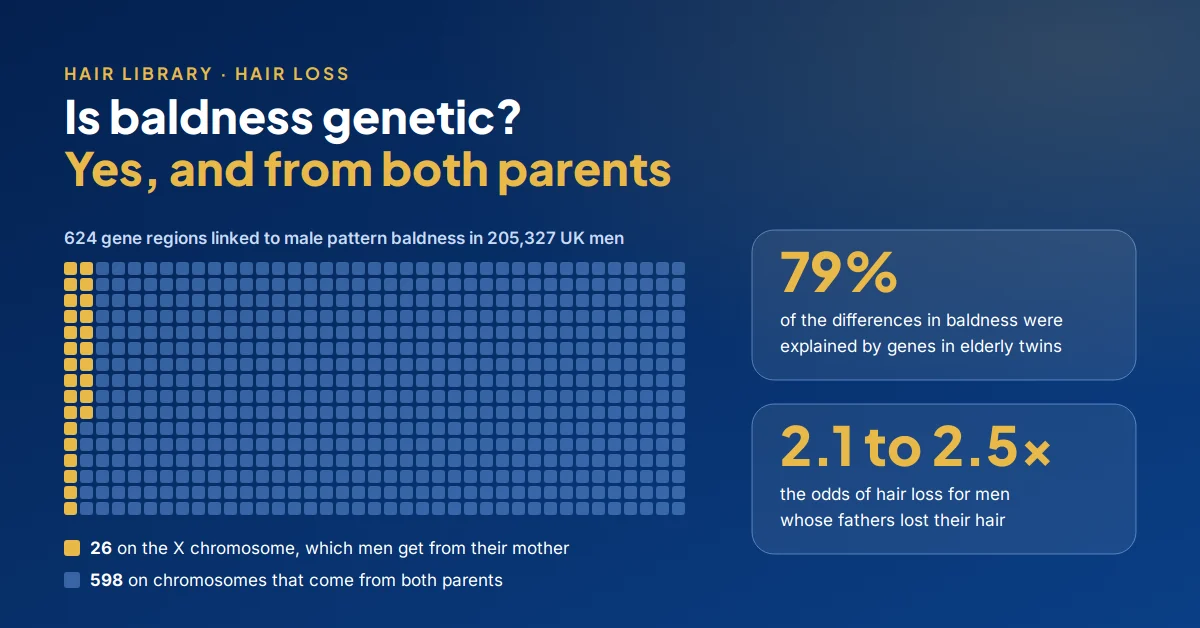
Yes. Common baldness, called androgenetic alopecia, is mostly inherited: twin and family studies put the genetic share at 62% to 79%.[1][2] It is not one gene. Hundreds of gene regions are involved, on chromosomes from both your mother and your father, so either side of the family can pass it on.
In practice, a family history raises your odds, age adds to them, and inherited thinning can be treated even though your genes stay the same.
2Complete guideFrom the X chromosome to stress shedding and surgery
How Baldness Is Inherited: Mother, Father or Both?
The X Chromosome and the Androgen Receptor Gene
One gene stands out: AR, which makes the receptor your follicles use to respond to male hormones. It sits on the X chromosome, which a man inherits from his mother. Variation in AR proved to be the main genetic requirement for early-onset pattern baldnessGlossaryAndrogenetic alopecia, or pattern baldness, is the pattern hair loss behind most male and female thinning. It is primarily driven by genetic predisposition and sensitivity to androgen hormones. Open in the glossary →, and its X location is why researchers stress the mother's line.[3]
Hundreds of Genes From Both Parents
AR is only part of the story. A study of 205,327 UK men found 624 gene regions linked to baldness, and only 26 of them were on the X chromosome.[2] The other 598 sit on chromosomes you get from both parents, and all 624 together explained only part of the inherited share.
Here is how we'd read your family history; the last column is our advice.
Lower odds, not zero; relatives may be too young to show it
A sensible first move
Judge your own scalp, not the family tree
Sudden shedding all over
What it means
More likely stress shedding, the most common cause of diffuse loss
A sensible first move
Look back 3 to 4 months for a trigger such as stress or an illness
Does Baldness Skip a Generation?
It can look that way, but no study we read shows a true skip. The main X-linked gene comes down the mother's line, and male pattern baldness is a sex-limited, age-related trait: it shows in men, and more often as they age.[2] So a mother can pass it on without showing it, and a relative who is still young can look unaffected.
What If No One in Your Family Is Bald?
Your odds are lower, but not zero. In one community study, the chance of hair loss depended on both family history and age. A father in his forties or a brother in his twenties may simply not show it yet.
If Baldness Runs in Your Family
Is Baldness Genetic or Environmental?
Both, with genes doing most of the work. In the twin study, the rest of the variation was put down to non-shared environment, meaning influences each twin met on his own.[1] A review of 31 studies tied several habits to faster progression:[5]
Smoking, which was also tied to having pattern loss at all
Drinking alcohol
Too little sleep, or poor-quality sleep
Being overweight or obese
These are links, not proof that changing a habit saves hair. The same review also tied pattern loss to insulin resistance and, in men, to high blood pressure.
Can a Genetic Test Tell If You Will Go Bald?
A gene test can sort men into higher and lower risk, but its verdict is far from certain. In one UK study, a gene score separated men with severe loss from men with none, yet only 59% of the men it flagged actually had severe loss.[6]
Your own scalp can be checked directly. A magnified scalp exam called trichoscopy is used routinely to diagnose pattern loss, stage it and follow the response to treatment.[7]
Can You Prevent Genetic Baldness?
You can't change the genes, but the hair loss they cause can be treated. The effective treatments are oral finasteride, topical minoxidil and moving androgen-resistant hair from the back of the scalp; not everyone responds, and the medicines need daily use.[8]
To catch it early:
Photograph your hairline, temples and crown every few months, in the same light.
Look for hairs there that grow finer, shorter and lighter than the hair at the back.
Have a patterned change assessed while it is still mild.
Act on the habits above.
Genetic Hair Loss: Men, Women and Transplants
How Inherited Sensitivity Shrinks Follicles
Pattern hair loss is the most common form of hair loss, affecting up to 80% of men and 50% of women over their lives.[7]DHTGlossaryDihydrotestosterone (DHT) is a potent androgen that the body makes from testosterone using an enzyme called 5-alpha reductase. In people who are genetically sensitive to it, DHT makes hair follicles shrink. Open in the glossary →, a hormone made from testosterone, makes sensitive follicles produce thinner, shorter and paler hair over time, and the number of active follicles falls. The hormone side is covered in DHT and hair loss.
Genetic Hair Loss in Men
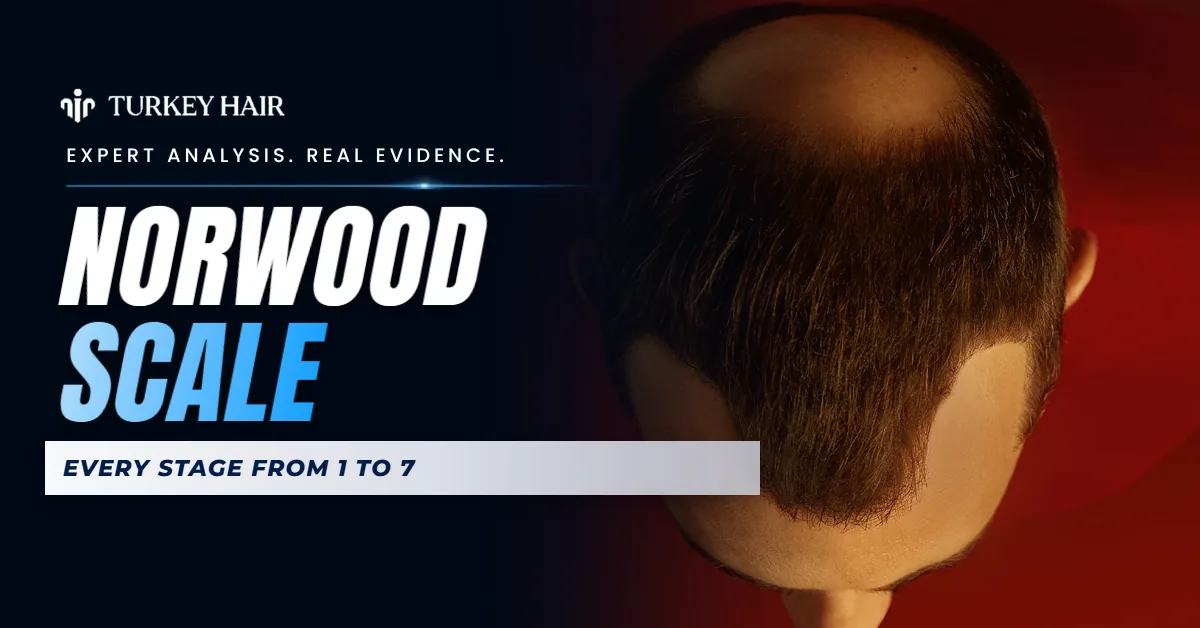
In men, the follicles at risk are at the front, the mid-scalp and the crown, and the change can begin at any point after puberty.[8] The pattern is staged on the Norwood scale.
Genetic Hair Loss in Women
Women get pattern hair loss too, mainly after menopause. In men the cause is thought to be stronger androgen signalling in susceptible follicles, but in women the molecular cause is still undetermined.[8] Most of the inheritance findings on this page come from studies of men. Signs and treatment are in our female pattern hair loss entry.
Genetic or Stress Shedding: How to Tell
They can look alike in the shower but behave differently. Our side-by-side summary:
Find the trigger; blood tests can rule out hormone, nutrition or autoimmune causes
Stress is thought to be the most common trigger. Stress shedding is called telogen effluvium, and its own entry covers the timeline.
Why the Back of Your Head Keeps Its Hair
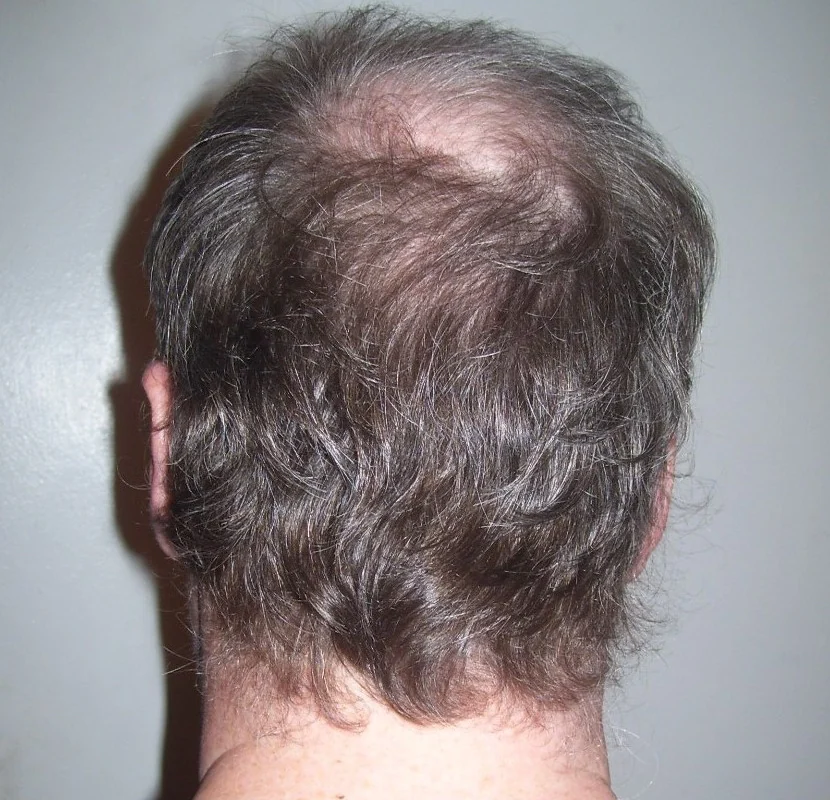
Follicles in the donor areaGlossaryThe donor area is the back and sides of the head, where follicles resist DHT. An extracted follicle does not grow back in that spot, so extractions are spread out, and the donor supply is the limit of every plan. Open in the glossary → at the back of the scalp resist androgens, which is why that hair survives even when the top is bare. A transplant moves them into thinning areas, and they keep their genetic traits in the new site, a principle called donor dominance.[11]
Crown thinning above a full band of hair at the back and sides. Photo: Before My Ken, CC BY-SA 3.0, via Wikimedia Commons, cropped.
Medical treatment alongside surgery has improved results and helps maintain density. A transplant is the wrong answer for stress shedding, which generally settles by itself.
Frequently Asked Questions
Is baldness inherited from your mother or your father?
From both. The AR gene comes through your mother, but most gene regions linked to baldness sit on chromosomes from both parents, and a balding father roughly doubles your odds.
What percentage of baldness is genetic?
Between 62% and 79%. The higher figure comes from elderly Danish twins, the lower one from close relatives in a UK study of over 200,000 men.
Is the baldness gene dominant or recessive?
Neither, in the textbook sense. Baldness is polygenic, with hundreds of gene regions involved, rather than the work of one dominant or recessive gene.
When does genetic baldness start?
Any time after puberty. It grows more common with age, so a family tree drawn while relatives are young can understate it.
Does genetic hair loss get worse with age?
Yes, it is progressive, though its onset, severity and pattern vary from person to person.
Can genetic baldness be reversed or cured?
Your genes stay the same, but the loss can be treated. Oral finasteride, topical minoxidil and transplanting androgen-resistant hair are the effective options, though not everyone responds.
Should You Act on a Family History?
If relatives lost hair early and your temples or crown are thinning, have it assessed while the change is mild. If the shedding was sudden and all over, look for a trigger 3 to 4 months back first.
A transplant can treat pattern loss, with medical treatment alongside it, but it isn't the answer to a shed. Send us three photos for a free hair analysis, and the medical team will tell you whether your pattern looks inherited and whether medication, a transplant or both fit. You can also message us on WhatsApp.
About the Author
Written by: Nazmi Güldeş, Certified Trichologist. Nazmi Güldeş focuses on patient education around androgenetic alopecia, evaluating miniaturization through dermoscopy, and assessing candidates for medical treatments and hair transplants.
Editorial Policy & Trust
This entry was medically reviewed by Dr. Teuku Adifitrian, Sp.BP-RE (Dr. Tompi) on 31 October 2026. Every study cited here was checked against PubMed on 31 October 2026. Key figures are marked with their source, and every source is listed at the end of this entry. Read how we work in our editorial policy.
3 questions
Test yourself
Check what you remember from this entry. Each answer links back to the section that explains it.
Of the 624 gene regions linked to baldness in 205,327 UK men, how many were on the X chromosome?
Only 26 were on the X chromosome, which men get from their mother. The other 598 lay on chromosomes that come from both parents. Read the section
How long after a trigger does telogen effluvium, the common stress shedding, usually show?
Diffuse shedding shows about 3 to 4 months after the trigger, and it is generally self-limited. Read the section
Why does a hair transplant take hair from the back of the scalp?
Follicles at the back resist androgens, and transplanted hair keeps its genetic traits in the new site, a principle called donor dominance. Read the section
3Scientific evidenceStudy types, references and how to cite this entry
11sources
Evidence behind this entry: 11 publications indexed in PubMed (2004 to 2026): 5 clinical studies, 4 reviews, 1 systematic review and 1 guideline. 5 sources have free full text.
Reviewsummarises many studies
Clinical studya study in people without random groups
Guideline or labela professional body, or the official drug label
Rexbye H, Petersen I, Iachina M, et al. Hair loss among elderly men: etiology and impact on perceived age. The Journals of Gerontology Series A, Biological Sciences and Medical Sciences. 2005;60(8):1077-1082.Clinical studyPubMedDOI
Yap CX, Sidorenko J, Wu Y, et al. Dissection of genetic variation and evidence for pleiotropy in male pattern baldness. Nature Communications. 2018;9(1):5407.Clinical studyPubMedDOIFree full text
Hillmer AM, Hanneken S, Ritzmann S, et al. Genetic variation in the human androgen receptor gene is the major determinant of common early-onset androgenetic alopecia. American Journal of Human Genetics. 2005;77(1):140-148.Clinical studyPubMedDOIFree full text
Chumlea WC, Rhodes T, Girman CJ, et al. Family history and risk of hair loss. Dermatology (Basel, Switzerland). 2004;209(1):33-39.Clinical studyPubMedDOI
Li H, Li W, Zhang J, et al. Risk factors for androgenetic alopecia: a systematic review and meta-analysis. BMC Public Health. 2026;26(1).Systematic reviewPubMedDOIFree full text
Hagenaars SP, Hill WD, Harris SE, et al. Genetic prediction of male pattern baldness. PLoS Genetics. 2017;13(2):e1006594.Clinical studyPubMedDOIFree full text
Alessandrini A, Starace M, D'Ovidio R, et al. Androgenetic alopecia in women and men: Italian guidelines adapted from European Dermatology Forum/European Academy of Dermatology and Venereology guidelines. Giornale Italiano Di Dermatologia E Venereologia. 2020;155(5):622-631.GuidelinePubMedDOI
Liu Y, Tosti A, Wang ECE, et al. Androgenetic alopecia. Nature Reviews Disease Primers. 2025;11(1):73.ReviewPubMedDOI
Malkud S. Telogen Effluvium: A Review. Journal of Clinical and Diagnostic Research. 2015;9(9):WE01-3.ReviewPubMedDOIFree full text
Jimeno Ortega I, Stefanato CM. Telogen effluvium: a 360 degree review. Italian Journal of Dermatology and Venereology. 2023;158(6):457-466.ReviewPubMedDOI
Queen D, Avram MR. Hair Transplantation: State of the Art. Dermatologic Surgery. 2025;51(9):874-881.ReviewPubMedDOI
Güldeş, N. (2026, October 31). Is baldness genetic? How hair loss is inherited. Turkey Hair Center Hair Library. https://turkeyhaircenter.com/is-baldness-genetic/
@misc{guldes2026isbaldnessgenetic,
  author       = {Güldeş, Nazmi},
  title        = {Is baldness genetic? How hair loss is inherited},
  howpublished = {Turkey Hair Center Hair Library},
  year         = {2026},
  month        = oct,
  url          = {https://turkeyhaircenter.com/is-baldness-genetic/},
  note         = {Last updated 31 October 2026}
}
TY  - ELEC
AU  - Güldeş, Nazmi
TI  - Is baldness genetic? How hair loss is inherited
T2  - Turkey Hair Center Hair Library
PY  - 2026
DA  - 2026/10/31
UR  - https://turkeyhaircenter.com/is-baldness-genetic/
N1  - Last updated 31 October 2026
ER  -
Talk to our hair team on a free video call, in your language. You receive a written plan with your technique, estimated grafts and all-inclusive price. If a hair transplant isn't right for you, we tell you honestly.
Your information is 100% confidential.
Real People Real Support
Send your photos on WhatsApp
Front, top and both sides, reviewed by the medical team.