Female Pattern Hair Loss: Signs, Stages, Causes and Treatment
How female pattern hair loss starts, how the Ludwig and Sinclair scales grade it, which tests rule out other causes, and what minoxidil, spironolactone and a transplant can and cannot do.
13sources
12in PubMed
17min read
Written by Nazmi Güldeş, Certified Trichologist · Medically reviewed by Dr. Teuku Adifitrian, Sp.BP-RE (Dr. Tompi), Plastic, Reconstructive and Aesthetic Surgeon · Last reviewed 31 October 2026
Reading level
Female pattern hair loss is slow thinning on the top of your head. Your part gets wider and the top starts to look see-through, while the hairline at the front usually stays where it was. It is the most common type of hair loss in women, and treatment has the most hair to work with if you start early.
The catch is that it creeps up: a thinner ponytail and more hair in the brush can come years before any scalp shows. Here's how to recognise it early and choose a treatment you can keep up.
1Quick answerThe short answer, in a few sentences
What Is Female Pattern Hair Loss?
Female pattern hair loss (FPHL) is the female form of androgenetic alopeciaGlossaryAndrogenetic alopecia, or pattern baldness, is the pattern hair loss behind most male and female thinning. It is primarily driven by genetic predisposition and sensitivity to androgen hormones. Open in the glossary →. Follicles on top of the scalp shrink and grow finer, shorter hairs, so the central part widens while the front hairline is usually kept. Nearly half of women develop it at some point.[1] Topical minoxidil is the first treatment to try.
Set your goal before you start: keep the hair you have, and count any regrowth as a bonus. The label for women's minoxidil foam says the amount of regrowth differs from person to person and that it will not work for all women.[2] Untreated, FPHL keeps going, so a part that looks the same after a year is already a result.
2Complete guideFrom the first signs to treatment and surgery
Signs, Stages and Causes
What Early Female Pattern Hair Loss Looks Like
The first change is usually volume, not bare skin. Thinning and extra shedding can come years before any scalp is visible.[3] Doctors describe two typical layouts: a part that widens outwards from the middle, and a "Christmas tree" pattern that is heavier towards the front.
Signs worth noting:
A central part that looks wider than it does in older photos.
A thinner ponytail, with no bald area anywhere.
More scalp showing on the crownGlossaryThe crown, also called the vertex, is the highest point at the back of the head, where hair grows out in a spiral. Crown and vertex are two names for the same area. Open in the glossary → and the upper sides of your head under bright light, while the front hairline looks the same.
More hair in the brush or the shower drain than you used to see.
Why Is My Hair Part Getting Wider?
A wider part usually means the hairs along it are getting finer, not that they have all fallen out. With each growth cycle the follicles on top get a little smaller and make thinner, shorter hairs, so each one covers less scalp.
A long shed can widen the part too, but it thins hair all over rather than making each hair finer. That's how a doctor tells the two apart: under magnification, hairs at the front of the scalp are thinner than those at the back in FPHL, and about the same in a shed.[4]
Female Pattern Hair Loss Stages: Ludwig and Sinclair Scales
The Ludwig scale has three grades, from a small area of thinning on top (grade I) to a large one (grade III), with the front hairline kept. The Sinclair scale has five stages, judged by looking down at the central part. Men are graded on the Norwood scale instead.
The last column is our own reading of what each Sinclair stage means in practice.
Sinclair stage
What you see from above
What it means for you
1
What you see from above
A normal part
What it means for you
Nothing to treat yet; take a baseline photo if thinning runs in your family
2
What you see from above
The central part widens
What it means for you
The early stage, when a long shed can look similar, so get a diagnosis
3
What you see from above
A wider part, with less volume on either side of it
What it means for you
Clear thinning but no bare spot yet: a good time to start treatment
4
What you see from above
A bald spot develops towards the front
What it means for you
Some follicles have shrunk for good; treatment aims to hold what is left
5
What you see from above
Advanced hair loss
What it means for you
Treatment still aims to hold what is left; ask whether the back of your scalp is dense enough for surgery
The Sinclair scale, stages 1 to 5. Photos: Sinclair R, Torkamani N, Jones L, CC BY 4.0, via F1000Research.
Grading matters for one reason: bare scalp shows only once every hair in a follicle group has shrunk. By the time you can see skin, some of that loss can no longer be reversed, so the earlier the stage, the more hair you have to protect.
What Causes It: Genes, Hormones and Age
FPHL comes from several factors acting together: genes, hormones and the environment. Androgens, often called male hormones, shorten the growth phase of the follicles, while oestrogens may protect them. The genes involved also seem to differ between women and men, so research on male balding doesn't transfer neatly. For inheritance in general, read is baldness genetic?
High androgen levels aren't required, though: on its own, with normal hormone levels, FPHL isn't a sign of a hormone disorder.[5] For the hormone itself, read our page on DHT and hair loss, and if your thinning began after you started or stopped the pill, see birth control and hair loss.
Age is the third factor, with menopause a common turning point; the menopause section below explains why.
Can PCOS Cause Hair Loss?
The two are linked. FPHL is more common in women with polycystic ovary syndrome (PCOS), and high androgen levels are associated with it, although FPHL also occurs when androgen tests are normal.[6] That's one reason every woman with FPHL should be checked for possible androgen excess.
Treatment follows the same steps, with two cautions. Hair-growth treatments can make unwanted facial or body hair worse, and pregnancy plans need discussing first, because PCOS is the most common cause of infertility in women of reproductive age.
Mention irregular periods, acne or new facial hair to your doctor, even if they seem unrelated. The tests are listed under blood tests.
Female Pattern Hair Loss in Your 20s
In your 20s, PCOS is worth ruling out: it is the most common hormone disorder in women of reproductive age.[6] A widening part at this age deserves a proper look rather than a new shampoo.
Starting now also means you have more hair to protect: until bare scalp shows, the main follicle in each group still holds its muscle attachment, and loss at that stage is still partly reversible.[3] If thinning runs in your family, photograph your part now as a baseline.
Hair Loss During Menopause: Why It Happens and What Helps
Menopause brings a fall in oestrogen, and oestrogen may help protect hair follicles. A 2026 systematic review found that most cases of FPHL, and of a different condition called frontal fibrosing alopecia (FFA), began after menopause, and that an early or surgical menopause raised the risk.[7]
Whether your hair comes back depends on what's causing the loss:
A shed (telogen effluvium) after childbirth, sudden weight loss or another physical stress usually settles on its own.
Female pattern hair loss won't settle by itself, but treatment can bring some regrowth, and earlier is better.
A hairline that is moving back is not the usual FPHL pattern, which generally spares the front. See a dermatologist: the women's foam is labelled for the top of the scalp. Our dead hair follicles entry explains which kinds of hair loss cannot regrow.
What helps for FPHL after menopause is the same as at any age: topical minoxidil first, with an antiandrogen added for severe loss or high androgen levels.
Hormone therapy has not been shown to help. The data on it are limited and inconsistent, and it has been linked with a higher risk of FFA, although mostly in studies of older formulations.[7]
How Female Pattern Hair Loss Is Diagnosed
The diagnosis is mainly clinical: a doctor looks at the pattern and examines your scalp up close.
Blood Tests: PCOS, Iron and Thyroid
Expect at least a hormone check. The Androgen Excess and PCOS Society task force says every woman with FPHL should be assessed for possible androgen excess, and calls tests for vitamin D, iron, zinc, thyroid hormones and prolactin optional but recommended.[5]
Our guide to thyroid hair loss lists the thyroid tests to ask about. Bring your results to the follow-up visit, so the doctor can read them alongside the pattern on your scalp.
Trichoscopy and Scalp Biopsy
Trichoscopy is a magnified look at your scalp and hairs. The main signs of FPHL are thinner hairs at the front than at the back, more than 10% very fine hairs at the front, and more "yellow dots" at the front than normal. When two of these are present, the diagnosis is very reliable.[4]
A biopsy is needed only occasionally. Doctors keep it for unclear cases, where a long shed or diffuse alopecia areata could look the same.
Female Pattern Hair Loss vs Telogen Effluvium
Telogen effluviumGlossaryTelogen effluvium is sudden diffuse shedding that follows illness, childbirth or stress. Shedding usually starts two to three months after the trigger, and it is usually self-limiting once the trigger is removed. Open in the glossary → is a shed, usually set off by a physical stress such as childbirth or sudden weight loss.[8] It tends to settle on its own, while FPHL keeps going until you treat it. Our telogen effluvium entry covers it in full.
Female pattern hair loss
Telogen effluvium
Main problem
Female pattern hair loss
Hairs grow finer
Telogen effluvium
Too many hairs shed
Where
Female pattern hair loss
Top of the scalp, front hairline usually kept
Telogen effluvium
All over the scalp
Usual trigger
Female pattern hair loss
Genes and hormones; more common after menopause
Telogen effluvium
Often childbirth or sudden weight loss
Under magnification
Female pattern hair loss
Front hairs thinner than back hairs
Telogen effluvium
Front and back hairs of similar thickness
Course
Female pattern hair loss
Slowly progressive without treatment
Telogen effluvium
Usually settles by itself
Your first move
Female pattern hair loss
Start treatment early
Telogen effluvium
Find the trigger and give it time
Female Pattern Hair Loss Treatment: What the Evidence Shows
Pick something you can keep up for years. Minoxidil, for one, works only while you use it: stop, and the hair loss begins again.[2] The last column is our own summary of the evidence.
Treatment
How you use it
When to judge it
Evidence, in plain words
Topical minoxidil
How you use it
Foam once a day, or liquid twice a day
When to judge it
Results may show at 3 months; allow 6
Evidence, in plain words
Best supported: the only FDA-approved treatment
Low-dose oral minoxidil
How you use it
A daily tablet, off-label
When to judge it
Response expected in 4 to 6 months
Evidence, in plain words
Dosing comes from expert consensus, not FDA approval
Spironolactone
How you use it
A daily tablet, off-label
When to judge it
Not well defined; ask your doctor
Evidence, in plain words
Widely used, but more randomised trials are needed
Finasteride 1 mg
How you use it
A daily tablet, off-label
When to judge it
No benefit shown at this dose
Evidence, in plain words
Did no better than placebo in women
Low-level laser
How you use it
A comb or similar device at home
When to judge it
Not well defined
Evidence, in plain words
Mixed: hair counts rose, but women didn't rate it above a sham device
PRP
How you use it
Injections into the scalp
When to judge it
Not well defined
Evidence, in plain words
Limited data; best used alongside medicine
Hair transplant
How you use it
Surgery, with medicine continued around it
When to judge it
Ask your surgeon for a timeline
Evidence, in plain words
For patterned loss when the back of the scalp is still dense
Four beliefs that cost women time:
"It means my hormones are off." Not necessarily. FPHL also happens when hormone tests are normal.
"Finasteride works for women too." The 1 mg dose used by men did no better than placebo in women.
"Once it grows back, I can stop." With minoxidil, the gain lasts only as long as you keep using it.
"A transplant ends the problem." FPHL keeps progressing after surgery, which is why some women need a second session.
Topical Minoxidil, the First-Line Treatment
Topical minoxidilGlossaryMinoxidil is an established medication for certain types of hair loss. It is a drug, not a hair oil, and the FDA-approved label says not to use it for sudden or patchy hair loss. Open in the glossary → is the only FDA-approved treatment for FPHL[1], and it's where guidelines start. In the Cochrane review, women using it were about twice as likely as women on placebo to report moderate or marked regrowth.[9]
Which strength? The PCOS Society task force recommends 5%, while the Cochrane review found no clear difference between 2% and 5%. In practice, the 5% foam once a day is the easier routine to keep.
Here is the timeline to hold yourself to:
Before you start: take your baseline photos.
Month 3: the earliest point the US label for women's 5% foam expects results with once-daily use.[2]
Month 6: the fair verdict. Some women need this long to see anything, and the label says to stop and ask a doctor if there's no regrowth by then.
After that: keep going, because stopping lets the loss start again.
The same label says to stop and see a doctor if you get chest pain, a racing heart, dizziness, swollen hands or feet, or unwanted facial hair. It also says the foam isn't meant for sudden or patchy loss, shedding after childbirth or hair loss with no known cause, which is one more reason to get a diagnosis first. How to apply it is in our minoxidil entry.
Low-Dose Oral Minoxidil
Low-dose minoxidil tablets are an off-label option, useful if a daily scalp routine doesn't suit you. A 2026 expert consensus suggests starting women on 0.625 to 1.25 mg a day, at most 2.5 mg, after checking weight and blood pressure, and expects a response within 4 to 6 months.[10]
If you have PCOS, keep in mind that hair-growth treatments can make unwanted facial or body hair worse. The consensus also advises avoiding minoxidil during pregnancy and breastfeeding.
Spironolactone and Other Antiandrogens
Antiandrogens block the effect of androgens. Guidelines add one when hair loss is severe or there are signs of androgen excess, and spironolactoneGlossarySpironolactone is a prescription water tablet that dermatologists use off-label for women with female pattern hair loss, because it blocks the effect of androgen hormones on the hair follicle. Open in the glossary →, used off-label, is one of them. It is widely prescribed, but the Cochrane review still called for proper randomised trials of it.[9] Dosing, blood tests and pregnancy rules are on our spironolactone page.
FinasterideGlossaryFinasteride blocks the enzyme that turns testosterone into DHT, the hormone that shrinks follicles in male pattern hair loss. It is a prescription medicine with possible side effects, so it should be started and followed by a doctor. Open in the glossary → is the exception: at the men's dose it did no better than placebo, as our finasteride entry explains.
Lasers, PRP and Camouflage
Low-level laserGlossaryRed light therapy, or low-level light therapy (LLLT), is a non-invasive option for pattern hair loss. Clinical studies suggest it may improve hair density, but research does not prove it is consistently more effective than minoxidil. Open in the glossary → devices gave mixed results in women: hair counts rose, yet the women using them didn't rate them better than sham devices. PRP, an injection of a concentrate made from your own blood, has limited data behind it. Both are best used alongside medical treatment, not as replacements.
Camouflage treats nothing, but it can carry you through the months before treatment shows. Some women need cosmetic camouflage alongside medical treatment[11], and it can be as simple as a different parting or a tinted root powder.
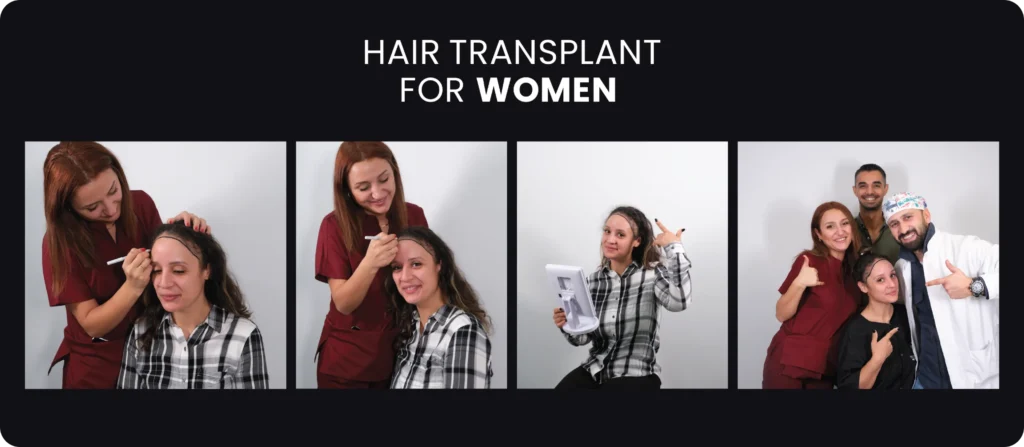
Hair Transplant for Women: Who Is a Candidate?
A transplant moves follicles from the donor areaGlossaryThe donor area is the back and sides of the head, where follicles resist DHT. An extracted follicle does not grow back in that spot, so extractions are spread out, and the donor supply is the limit of every plan. Open in the glossary → at the back of your head to the thinning zone on top. That only works if the back is still dense. When thinning reaches the back of the scalp as well, a transplant is often ruled out and treatment stays medical.[12]
For the right woman, surgery can work. In one surgeon's series of 751 women treated with FUTGlossaryIn FUT, a thin strip of skin is removed from the back of the head, divided into grafts of 1 to 4 hairs, and the wound is closed with stitches. It leaves a line scar, while FUE leaves tiny dots. Open in the glossary → over 31 years, complications were few, but 18% came back for a second session about four years later because their FPHL kept progressing.[13]
That's why medicine continues around surgery. The 2026 consensus says oral minoxidil can usually be restarted 1 to 3 days after a transplant, and topical minoxidil on the grafted area after 7 to 14 days.[10] Before you book, ask how likely shock loss is in your case.
Frequently Asked Questions
What is the best treatment for female pattern hair loss?
For most women, topical minoxidil, the only FDA-approved treatment. Antiandrogens such as spironolactone are added for severe loss or signs of androgen excess.
Can female pattern hair loss be reversed?
Partly, and mostly early. Once the main follicle in each group has shrunk and lost its muscle attachment, that loss can't be undone, so treatment aims to hold what you have.
Is female pattern hair loss genetic?
Partly. Genes and hormones both play a part, and the genes involved seem to differ from those behind male balding.
Which hormone causes female pattern hair loss?
No single hormone. Androgens push follicles to shrink and oestrogens may protect them, but FPHL also happens with normal androgen levels.
Can stress cause female pattern hair loss?
Physical stress such as childbirth or sudden weight loss is a known trigger of telogen effluvium, a different and usually temporary shed. The two can look alike early on, so have new shedding examined.
Does female pattern hair loss ever stop?
Not by itself: it is a progressive condition. Treatment aims to halt it, and a part that holds steady counts as success.
Can you use minoxidil while pregnant?
No. The label for women's minoxidil foam warns that it may be harmful in pregnancy or while breastfeeding, and the 2026 consensus advises avoiding it. For shedding after the birth, see our postpartum hair loss guide.
Medication, Surgery or Both: What Suits You?
Medication suits you if:
your part is widening but your front hairline is intact, and the earlier the better;
you can keep up a daily routine for years.
A transplant may suit you if:
you've given medicine a fair trial and bare areas remain on top;
the back of your scalp is still dense;
you're willing to stay on medicine afterwards.
A transplant is the wrong answer if thinning covers the whole scalp, back included, or if you're shedding after a trigger and the hair is likely to come back.
Send us three photos for a free hair analysis and the medical team will tell you whether your pattern suits medication, surgery or both. You can also message us on WhatsApp.
About the Author
Written by: Nazmi Güldeş, Certified Trichologist. Nazmi Güldeş focuses on patient education around androgenetic alopecia, evaluating miniaturization through dermoscopy, and assessing candidates for medical treatments and hair transplants.
Editorial Policy & Trust
This entry was medically reviewed by Dr. Teuku Adifitrian, Sp.BP-RE (Dr. Tompi) on 31 October 2026. Every study cited here was checked against PubMed on 31 October 2026. Key figures are marked with their source, and every source is listed at the end of this entry. Read how we work in our editorial policy.
3 questions
Test yourself
Check what you remember from this entry. Each answer links back to the section that explains it.
On the Sinclair scale, at which stage does a bald spot first develop towards the front?
Stage 2 is a widening part and stage 3 adds lost volume beside it; a bald spot towards the front appears at stage 4. Read the section
Which treatment is the only FDA-approved option for female pattern hair loss?
Topical minoxidil is the only FDA-approved treatment; spironolactone and oral minoxidil are used off-label. Read the section
Why is a transplant often ruled out when thinning covers the whole scalp?
When miniaturization reaches the back of the scalp too, a transplant is often ruled out and treatment stays medical. Read the section
3Scientific evidenceStudy types, references and how to cite this entry
13sources
Evidence behind this entry: 12 publications indexed in PubMed (2009 to 2026): 7 reviews, 2 clinical studies, 2 systematic reviews and 1 guideline. Plus . 6 sources have free full text.
Reviewsummarises many studies
Clinical studya study in people without random groups
Guideline or labela professional body, or the official drug label
Kearney CA, Brinks AL, Lawrence CN, et al. Androgenetic Alopecia in Women: A Narrative Review of Pathophysiology, Clinical Evaluation, and Treatments. American Journal of Clinical Dermatology. 2026;27(2):363-389.ReviewPubMedDOI
U.S. National Library of Medicine, DailyMed. Women's Rogaine Unscented (minoxidil 5% topical aerosol foam): Drug Facts label. Kenvue Brands LLC. Version effective November 2024.Drug labelSource page
Sinclair R, Torkamani N, Jones L. Androgenetic alopecia: new insights into the pathogenesis and mechanism of hair loss. F1000Research. 2015;4(F1000 Faculty Rev):585.ReviewPubMedDOIFree full text
Rakowska A, Slowinska M, Kowalska-Oledzka E, et al. Dermoscopy in female androgenic alopecia: method standardization and diagnostic criteria. International Journal of Trichology. 2009;1(2):123-130.Clinical studyPubMedDOIFree full text
Carmina E, Azziz R, Bergfeld W, et al. Female Pattern Hair Loss and Androgen Excess: A Report From the Multidisciplinary Androgen Excess and PCOS Committee. Journal of Clinical Endocrinology & Metabolism. 2019;104(7):2875-2891.GuidelinePubMedDOI
Jiang VS, Hawkins SD, McMichael A. Female pattern hair loss and polycystic ovarian syndrome: more than just hirsutism. Current Opinion in Endocrinology, Diabetes, and Obesity. 2022;29(6):535-540.ReviewPubMedDOI
Roster K, Fleshner L, Karatas TB, et al. Menopause and Common Dermatoses: A Systematic Review. American Journal of Clinical Dermatology. 2026;27(1):67-84.Systematic reviewPubMedDOIFree full text
Chien Yin GO, Siong-See JL, Wang ECE. Telogen Effluvium - a review of the science and current obstacles. Journal of Dermatological Science. 2021;101(3):156-163.ReviewPubMedDOI
van Zuuren EJ, Fedorowicz Z, Schoones J. Interventions for female pattern hair loss. The Cochrane Database of Systematic Reviews. 2016;2016(5):CD007628.Systematic reviewPubMedDOIFree full text
Gupta AK, Talukder M, Williams G, et al. Low-dose oral minoxidil (LDOM) and topical minoxidil: consensus recommendations for managing male and female pattern hair loss in hair transplant patients using a modified Delphi process. Expert Opinion on Pharmacotherapy. 2026;27(3):253-261.ReviewPubMedDOI
Bhat YJ, Saqib NU, Latif I, et al. Female Pattern Hair Loss-An Update. Indian Dermatology Online Journal. 2020;11(4):493-501.ReviewPubMedDOIFree full text
Spindler A, Maas D, Zappi I, et al. Revisiting Diffuse Unpatterned Alopecia: Reappraisal of a Controversial Diagnosis. Skin Appendage Disorders. 2026.ReviewPubMedDOIFree full text
Uebel CO, Piccinini PS, Spencer LSB, et al. Female Pattern Hair Loss: Why the Follicular Unit Transplantation Surgical Technique Remains a Good Option. Plastic and Reconstructive Surgery. 2021;147(4):839-849.Clinical studyPubMedDOI
Güldeş, N. (2026, October 31). Female pattern hair loss: Signs, stages, causes and treatment. Turkey Hair Center Hair Library. https://turkeyhaircenter.com/female-pattern-hair-loss/
@misc{guldes2026femalepatternhairloss,
  author       = {Güldeş, Nazmi},
  title        = {Female pattern hair loss: Signs, stages, causes and treatment},
  howpublished = {Turkey Hair Center Hair Library},
  year         = {2026},
  month        = oct,
  url          = {https://turkeyhaircenter.com/female-pattern-hair-loss/},
  note         = {Last updated 31 October 2026}
}
TY  - ELEC
AU  - Güldeş, Nazmi
TI  - Female pattern hair loss: Signs, stages, causes and treatment
T2  - Turkey Hair Center Hair Library
PY  - 2026
DA  - 2026/10/31
UR  - https://turkeyhaircenter.com/female-pattern-hair-loss/
N1  - Last updated 31 October 2026
ER  -
Talk to our hair team on a free video call, in your language. You receive a written plan with your technique, estimated grafts and all-inclusive price. If a hair transplant isn't right for you, we tell you honestly.
Your information is 100% confidential.
Real People Real Support
Send your photos on WhatsApp
Front, top and both sides, reviewed by the medical team.