7000 Grafts Hair Transplant: Cost, Hair Count & Is It Too Much?
Performed at authorized partner hospitals Turkey Hair Center is a Ministry of Health authorized health-tourism intermediary, not a clinic.
For most men, 7,000 grafts is too much for one operation and close to the limit of a lifetime donor supply. The 2021 hair transplant practice guidelines put the best upper limit for a single session at about 2,500 to 3,000 grafts. In a study of 580 men, the widest scalp donor zone gave about 6,321 grafts over two sittings at least 6 months apart, which is still below 7,000. Reaching 7,000 therefore usually means two sessions, a donor area denser than average, and often beard hair as well.
Cover built on the back of a closely shaved head and nape. Photo: Helpaeatcontu, CC BY-SA 3.0, via Wikimedia Commons, cropped, text and logo added.
Here are the short answers to the questions people ask most:
Is 7,000 grafts too much? For one day, yes, as a rule. Across two sessions it is possible only with a strong donor area.
How many hairs is that? About 12,600 to 16,100 hairs, at 1.8 to 2.3 hairs per graft.
What does it cost in Turkey? Our packages are $2,550 to $4,500 per procedure. Two sessions mean two procedures.
Is a "two-day" 7,000 graft offer the same as two sessions? No. Two days in a row give the donor area no time to heal in between.
Who might need it? Men with advanced loss, usually Norwood 6 or 7.
The cover photo is not one of our patients and not a transplant result. It shows the back of the head and the nape, the band between the ears where donor grafts are usually taken. A photo cannot show how dense that band is, so it says nothing about how many grafts this man could give.
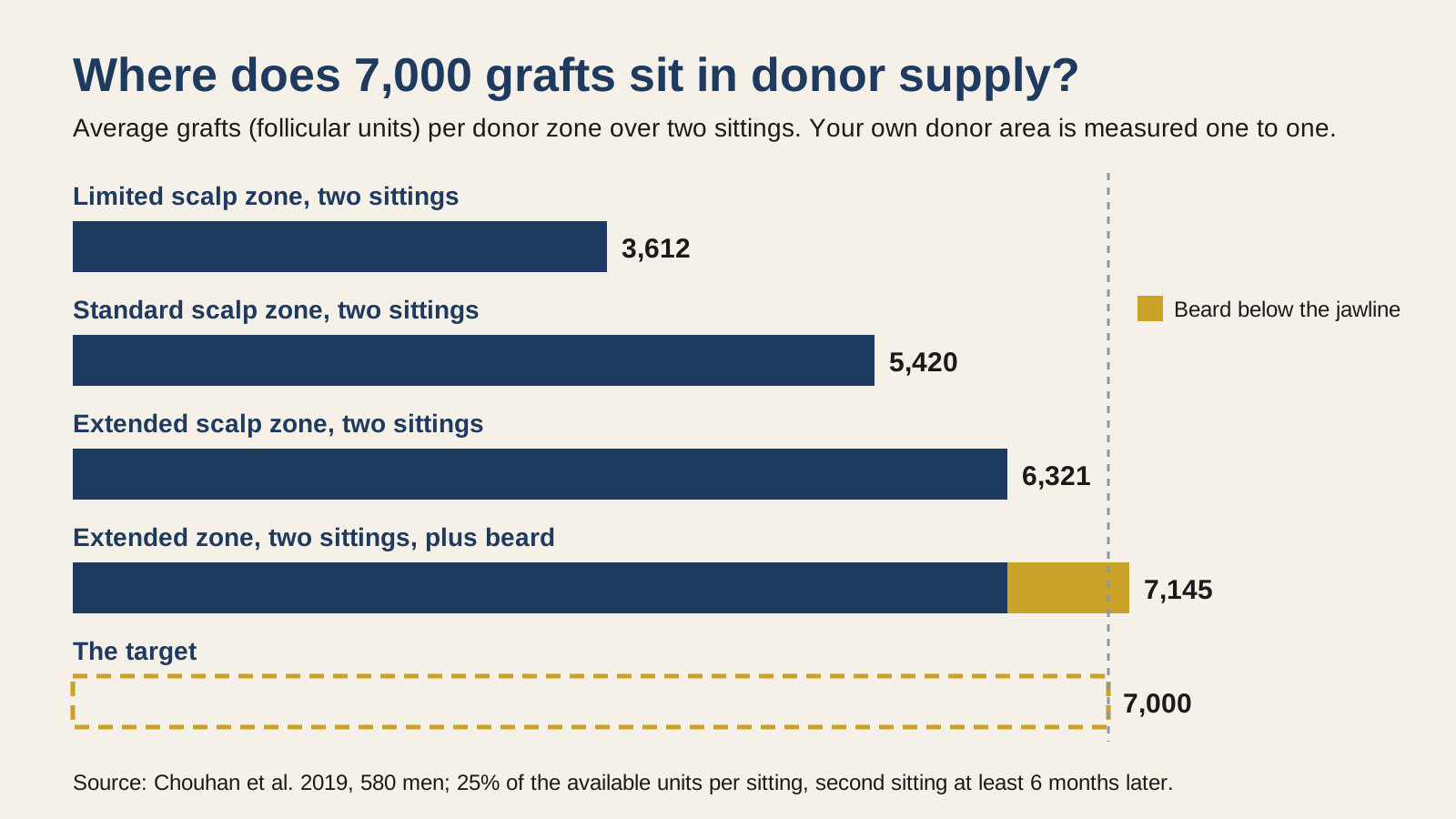
Average donor supply over two sittings in a study of 580 men, against a 7,000 graft target. Only the widest zone with beard hair added passes it. Chart: Turkey Hair Center, from Chouhan et al. 2019.
The chart uses group averages at an average density of 78.2 units per square centimetre. A man with denser donor hair can give more, and a man with sparser hair gives less. That is why the same number can be realistic for one patient and harmful for another.
Is 7,000 Grafts Too Much?
The answer depends on two separate questions: too much for one day, and too much for your donor area over a lifetime.
For one day, the guidelines are clear. They name 2,500 to 3,000 grafts as the best upper limit per session and say it is better to repeat surgery than to stretch one session longer. The largest megasessions we found in the research averaged about 3,705 grafts. In that 2023 study by Di and colleagues, 36 men with Hamilton grade V to VI loss had FUE sessions lasting about 10.6 hours. Seven thousand grafts is almost twice that figure.
For a lifetime, the limit is the donor band at the back and sides of the head. The guidelines put the safe donor area at about 189 to 203 square centimetres. Hair outside it may thin later with pattern loss, so grafts taken from there may not last. Every graft taken from the safe band leaves that spot for good.
Where Do 4,000, 5,000, 6,000 and 7,000 Grafts Sit?
People also ask whether 4,000, 5,000 or 6,000 grafts count as overharvesting. In the 580-man study by Chouhan and colleagues, the authors suggest taking 25 percent of the units in a sitting. This table sets each number against what their scalp zones gave at that rate:
Graft count
Against one sitting (largest scalp zone 3,612)
Against two sittings (largest scalp zone 6,321)
4,000
Above every scalp zone
Inside the standard zone (5,420)
5,000
Above every scalp zone
Inside the standard zone (5,420)
6,000
Above every scalp zone
Inside the extended zone only
7,000
Above every scalp zone
Above every scalp zone; reached only with beard hair added
These are averages, not personal limits. A dense donor area can give more per sitting. Still, the table shows why the question changes at 7,000: below it, a plan can stay on the scalp; at it, the plan has to reach the extended zone and beyond.
A 2026 review of FUE complications by Romera de Blas and colleagues adds a warning sign from practice. It reports overharvesting, seen as a "moth-eaten" or see-through donor area, more often in sessions above 3,000 to 4,000 grafts. It also notes that many authors limit extraction to 10 to 20 percent of the starting density per session.
How Many Hairs Are in 7,000 Grafts?
A graft, or follicular unit, is a small natural bundle of hairs. The StatPearls review of hair transplantation describes units of 1 to 4 hairs. Using the 1.8 to 2.3 hairs per graft in our graft guide, the numbers work out like this:
Offer
Grafts
Hairs
5,000 grafts
5,000
About 9,000 to 11,500
7,000 grafts
7,000
About 12,600 to 16,100
7,000 hairs
About 3,000 to 3,900
7,000
The last row matters most when you compare offers. A quote of "7,000" that counts hairs describes a session of around 3,000 to 3,900 grafts, which is a large but ordinary operation. Ask for the number in grafts and in writing.
5,000 vs 7,000 Grafts: How Much More Density?
Seven thousand grafts is 40 percent more than 5,000. Whether that shows as 40 percent more density depends on the area treated. If the extra 2,000 grafts go to a crown that the 5,000 plan left bare, you gain coverage, not density. If they go to the same area, the front looks fuller.
Our guide to the 5,000 graft transplant shows what a single large session covers. The jump to 7,000 mostly buys the crown, which a smaller plan usually leaves for later.
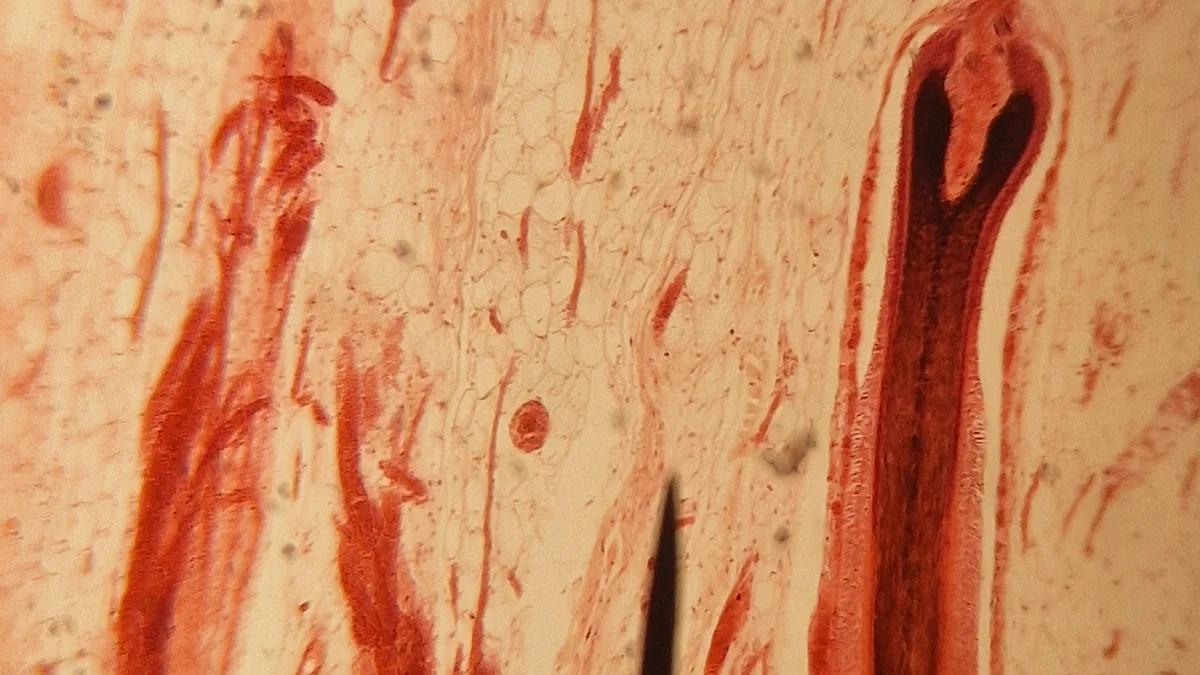
Hair follicles in a stained skin section under a microscope. Photo: Deset.apple, CC0, via Wikimedia Commons, cropped.
The slide shows follicles sitting inside the skin, not grafts that have been removed. In FUE each graft is cut out around such a follicle group, so every graft taken leaves the donor skin with one group fewer, and that is the limit the next sections count against.
How Much Does a 7,000 Graft Hair Transplant Cost in Turkey?
We do not set prices by the graft. Our packages are fixed prices per procedure, from $2,550 to $4,500, and the medical team decides how many grafts your donor area can safely give in each one. Because 7,000 grafts normally needs two sessions, a full plan usually involves two procedures.
Package
Price per procedure
Sapphire Prime
$2,550
Sapphire Advanced Regrowth
$3,000
DHI Comfort
$3,350
Exosapphire Microflow Elite
$4,500
What every package covers:
Hotel: 2 nights in Istanbul.
Transfers: VIP transfer between the airport, the hotel and the hospital.
No source we could check publishes a price for 7,000 grafts abroad, so the figures below are not a like-for-like comparison:
Country
Published figure
Source
United States
$12,000 to $15,000 for large cases of 2,000 grafts or more
American Society of Plastic Surgeons, 2018
United Kingdom
£1,000 to £30,000 depending on the area treated
NHS
Turkey
$2,550 to $4,500 per procedure package
Turkey Hair Center packages
Since a 7,000 graft plan has two parts, compare the total for both sessions, not the price of the first day. Our 8,000 graft guide lists the questions a quote for a staged plan should answer.
Two Sessions or Two Days in a Row?
Searches for 7,000 grafts often turn up offers to do the whole number "in two days". That is not the same as two sessions, and the difference matters for your donor area.
Two days in a row
Two staged sessions
Gap between harvests
One night
At least 6 months in the 580-man study
Donor area between harvests
Still healing from day one
Healed and re-assessed
What the team can check before more grafts are taken
Very little
Growth from session one and the donor scars
What the research describes
Not studied as a method in the sources we used
Staging in Chouhan et al. 2019 and Umar et al. 2026
In the Chouhan study, the second sitting takes 25 percent of what remains, at least 6 months after the first. Two days in a row skip that gap, so for the donor area both days count as one large harvest. A 2026 review by Umar and colleagues concludes that staged procedures can be safer than one large session, especially when extended donor zones are used.
If you have a two-day offer, ask the provider in writing:
How many grafts are taken on each day, and from which zones?
What share of my donor density do both days take together?
How long are grafts kept outside the body before placement?
Who removes and who places the grafts on each day?
Why is the plan not staged six months or more apart?
How Long Does a 7,000 Graft Plan Take?
The surgery days are the short part. Each large session fills a long day, and Di's megasessions ran about 10.6 hours. The waiting between sessions, and the growth after each one, take far longer.
Step
Typical timing
Source
First session
One long day
Di et al. 2023
Swelling on the forehead and around the eyes
Settles in about 5 to 7 days
Romera de Blas et al. 2026
Shedding of transplanted hair
2 to 8 weeks
American Academy of Dermatology
Visible results
6 to 9 months, sometimes 12
American Academy of Dermatology
Second sitting
At least 6 months later in the study; secondary procedures often after 12 months or more
Chouhan et al. 2019; Romera de Blas et al. 2026
Full result of each session
10 to 18 months
NHS
Put together, a two-session plan usually runs close to two years from the first day to the final result of the second session.
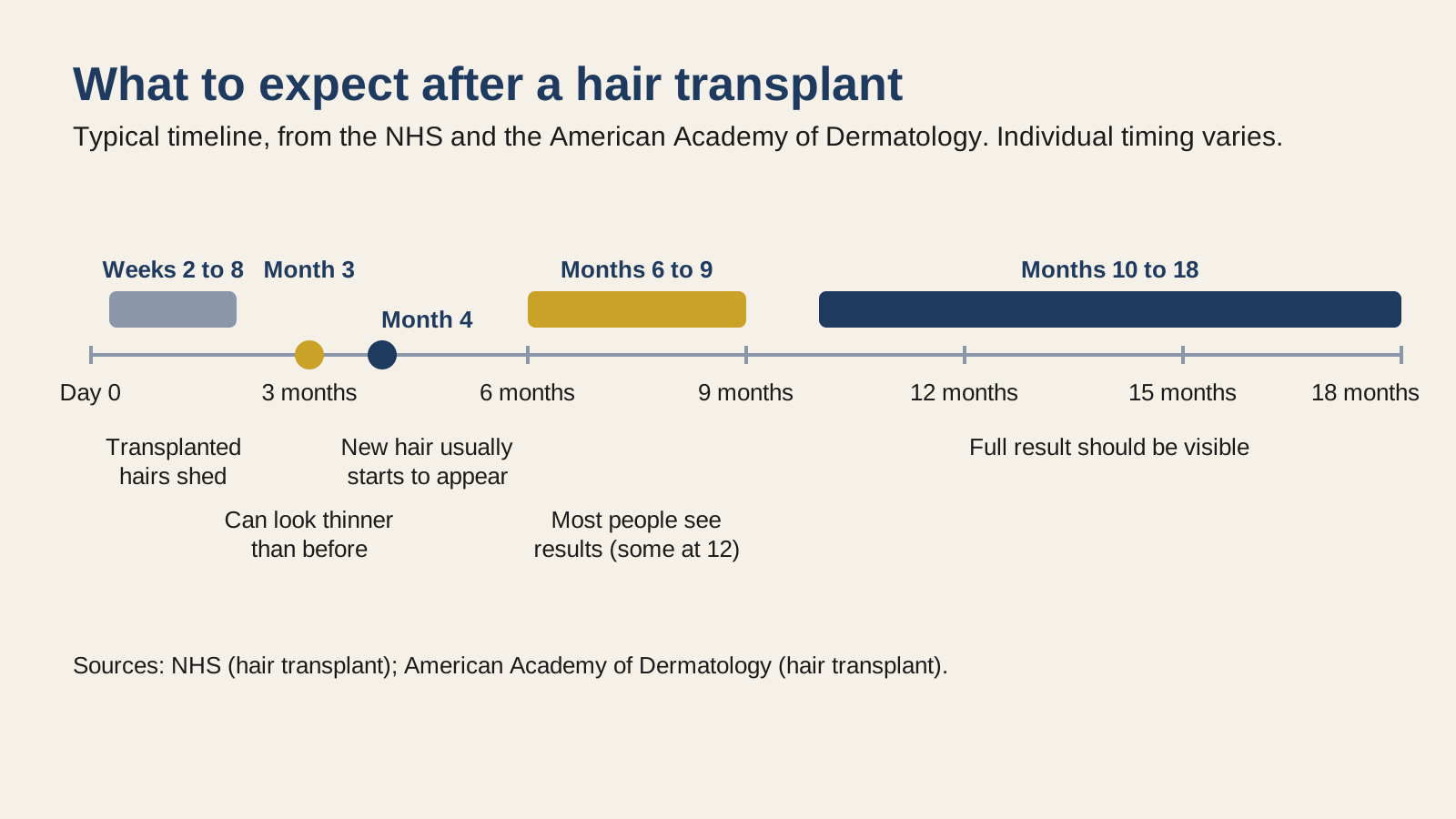
Typical growth timeline after a hair transplant, from NHS and American Academy of Dermatology information.
Each session starts its own clock. That gives the team time to see how the first grafts grew before choosing where the second set goes. Our recovery timeline covers the weeks after surgery in detail.
What Results Can 7,000 Grafts Give?
A plan of this size aims to cover a large bald area so that it looks natural from a normal distance. It does not rebuild the density of a teenager's hair. The first session usually goes to the hairline and the front, because they frame the face. The crown, which needs many grafts and shows less, usually comes second.
These factors shape how full the result looks, more than the headline number:
Hair thickness. Coarse hairs cover more scalp per graft than fine ones.
Colour against skin. Little contrast between hair and skin looks fuller.
Wave or curl. Curly hair lifts and covers more area.
Size of the bald area. The same grafts look denser on a smaller target.
Who Is a Candidate for 7,000 Grafts?
Only a small group of men both need and can supply this many grafts. The StatPearls review describes the ideal candidate as someone with a clear and stable pattern of loss, a healthy scalp, donor hair of good quality and quantity, good general health and realistic expectations. For 7,000 grafts, these points come first:
A dense donor band. Above the study average, so that the extended zone can give more than its average of 6,321.
A wide, stable band. The fringe at the back has not moved down.
Age and stability. The guidelines advise waiting until at least 23 to 25 and do not recommend surgery under 21.
Medical treatment. The guidelines recommend continuing medicine after surgery, such as topical minoxidil 2 to 5 percent or oral finasteride 1 mg daily, on a doctor's advice.
If your donor density is near or below the average, a well planned smaller transplant that places grafts where they show most often looks better than a 7,000 graft plan that thins the back of the head.
Not sure of your stage? The Norwood scale guide shows each one with its usual graft range.
Can Beard Hair Make Up the Difference?
It can add to the scalp supply, within limits. In the 580-man study, the beard below the jawline gave about 824 units per sitting at the same 25 percent rate. Adding one beard sitting to the extended zone's 6,321 grafts gives about 7,145, our sum of the study's figures and the only combination in it that passes 7,000.
The Romera de Blas review advises a test extraction before beard or body FUE, to check how the skin heals. Our body hair transplant guide explains when beard and chest hair are used, and the beard transplant guide covers the beard as an area to restore.
How Do Large Sessions Protect Graft Survival?
The sources we used give no survival rate specific to 7,000 grafts, so we do not quote one. They do describe what matters in long sessions:
Time outside the body. The guidelines prefer placing grafts within 2 to 4 hours and note survival up to 6 hours.
Cold storage. Gan and colleagues found no significant difference in survival for grafts kept up to 8 hours in chilled Ringer's solution at 4°C.
Packing density. The Romera de Blas review links packing above 45 units per square centimetre to folliculitis and above 50 to poor blood flow in the recipient area.
Early washing. The same review links delaying the first wash beyond 3 days to folliculitis and lasting redness. Our post-operative hair wash guide shows how to wash safely.
A single human hair root under a light microscope. Photo: Juan de Vojníkov, CC BY-SA 4.0, via Wikimedia Commons, cropped.
This is one hair and its root, not a graft. The root end is the living part of a hair, and it is what the time and storage limits above protect while thousands of grafts wait outside the body during a long session.
Frequently Asked Questions
Is 7,000 grafts too much for one session?
Yes, as a rule. The 2021 guidelines name 2,500 to 3,000 grafts as the best upper limit per session and prefer repeat surgery to a longer session. Studied megasessions averaged about 3,705 grafts.
Can a Norwood 6 or 7 patient get 7,000 grafts?
Some can, over two sessions and with a dense donor area. Even then, the average extended scalp zone in the 580-man study gave about 6,321 grafts over two sittings, so many Norwood 7 plans settle on fewer grafts and focus on the front.
Is 6,000 grafts too much?
In one sitting, 6,000 is above every scalp zone in the 580-man study at a 25 percent rate. Over two sittings, only the extended zone reached it on average. Our 6,000 graft guide covers that size in detail.
Is 5,000 grafts overharvesting?
Not over two sittings for an average donor: the standard zone gave about 5,420. In one sitting it is above the study's largest scalp zone, and the Romera de Blas review sees overharvesting more often above 3,000 to 4,000 grafts per session.
How long does the donor area take to recover?
The small wounds heal, but removed follicles do not grow back in place. The Romera de Blas review describes shedding of nearby donor hair 2 to 4 weeks after surgery that usually settles within 3 to 6 months.
Are the results of 7,000 grafts permanent?
Grafts from the safe donor band keep their resistance to pattern loss, so they are expected to last. Your untreated hair can keep thinning, which is why the guidelines advise ongoing medical treatment. Read how long hair transplants last for more.
What will 7,000 grafts look like 10 or 20 years later?
At 7,000 grafts, most of the safe donor band has been used, so a decade later the main limit is how little reserve remains. The transplanted hair is expected to last, but the evidence covers years, not decades: in a 2020 study of 112 patients, most showed some density loss between year one and year four, while 8.92% showed none. Another study (2024) found over 90% kept their density when grafts came from a measured permanent zone. Ongoing medical treatment can help protect the hair around the grafts.
Do I need to shave my head for 7,000 grafts?
The donor area is shaved. Dua and Dua note that FUE requires shaving and that large areas are hard to treat without it. A no-shave hair transplant suits much smaller cases.
When can I return to work?
The sources we used do not set one day for everyone. Swelling usually settles within 5 to 7 days, and the return to work guide explains how the type of job changes the answer.
Can DHI be used for 7,000 grafts?
DHI changes how grafts are placed, with an implanter pen, not how many the donor area can give. The donor limit is the same for both. Compare them in FUE vs DHI or read about DHI hair transplant.
Will I need a second transplant?
For 7,000 grafts, almost always. The study's second sitting came at least 6 months after the first, and the Romera de Blas review places secondary procedures after 12 months or more, once growth from the first is complete.
Find Out What Your Donor Area Can Give
The right graft count is the one your donor area can supply while the back of your head still looks natural. Send clear pictures of the front, top, both sides and back in daylight for a free hair analysis. The medical team will estimate how many grafts your donor area can support, whether that takes one or two sessions and whether beard hair should be part of the plan.
Medical disclaimer: This article is for informational purposes only and is not medical advice. Individual results and recovery vary from person to person. Always follow the written aftercare plan from your own medical team.
Chouhan K, Kota RS, Kumar A, Gupta J. Assessment of safe donor zone of scalp and beard for follicular unit extraction in Indian men: a study of 580 cases. Journal of Cutaneous and Aesthetic Surgery, 2019;12(1):31-35
Di M, Liu Q, Liu C, Zhu S, Jiang B, Wu W. Follicular unit extraction megasession treatment of high-grade androgenetic alopecia in Asians: introducing novel principles for surgical design. Journal of Cosmetic Dermatology, 2023;22(12):3395-3404
Gan YY, Du LJ, Hong WJ, Hu ZQ, Miao Y. Theoretical basis and clinical practice for FUE megasession hair transplantation in the treatment of large area androgenic alopecia. Journal of Cosmetic Dermatology, 2021;20(1):210-217
Send three photos: front, top and sides. You get a technique recommendation, a graft range and a straight answer about what is achievable, before anyone talks about price.
Your details are with the team
A patient coordinator will get back to you shortly. If you would like to send your photos now, WhatsApp is the fastest way to do it.
We respond quickly, day or night, in your language.
Multilingual team, no obligation
Data protectedKVKK and GDPR compliant, 100% confidential
Authorized Health Tourism Intermediary
Turkey Hair Center is the hair-restoration brand of Healthy Way Tourism, an authorized international health-tourism intermediary. All medical procedures are performed by licensed medical professionals at authorized healthcare facilities in Turkiye, in accordance with the regulations of the Ministry of Health.