Performed at authorized partner hospitals Turkey Hair Center is a Ministry of Health authorized health-tourism intermediary, not a clinic.
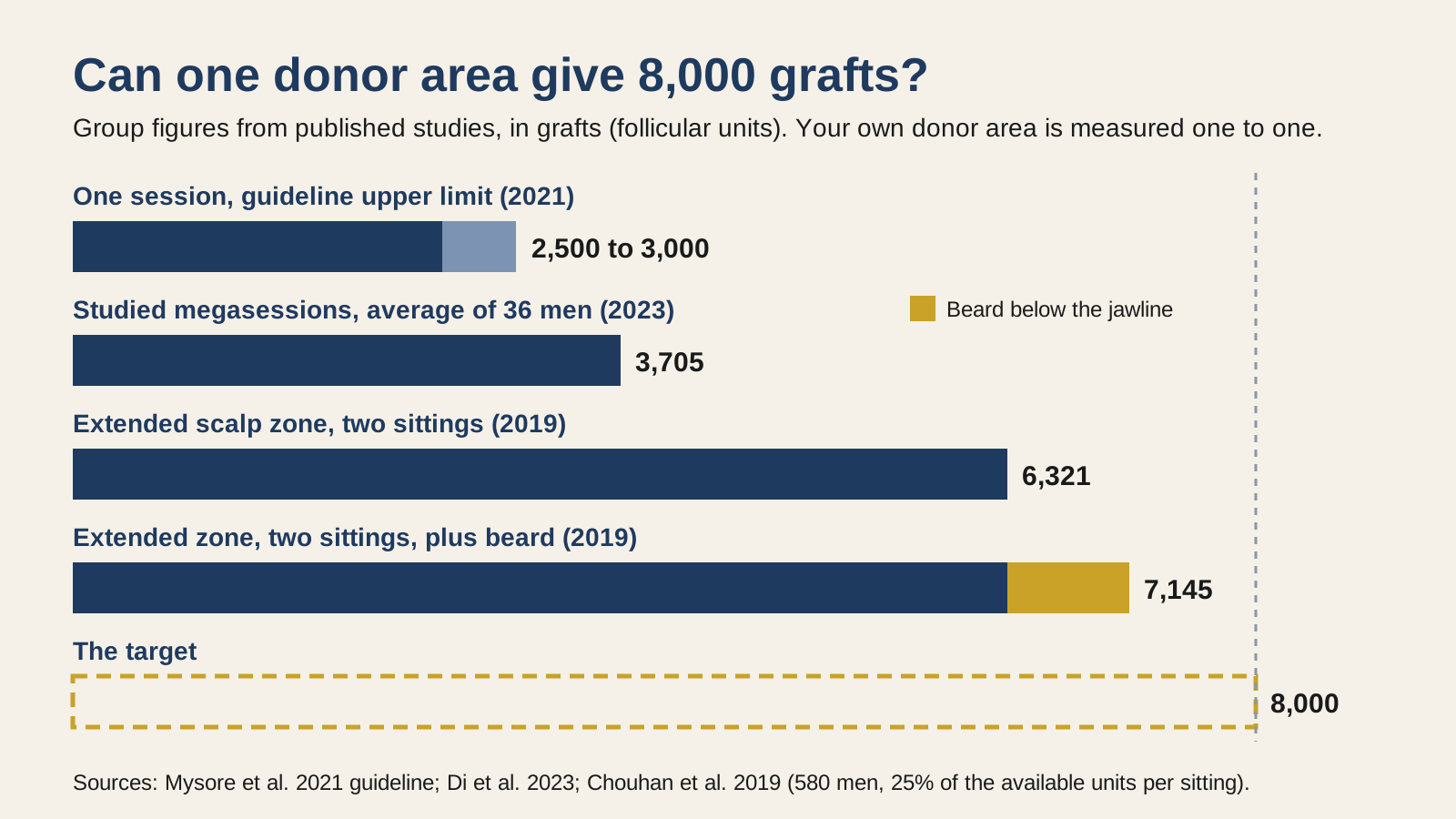
An 8,000 graft hair transplant is almost never one operation. The 2021 hair transplant practice guidelines put the best upper limit for one session at about 2,500 to 3,000 grafts. In a large study of donor areas, even the extended scalp zone gave about 6,321 grafts over two sittings, and about 7,145 with beard hair added. So a true 8,000 graft plan means two or more sessions spread over more than a year, extra donor sources such as beard or body hair, and a man with an unusually dense and wide donor area.
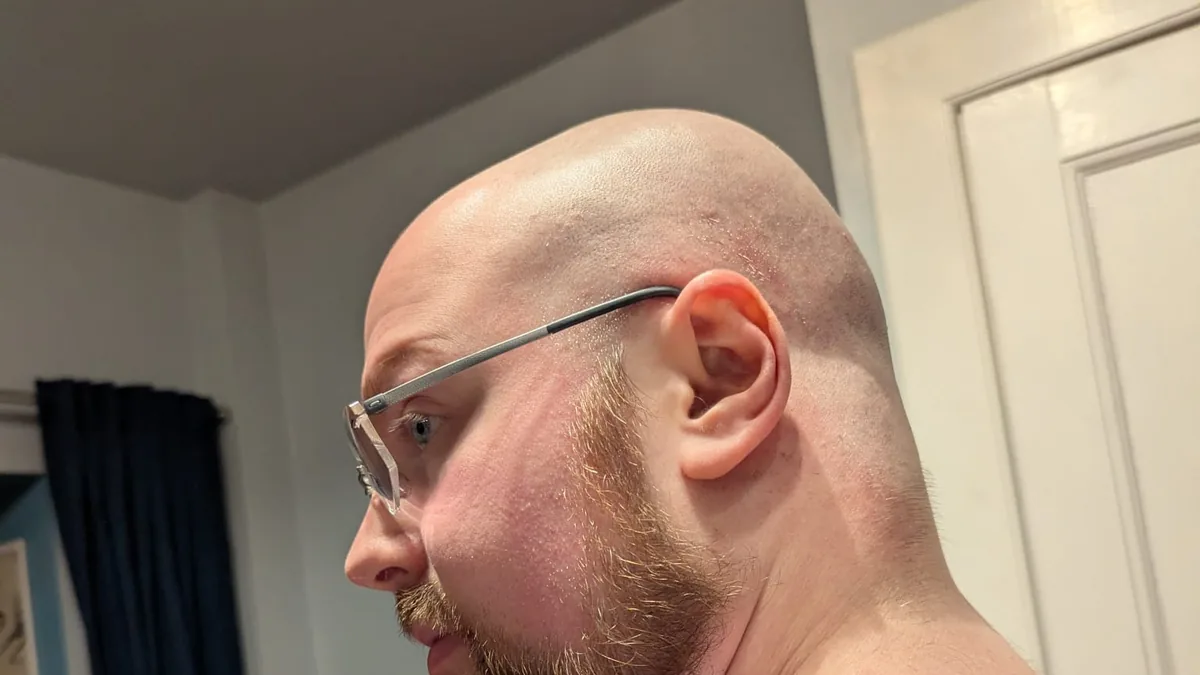
Cover built on the closely shaved back of a man's head. Photo: Genusfotografen (Tomas Gunnarsson) / Wikimedia Sverige, CC BY-SA 4.0, via Wikimedia Commons, cropped, text and logo added.
If you want the short answers first, here they are:
Can 8,000 grafts be done in one day? Not safely as a rule. Published megasessions average under 4,000 grafts.
Is the number grafts or hairs? Check this first. 8,000 hairs is often only about 4,000 grafts.
How much does it cost in Turkey? Our packages run from $2,550 to $4,500 per procedure. A plan that needs two sessions involves two procedures.
How long does the whole plan take? Usually two years or more from the first session to the final result of the last one.
Who is it for? Men with advanced loss, such as Norwood 6 or 7, and a strong donor area.
The cover photo is not one of our patients and not a transplant result. It shows the back of a closely shaved head, the area between the ears where donor grafts are usually taken. The photo cannot show how dense that hair is, and density is what decides whether a plan as large as 8,000 grafts is possible at all.
Group figures from published sources, in grafts. Even the largest combined figure stays under 8,000. Chart: Turkey Hair Center, from Mysore et al. 2021, Di et al. 2023 and Chouhan et al. 2019.
Each bar comes from a different kind of source: a practice guideline, a clinical series of 36 men and a donor area study of 580 men. Your own figure can be higher or lower, because it depends on your donor density, which a doctor measures one to one.
Why Is an 8,000 Graft Transplant So Challenging?
Two limits meet at this number. The first is the donor supply, the band of hair at the back and sides of the head that resists pattern hair loss. The second is the session itself: how many grafts a team can take out, keep healthy outside the body and place in one day.
The donor band is finite. The 2021 guidelines advise surgeons to stay within the safe donor area, which they put at about 189 to 203 square centimetres depending on the person and ethnicity. Every graft taken from it is gone for good from that spot, so each session uses up part of a fixed supply.
Grafts or Hairs? Check the Offer First
A graft, or follicular unit, is a small natural group of hairs. The StatPearls review of hair transplantation notes that a unit holds 1 to 4 hairs. That gap between grafts and hairs is why the number in an offer matters:
What the offer says
What it usually means
8,000 grafts
About 14,400 to 18,400 hairs, at 1.8 to 2.3 hairs per graft
8,000 hairs
About 3,500 to 4,400 grafts
"8,000" with no unit
Ask in writing before you compare prices
Our guide to how many grafts you need shows the same point from the other side: at 1.8 to 2.3 hairs per graft, 4,000 grafts hold about 7,200 to 9,200 hairs. An "8,000" offer can therefore describe a 4,000 graft operation, which is a large but realistic single session.
Ask for the plan as grafts per zone and per session, not as one total: how many go to the hairline, the mid scalp and the crown, and in which session. One headline number does not show where the hair will go.
How Does 8,000 Compare With Smaller Plans?
Most plans are far smaller. Our guides to the 5,000 graft, 6,000 graft and 7,000 graft transplant explain where the next limits sit. At 8,000, the plan is no longer a bigger version of one session. It is a staged project.
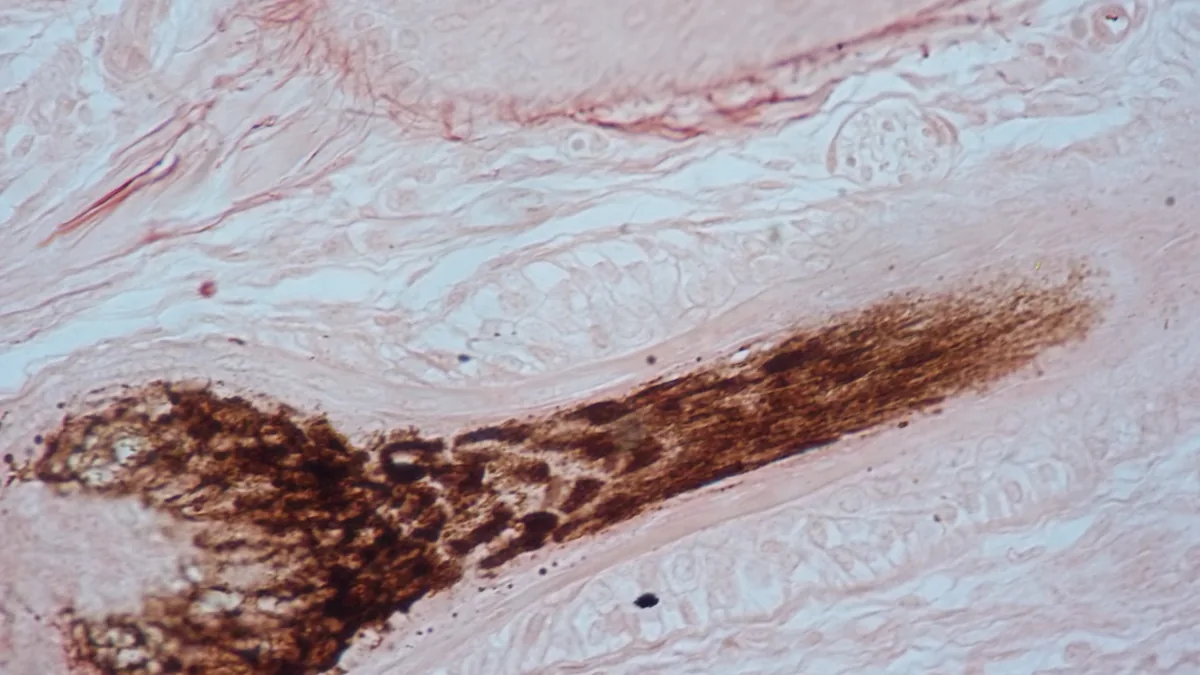
A hair follicle cut lengthwise in a stained skin section under a microscope. Photo: Ganímedes, CC BY-SA 3.0, via Wikimedia Commons, cropped.
The slide shows a follicle inside the skin, not a graft that has been removed. Each FUE graft is cut out around a follicle group like this one, and a removed follicle does not grow back, which is why the donor total sets a hard ceiling on any large plan.
How Much Does an 8,000 Graft Hair Transplant Cost in Turkey?
We do not price by the graft. Our packages are fixed prices per procedure, from $2,550 to $4,500, and the medical team decides how many grafts your donor area can safely give. A true 8,000 graft plan needs more than one procedure, so the total depends on how many sessions the plan requires.
Package
Price per procedure
Sapphire Prime
$2,550
Sapphire Advanced Regrowth
$3,000
DHI Comfort
$3,350
Exosapphire Microflow Elite
$4,500
Each package includes:
2 nights in a hotel in Istanbul.
VIP transfer between the airport, the hotel and the hospital.
2 years of care consultation after the procedure.
Flights are not included, so add them to your own budget.
Before the first session, ask for the price of a possible second session in writing. Our full hair transplant cost page covers what changes the price.
How Does Turkey Compare With the US and UK?
Published prices from other countries are not quoted per 8,000 grafts, so a direct comparison is not possible. These are the figures we could check:
Country
Published figure
Source
United States
$12,000 to $15,000 for large cases of 2,000 grafts or more
American Society of Plastic Surgeons, 2018
United Kingdom
£1,000 to £30,000 depending on the area treated
NHS
Turkey
$2,550 to $4,500 per procedure package
Turkey Hair Center packages
The sources we used do not compare costs between countries, so we do not guess why the gap exists. What you can compare is what each price includes, how many grafts are planned per session and who carries out each step.
What Should a Price Quote for 8,000 Grafts Include?
A clear quote answers these questions:
Is the number in grafts or hairs?
How many sessions are planned, and what does each one cost?
Which donor zones are used: scalp only, or beard and body too?
Large staged plans aim to cover a large bald area with a natural look. They rarely give the density of a full head of hair, and the result depends on where the grafts go. Most plans spend the first session on the front and the hairline, because they frame the face, and leave the crown for later.
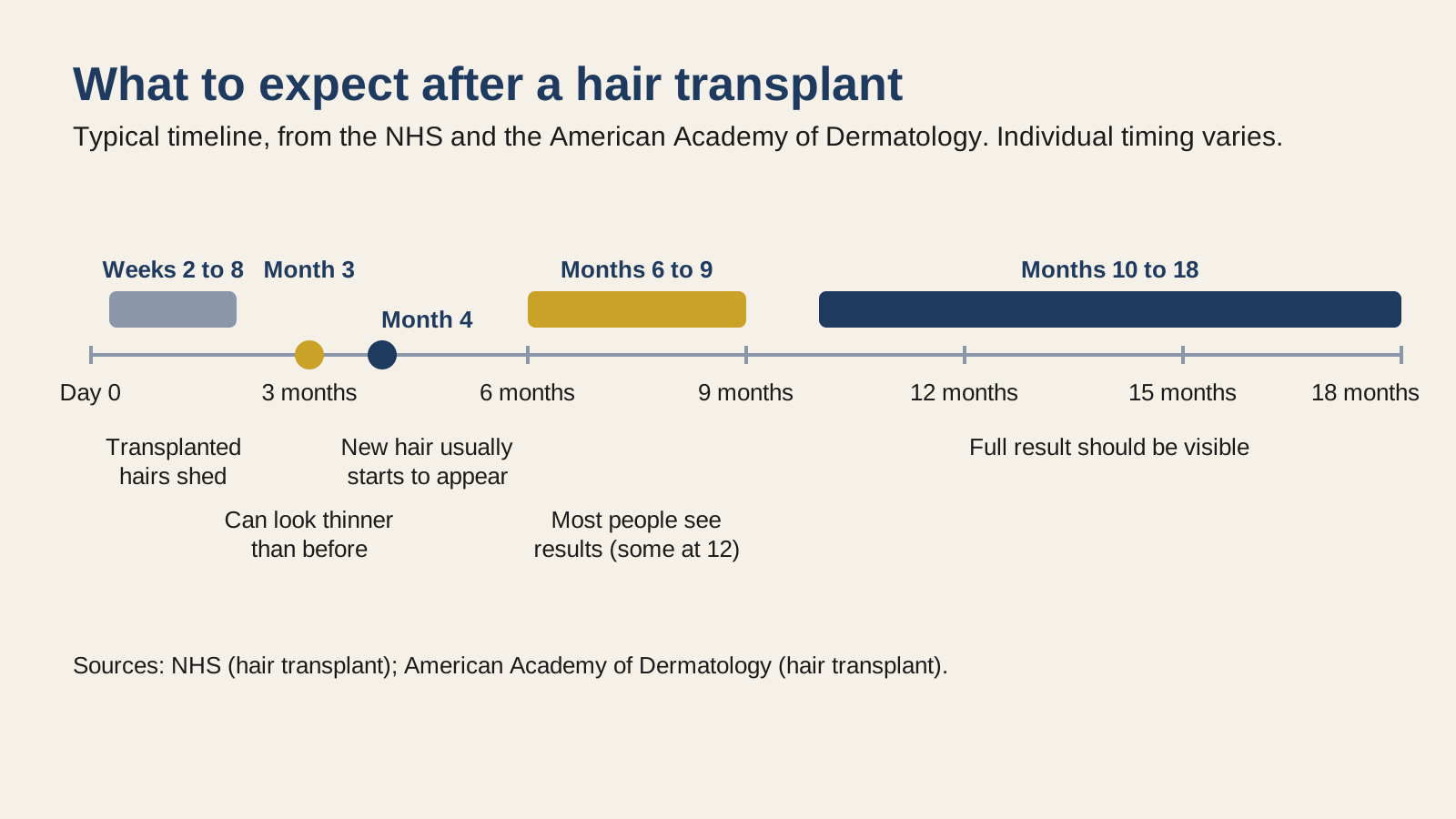
Growth after each session follows the usual slow pattern. The NHS says a full result can take 10 to 18 months, and the American Academy of Dermatology describes shedding at 2 to 8 weeks and results at 6 to 9 months, sometimes 12.
Typical growth timeline after a hair transplant, from NHS and American Academy of Dermatology information.
With two sessions, each one starts its own timeline. You see the first session's result before the second is planned, which helps the team decide where the remaining grafts make the most difference. Our recovery timeline guide covers each stage week by week.
These factors change how full the result looks:
Hair calibre. Thick hairs cover more scalp than fine ones.
Contrast. Grey hair on fair skin looks fuller than dark hair on fair skin.
Curl. Wavy or curly hair covers more area.
The area treated. A smaller target gives more density per square centimetre.
Can You Get 8,000 Grafts in One Session?
In practice, no. The 2021 guidelines call 2,500 to 3,000 grafts the best upper limit for a session and state that it is better to repeat surgery than to prolong one session. They also note that grafts are best placed within the first 2 to 4 hours outside the body, although survival has been seen up to 6 hours.
Larger sessions exist. In a 2023 study by Di and colleagues, 36 men with Hamilton grade V to VI loss had FUE megasessions averaging 3,705 grafts (plus or minus 383) over about 10.6 hours, with no serious side effects reported. That is a careful result in selected patients, and it is still under half of 8,000.
Why Does Graft Time Outside the Body Matter?
The longer a session runs, the longer early grafts wait. In a 2021 study, Gan and colleagues found no significant difference in survival for grafts stored up to 8 hours in chilled Ringer's solution at 4°C. That supports careful storage in long sessions. It does not make an 8,000 graft session safe in one day, because time is only one of several limits.
What Goes Wrong When Sessions Get Too Big?
A 2026 review of FUE complications by Romera de Blas and colleagues links several problems to very large sessions:
Overharvesting. A "moth-eaten" look, a see-through "window" effect or permanent donor depletion, increasingly seen in sessions over 3,000 to 4,000 grafts.
Folliculitis. Higher risk in megasessions over 4,000 grafts, with dense packing over 45 units per square centimetre, with washing delayed beyond 3 days and in summer.
Poor blood flow in the recipient area. Linked to packing over 50 units per square centimetre and to sessions over 3,500 to 4,000 grafts.
The same review notes that many authors limit extraction to 10 to 20 percent of the starting density per session.
How Long Does an 8,000 Graft Hair Transplant Take?
Each session is a long day. Di's megasessions lasted about 10.6 hours. A 2010 review by Dua and Dua described megasessions of up to 2,000 FUE grafts in a 10 to 12 hour day at the time, which shows how much the pace of extraction has changed and why large cases were once run over several days.
The waiting time between sessions takes longer than the sessions themselves:
Stage
Typical timing
Source
First session
One long day
Di et al. 2023
Swelling settles
About 5 to 7 days
Romera de Blas et al. 2026
Earliest second sitting
At least 6 months later
Chouhan et al. 2019
Usual secondary procedure
After 12 months or more, if needed
Romera de Blas et al. 2026
Full result of each session
10 to 18 months
NHS
Adding these together, a plan of two sessions usually takes two years or more from the first day to the final result of the second session. That time also lets the team see how the donor area healed before taking more from it.
How Is the Donor Area Managed for 8,000 Grafts?
Donor management decides whether an 8,000 graft plan is possible at all. The aim is to take enough grafts for coverage while leaving the back of the head looking natural for life.
In the study by Chouhan and colleagues of 580 men, the scalp donor area held on average 78.2 units per square centimetre. They recommend taking 25 percent in the first sitting and 25 percent of what remains in a second sitting, at least 6 months later, for a total of about 43.75 percent. They advise against taking 50 percent in one sitting. At that rate, their zones gave:
Donor zone
One sitting
Two sittings
Limited scalp zone
2,064
3,612
Standard scalp zone
3,097
5,420
Extended scalp zone
3,612
6,321
Beard below the jawline
824
Not given
Other authors are more cautious. Mohmand and Ahmad advised taking under 35 percent of donor density in a first session and only 10 to 20 percent in a second. A 2026 review by Umar and colleagues concludes that staged procedures can be safer than one large session, especially when extended zones are used.
Can Beard and Body Hair Help Reach 8,000?
Sometimes, and only as an addition. Beard hair added about 824 units per sitting in the 580-man study. Body hair, such as chest hair, can only be harvested with FUE, as Dua and Dua note. The Romera de Blas review advises against beard or body FUE unless a test extraction first shows that the skin heals well.
Beard and body grafts add to the scalp supply; they do not replace it. Our guide to body hair transplant covers it in detail, and the beard transplant guide explains the beard as a target area.
A man with a newly shaved head and a full beard, seen from the side. Photo: Sister of necronwarrior, uploaded by necronwarrior, CC BY-SA 4.0, via Wikimedia Commons, cropped.
This man has not had a transplant. His head is shaved, so the side and back of the scalp and the beard below the jaw are both visible, the two donor sources this section compares. Whether either could give enough grafts is decided by measuring density at the examination, not from a photo.
Who Is the Ideal Candidate for 8,000 Grafts?
Very few men need or can supply 8,000 grafts. The StatPearls review lists the traits of an ideal candidate: a clear and stable pattern of loss, a healthy scalp, donor hair of good quality and quantity, good general health and realistic expectations. For a plan this size, these points weigh most:
Advanced loss. Usually Norwood 6 or Norwood 7, where the bald area is large.
A dense, wide donor band. Density well above average, and a band that has not moved down the head.
Good hair calibre. Thick hair gives more coverage per graft.
A stable pattern. The guidelines advise waiting until at least 23 to 25 and do not recommend surgery under 21.
Long-term medical care. The guidelines recommend continuing medicine after surgery, such as topical minoxidil 2 to 5 percent or oral finasteride 1 mg a day, on a doctor's advice.
If your donor band is narrow, the honest plan is smaller. Our guide to the Norwood scale helps you find your stage before a consultation.
Is an 8,000 Graft Hair Transplant Worth It?
For the right person, a staged plan can change the look of advanced baldness more than any single session could. For others, chasing a number risks the donor area. Weigh both sides:
Reasons it can be worth it:
Transplanted hair keeps the traits of donor hair, so it is expected to last. Our guide on how long hair transplants last explains why.
Staging lets you see each result before committing to the next step.
The front can look natural after the first session alone.
Reasons to think twice:
Two or more procedures mean more time, travel and recovery.
Overharvesting cannot be undone.
Medical treatment may still be needed to protect your own hair.
A good plan is built from the donor area outwards, not from a target number inwards.
Frequently Asked Questions
How many hairs are in 8,000 grafts?
About 14,400 to 18,400 hairs, at the 1.8 to 2.3 hairs per graft reported in the studies our graft guide uses. StatPearls notes that a single graft holds 1 to 4 hairs, so your own figure depends on your donor area.
Is it safe to do 8,000 grafts in one procedure?
It is not a standard approach. The 2021 guidelines put the best upper limit at 2,500 to 3,000 grafts per session and prefer a repeat surgery to a longer session. Studied megasessions averaged about 3,705 grafts.
Why is Turkey a common choice for large hair transplants?
Many patients compare fixed package prices and travel for them. Experience with large cases depends on the team, not the country. Turkey Hair Center is a Ministry of Health authorized health-tourism intermediary; our own team performs procedures in authorized partner hospitals in Istanbul. Ask any provider how many large sessions their team performs and who does each step.
Does the donor area recover after 8,000 grafts?
The wounds heal, but extracted follicles do not grow back in the same spot. FUE leaves small round scars. Some patients also shed nearby hair in the donor area 2 to 4 weeks after surgery, which usually settles within 3 to 6 months, according to the Romera de Blas review.
Are the results of an 8,000 graft transplant permanent?
Transplanted hair comes from the donor band and keeps its resistance to pattern loss, so it is expected to last. Your own hair around it can keep thinning, which is why the guidelines recommend ongoing medical treatment.
What happens 10 or 20 years after an 8,000 graft transplant?
An 8,000 graft session is usually for advanced loss and uses most of the donor reserve, so there may be little left for a later procedure. The grafts are expected to keep growing, but long-term data is limited: Kumaresan (2020) followed 112 patients for four years and found 8.92% with no change and most with some thinning of transplanted hair. Punia (2024) linked careful permanent zone mapping to over 90% retaining density. No study has measured 20-year results. Read how long hair transplants last for the studies.
Do I need to shave my whole head?
The donor area is shaved for FUE. Dua and Dua note that FUE needs shaving and that large areas are hard to treat without it. A no-shave hair transplant suits smaller cases, not a plan of this size.
How long do swelling and redness last after a large session?
The Romera de Blas review reports swelling in about 40 to 50 percent of cases. It starts on day 1 or 2, peaks on day 2 or 3 and settles within 5 to 7 days, mainly on the forehead and around the eyes, sometimes with mild bruising. The same review lists redness that lasts beyond 4 weeks as an occasional problem, linked to folliculitis and to delaying the first wash beyond 3 days.
Is graft survival lower in megasessions?
The sources we used give no survival rate specific to 8,000 grafts. The guidelines prefer placing grafts within 2 to 4 hours, and Gan and colleagues found no significant difference in survival at up to 8 hours in chilled solution. Careful storage helps, but session size still raises other risks.
Can beard or chest hair help reach 8,000 grafts?
They can add grafts. The 580-man study counted about 824 beard units per sitting. Body hair can only be taken with FUE, and a test extraction is advised first. Even with beard hair, the study's largest total was about 7,145 grafts over two sittings.
Will I need a second procedure?
For a true 8,000 graft plan, yes. Chouhan and colleagues set the second sitting at least 6 months after the first, and the Romera de Blas review places secondary procedures after 12 months or more, once growth is complete. Read post-operative hair wash guidance to protect the grafts from the first session.
Is 4,000 grafts overharvesting?
Not by itself. It depends on your donor density and how much of it 4,000 grafts takes. The guidelines' best upper limit per session is 2,500 to 3,000 grafts, and the standard donor zone gave about 3,097 grafts in one sitting in the 580-man study. The Romera de Blas review sees overharvesting more often above 3,000 to 4,000 grafts, so a 4,000 graft session needs a strong donor area.
Plan Your 8,000 Graft Transplant
The right number is the one your donor area can give without leaving a thin back of the head. Send clear pictures from the front, the top, both sides and the back in daylight for a free hair analysis. The medical team will tell you how many grafts your donor area can support, how many sessions that would take and whether beard or body hair should be part of the plan. You can then compare it with the hair transplant cost before you decide.
Medical disclaimer: This article is for informational purposes only and is not medical advice. Individual results and recovery vary from person to person. Always follow the written aftercare plan from your own medical team.
Chouhan K, Kota RS, Kumar A, Gupta J. Assessment of safe donor zone of scalp and beard for follicular unit extraction in Indian men: a study of 580 cases. Journal of Cutaneous and Aesthetic Surgery, 2019;12(1):31-35
Di M, Liu Q, Liu C, Zhu S, Jiang B, Wu W. Follicular unit extraction megasession treatment of high-grade androgenetic alopecia in Asians: introducing novel principles for surgical design. Journal of Cosmetic Dermatology, 2023;22(12):3395-3404
Gan YY, Du LJ, Hong WJ, Hu ZQ, Miao Y. Theoretical basis and clinical practice for FUE megasession hair transplantation in the treatment of large area androgenic alopecia. Journal of Cosmetic Dermatology, 2021;20(1):210-217
Send three photos: front, top and sides. You get a technique recommendation, a graft range and a straight answer about what is achievable, before anyone talks about price.
Your details are with the team
A patient coordinator will get back to you shortly. If you would like to send your photos now, WhatsApp is the fastest way to do it.
We respond quickly, day or night, in your language.
Multilingual team, no obligation
Data protectedKVKK and GDPR compliant, 100% confidential
Authorized Health Tourism Intermediary
Turkey Hair Center is the hair-restoration brand of Healthy Way Tourism, an authorized international health-tourism intermediary. All medical procedures are performed by licensed medical professionals at authorized healthcare facilities in Turkiye, in accordance with the regulations of the Ministry of Health.