Do Eyebrows Grow Back: How Long It Takes & When They Don't
Yes, eyebrows usually grow back, as long as the hair follicles under the skin are still alive. How long it takes depends on the cause: brows threaded or plucked once are often back within weeks to a few months, while loss after chemotherapy or illness can take longer.
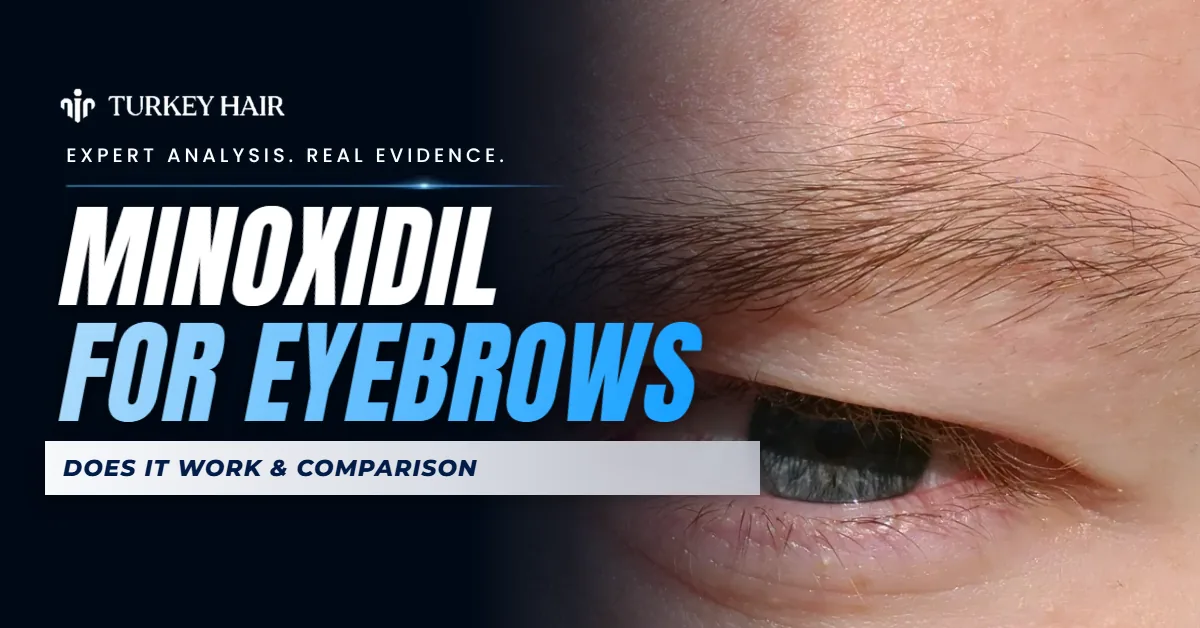
Cover built on a close view of one eyebrow and its fine hairs. Photo: PantheraLeo1359531, CC BY 4.0, via Wikimedia Commons, cropped, text and logo added.
So, do eyebrows grow back in every case? Not always. Scarring conditions, high-dose radiation and years of heavy plucking can destroy follicles, and then the hair does not return on its own. This guide sets out the expected time for each cause, the eyebrow growth cycle, what helps, and the signs that loss may be permanent.
Threading, waxing and tweezing all remove the hair with its root, yet the follicle that made it stays in the skin. That is why one session rarely causes lasting harm, and why the answer changes when the follicle itself is damaged by disease, scarring or repeated trauma.
How Long Does It Take for Eyebrows to Grow Back?
For most people, the first new hairs show within a few weeks, and a full brow takes about two to four months. A dermatologist quoted by Cleveland Clinic advises waiting at least two to three months before judging regrowth, and seeing a dermatologist if results are still poor after four months.
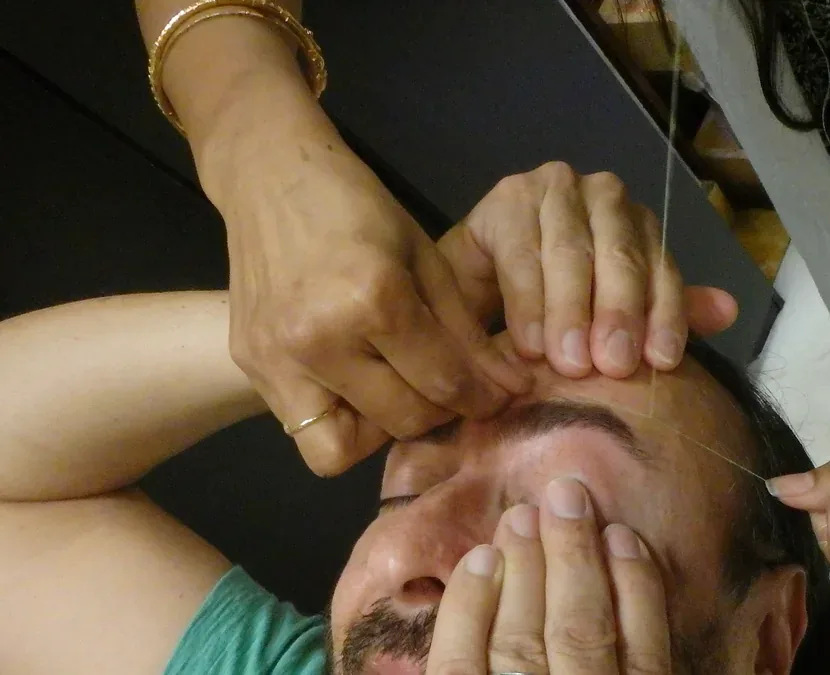
Eyebrow threading pulls hairs out at the root. Photo: osseous, CC BY 2.0, via Wikimedia Commons, cropped.
The table below brings the published timelines together. Where a source gives no time, the table says so rather than guessing.
Cause
When loss starts
Expected regrowth
Source
Threading or plucking
When loss starts
At once
Expected regrowth
Enough regrowth to thread again in 3 to 4 weeks; allow 2 to 3 months for a fuller brow
Source
Cleveland Clinic
Shaving
When loss starts
At once (hair cut at the skin)
Expected regrowth
The root is untouched; stubble lasts longer on brows than on the scalp
Source
Cleveland Clinic
Chemotherapy
When loss starts
About 2 to 3 weeks after the first cycle
Expected regrowth
Varies; most grows back, about 5% of patients report permanent loss
Source
ACS; Nguyen 2023
Radiation near the brow
When loss starts
1 to 3 weeks after the first treatment
Expected regrowth
More likely to be permanent; high doses can destroy follicles
Source
ACS; Nguyen 2023
Alopecia areata
When loss starts
Sudden patches, unpredictable
Expected regrowth
Often within a few months, sometimes white at first
Source
NIAMS
Underactive thyroid
When loss starts
Gradual, outer third of the brow
Expected regrowth
Response to treatment not well documented
Source
Nguyen 2023
Ageing
When loss starts
Gradual thinning and greying
Expected regrowth
No regrowth timeline reported
Source
Nguyen 2023
Hair pulling (trichotillomania)
When loss starts
Patchy, ongoing
Expected regrowth
Depends on stopping the pulling; long-term pulling can be permanent
Source
NHS; AAD
Scarring alopecia, including frontal fibrosing alopecia
When loss starts
Gradual, often starting at the tail
Expected regrowth
Destroyed follicles do not regrow
Source
Cheung 2026
Eyebrow transplant
When loss starts
Grafted hairs shed in the first weeks
Expected regrowth
New hairs from 3 to 4 months, density over the next 4 to 6 months
Source
Gupta 2017
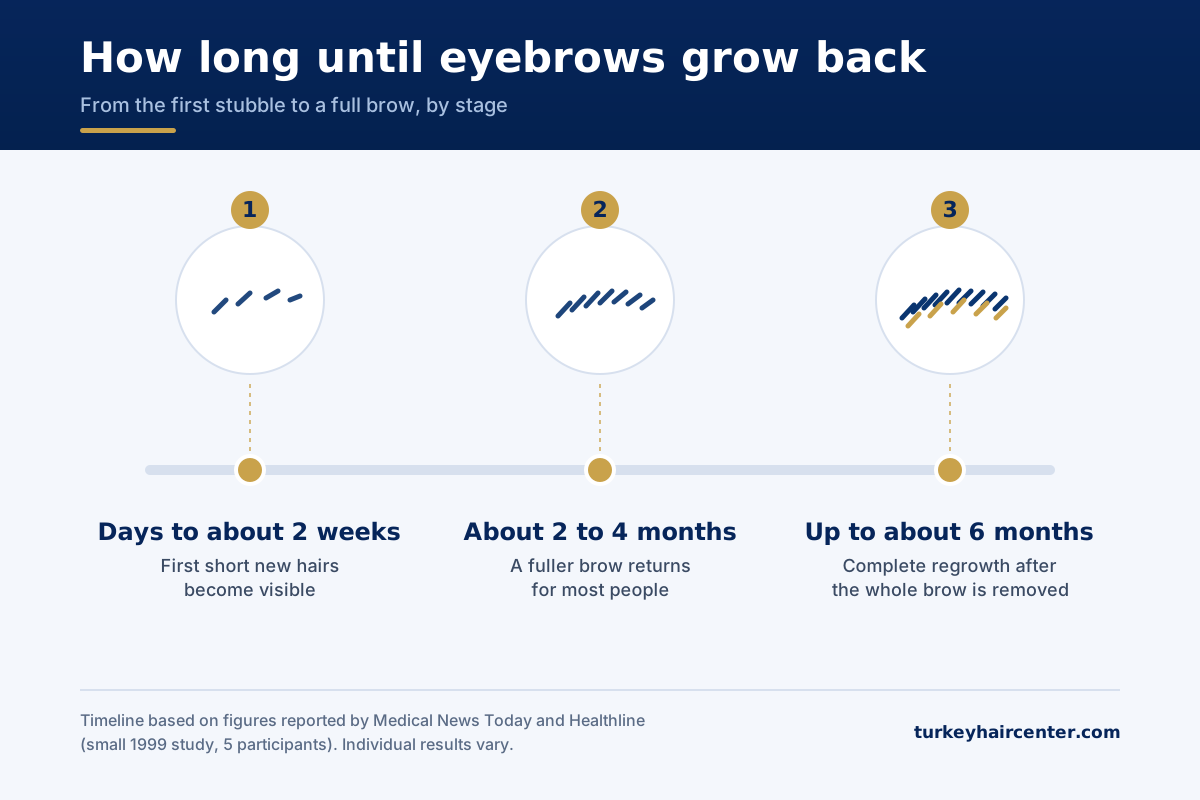
How long until a brow grows back fully? When the whole eyebrow is removed, for example by shaving it off, a small 1999 study reported by Medical News Today and Healthline found complete regrowth took up to about six months, with most of the hair back by around four months. The first short hairs are usually visible within days to a couple of weeks, but the exact pace varies quite a lot from one person to another.
How long eyebrows take to grow back, from first stubble to a full brow. Timeline based on figures reported by Medical News Today and Healthline (small 1999 study, 5 participants); individual results vary.
How Long for Eyebrows to Grow Back by Cause
The cause matters more than any product. Here is what the sources say about each one.
After Plucking, Waxing or Threading
"Most of the time, they grow back," says dermatologist Shilpi Khetarpal in a Cleveland Clinic article on overplucked brows. Another Cleveland Clinic dermatologist notes that most people return for threading every three to four weeks, which is enough time for hairs to regrow to a removable length.
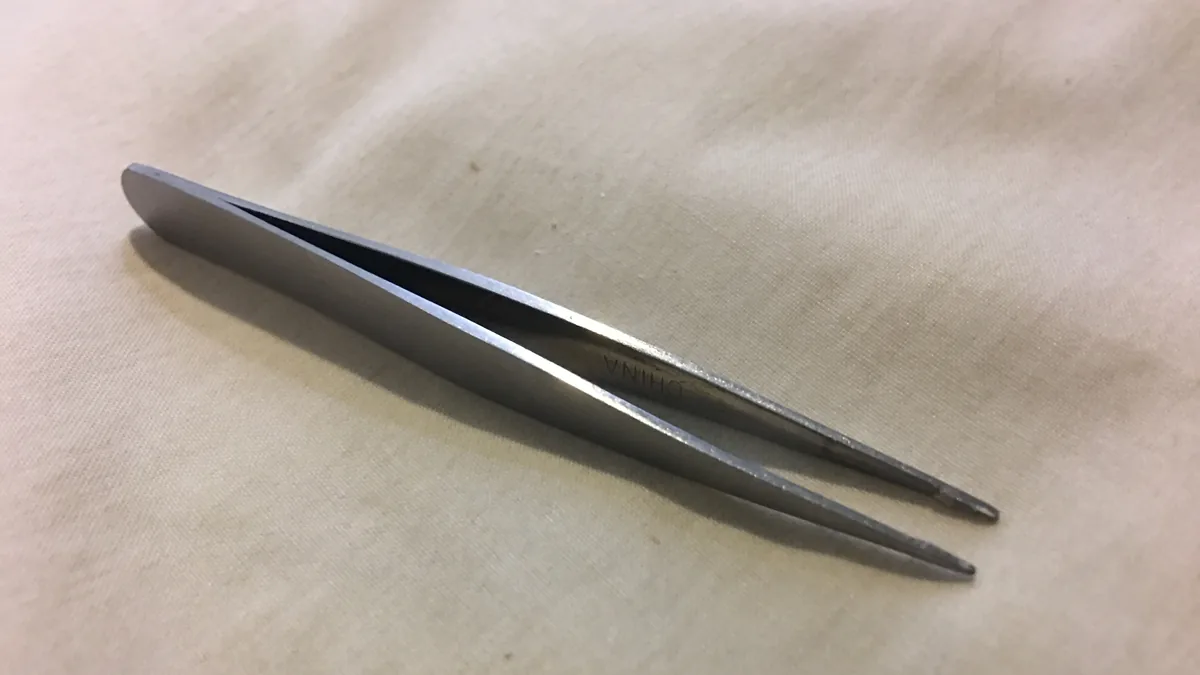
Slanted-tip tweezers, the tool most often used for plucking brows. Photo: Mrbeastmodeallday, CC BY-SA 4.0, via Wikimedia Commons, cropped.
The catch is repetition. Hairs can become less dense, thinner and slower to return after many threading sessions, and plucking every day can damage the skin, even causing scarring, after which the hairs may not grow back.
After Shaving
Shaving cuts the hair at the surface and does not touch the root, so shaved eyebrows grow back. They do not grow back thicker or darker: the blunt cut end only looks coarser. Cleveland Clinic notes that the stubble stage lasts longer on the eyebrows than on the scalp, because brow hair grows more slowly.
After Chemotherapy
The American Cancer Society says chemotherapy hair loss usually starts about 2 to 3 weeks after the first cycle and can include the eyebrows and eyelashes. A 2023 clinical review reports that in 68 patients treated with a combination of chemotherapy drugs, 56 (82.4%) lost eyebrow hair.
Most people regrow their brows after treatment ends, and younger patients may recover sooner. Breastcancer. New hair can also come back a different colour or texture at first; the American Cancer Society says a little over half of people who lose hair to cancer treatment report this, and the change is almost always temporary.
Permanent eyebrow loss has been reported in about 5% of patients, and the risk is higher with high-dose docetaxel or a taxane and anthracycline combination, so it is worth asking your oncology team about before treatment begins.
After Radiation Near the Brow
Radiation only causes hair loss in the area being treated. Loss usually starts 1 to 3 weeks after the first session, and the American Cancer Society notes it is more likely to be permanent than chemotherapy loss. At high doses, typically 50 to 60 Gy, eyebrow loss may be permanent because the follicle's stem cells or its base are damaged.
With Alopecia Areata
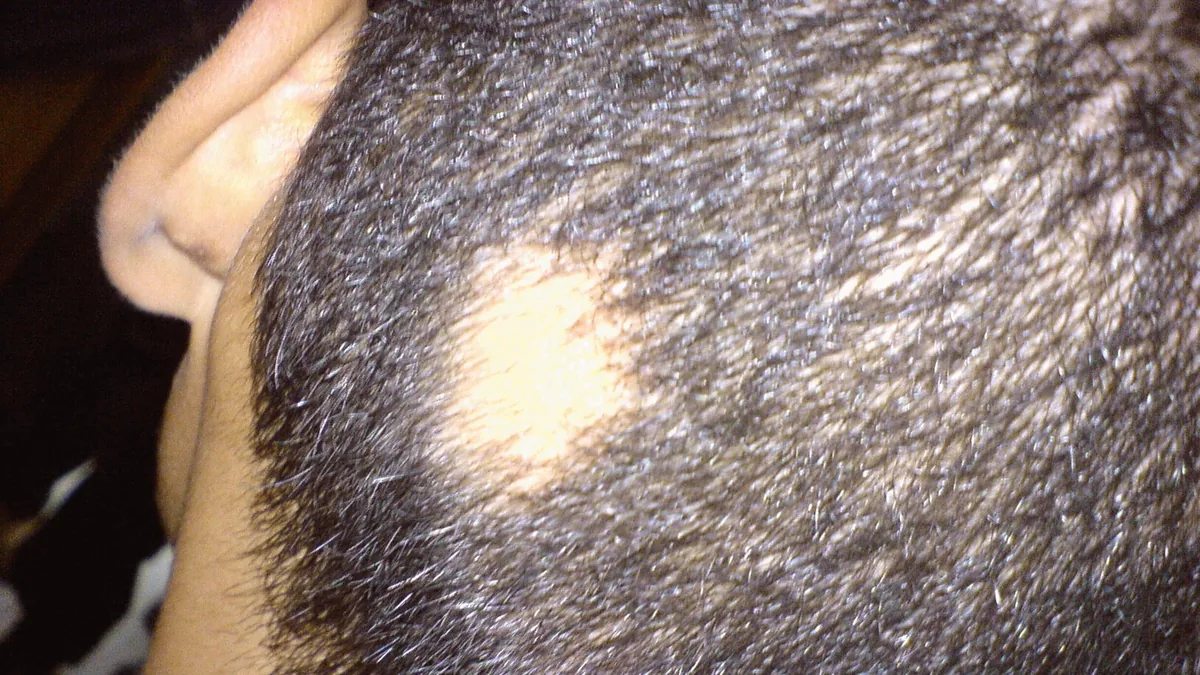
Alopecia areata is an autoimmune condition that can cause round patches of loss in the eyebrows, beard or scalp. The National Institute of Arthritis and Musculoskeletal and Skin Diseases says hair often regrows within a few months and may look white or grey at first before the natural colour returns. The course is unpredictable, and new patches can appear as others recover.
A round, smooth patch of alopecia areata on the scalp. Photo: Abbassyma at English Wikipedia, public domain, via Wikimedia Commons, cropped.
With an Underactive Thyroid
Loss of the outer third of the eyebrows, known as Hertoghe's sign, is a classic sign of hypothyroidism. The NHS lists dry hair and hair loss among the symptoms of an underactive thyroid. The 2023 review notes that how well eyebrows respond to thyroid treatment is not well documented, although one small study of 9 patients found the hair cycle balance returned to normal with treatment. The same sign appears in up to 39% of people with atopic dermatitis, so thin brow tails do not prove a thyroid problem.
With Age
Eyebrows can thin and turn white with age. In other people, mainly men, ageing brings thicker brows instead. The 2023 review notes that the reasons for these changes are unclear, and we found no published regrowth time for age-related thinning.
A quick word on waxing, named in the heading above. Waxing pulls several hairs out by the root at once, yet the follicle stays in the skin, so brows regrow much as they do after threading, often enough to wax again within a few weeks. The difference is frequency: Medical News Today notes that waxing or plucking the brows very often can damage the follicles over time, so regrowth may come back slower, thinner or patchy.
The Eyebrow Growth Cycle
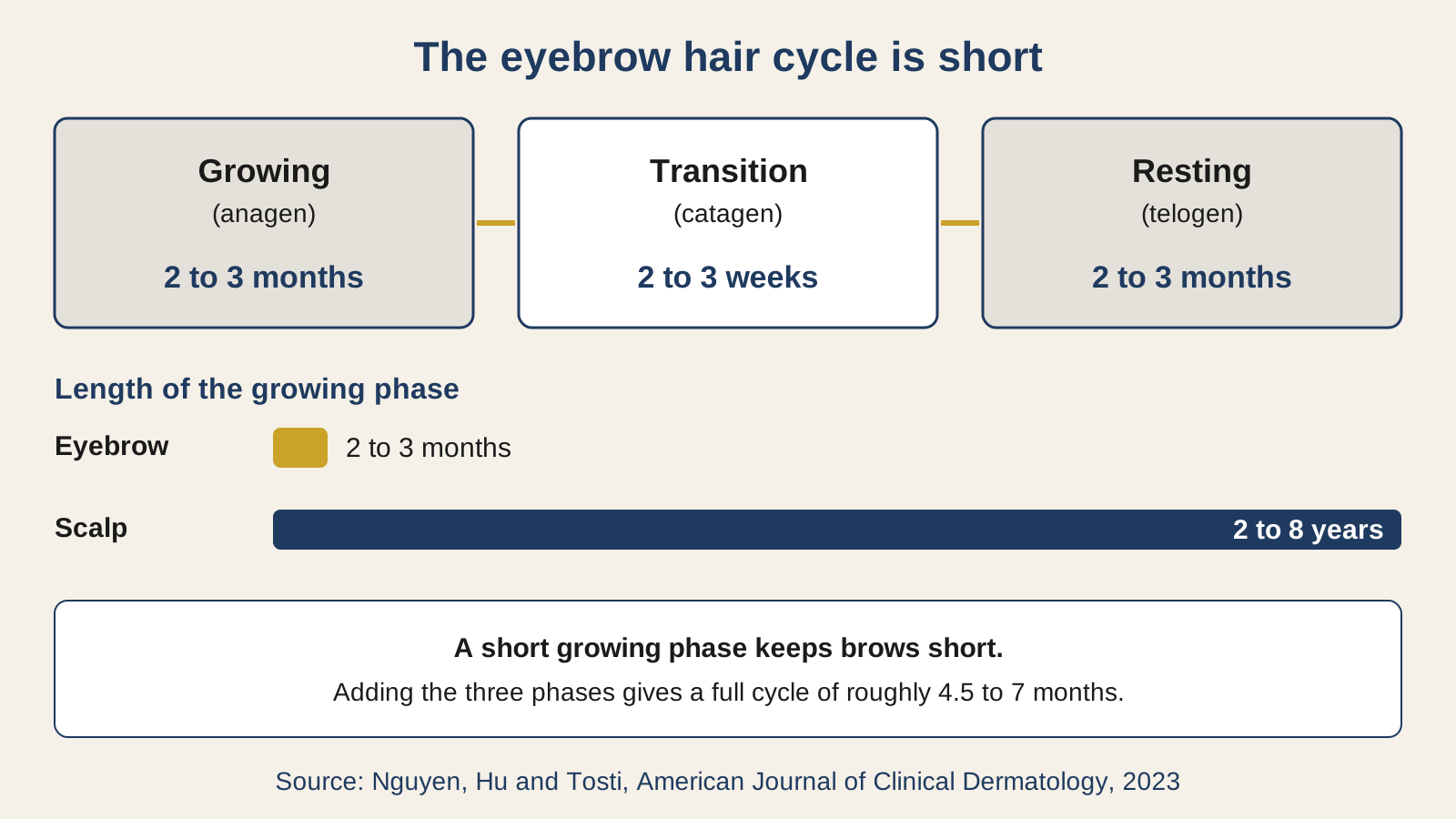
Every eyebrow hair goes through three phases: growing (anagen), transition (catagen) and resting (telogen). A 2023 review in the American Journal of Clinical Dermatology gives these lengths for the eyebrows:
Growing phase: 2 to 3 months.
Transition phase: 2 to 3 weeks.
Resting phase: 2 to 3 months.
Scalp growing phase, for comparison: 2 to 8 years.
Added together, those ranges give a full cycle of roughly 4.5 to 7 months. That total is our own sum of the published phases; the dermatologist quoted by Cleveland Clinic puts the cycle at three to four months. Either way, a new brow hair needs months, not days, to reach full length. For comparison with scalp hair, see our guide on how fast hair grows.
Why Do Eyebrows Grow Back So Slowly?
Eyebrows are short because their growing phase is short. A scalp hair can keep growing for years; an eyebrow hair stops after a few months, rests, and then sheds. That short growing window is what keeps brows at their natural length without trimming.
It also explains the wait. A follicle that has just lost its hair may be in its resting phase, and it will only start a new hair when the next growing phase begins. Because each follicle runs on its own clock, a gap fills in hair by hair rather than all at once.
Several things can slow the process further:
Repeated plucking or threading of the same area, which makes regrowth thinner and slower.
Iron, vitamin D or zinc deficiency; Cleveland Clinic lists these among factors that can slow or stop hair growth.
Thyroid problems, which affect hair across the body.
Ongoing triggers, such as rubbing, picking or a skin condition on the brow.
What Helps Eyebrows Grow Back
The most useful step is to stop whatever caused the loss, then give the follicles at least one full cycle. Practical steps from the sources:
Stop plucking the gap. Put the tweezers and magnifying mirror away, and leave stray hairs in place for at least two to three months.
Treat the cause. Loss linked to a medical condition usually grows back once you recover, according to the NHS, so getting the condition treated comes first.
Eat well and check for deficiencies. Ask your doctor about blood tests before buying supplements; our guide to the best vitamins for hair loss covers which nutrients have evidence.
Ask a doctor about medicines. A 16-week randomized trial in 39 people found more eyebrow hairs with a minoxidil lotion than with an inactive lotion. Our guide to minoxidil for eyebrows explains the evidence and the side effects.
Use make-up or semi-permanent cover while you wait. Brow pencils, powders and micropigmentation can fill the shape; the 2023 review notes that microblading usually lasts 12 to 18 months.
For pulling that feels hard to stop, the NHS recommends a form of cognitive behavioural therapy called habit reversal training. No drug is approved for trichotillomania, and psychotherapy remains the main treatment.
Why Eyebrows Sometimes Don't Grow Back
Eyebrows fail to return when the follicles are destroyed or scarred. A primary care review from 2026 explains that scarring (cicatricial) alopecia can cause permanent destruction of the follicles, resulting in irreversible hair loss, and that it should always be referred to a dermatologist.
Follicle Damage From Disease
Frontal fibrosing alopecia (FFA) is a scarring condition that involves the eyebrows in up to 96% of patients, usually starting at the outer ends. In 43.7% of cases, brow loss starts before any scalp loss, so thinning brow tails can be the first clue. The 2023 review advises starting treatment as early as possible, because people with complete eyebrow loss respond less well, or not at all.
Other conditions can scar the area too. In discoid lupus, an autoimmune skin disease that can affect the eyelids, the same review notes that early diagnosis and treatment are important to prevent scarring and permanent lash loss.
Overplucking and Pulling
The American Academy of Dermatology warns that, in time, anything that pulls on your hair can cause permanent hair loss. Trichotillomania, the urge to pull out hair, usually starts between the ages of 10 and 13 and often affects the eyebrows and eyelashes. Its patches typically contain hairs broken at different lengths.
Scars, Burns and High-Dose Radiation
An injury, burn or surgical scar through the brow leaves skin without follicles, and high-dose radiation can destroy the follicle stem cells. In these areas, hair cannot return on its own, and medical treatment to regrow it has little to work with.
Signs Your Eyebrows Will Not Grow Back
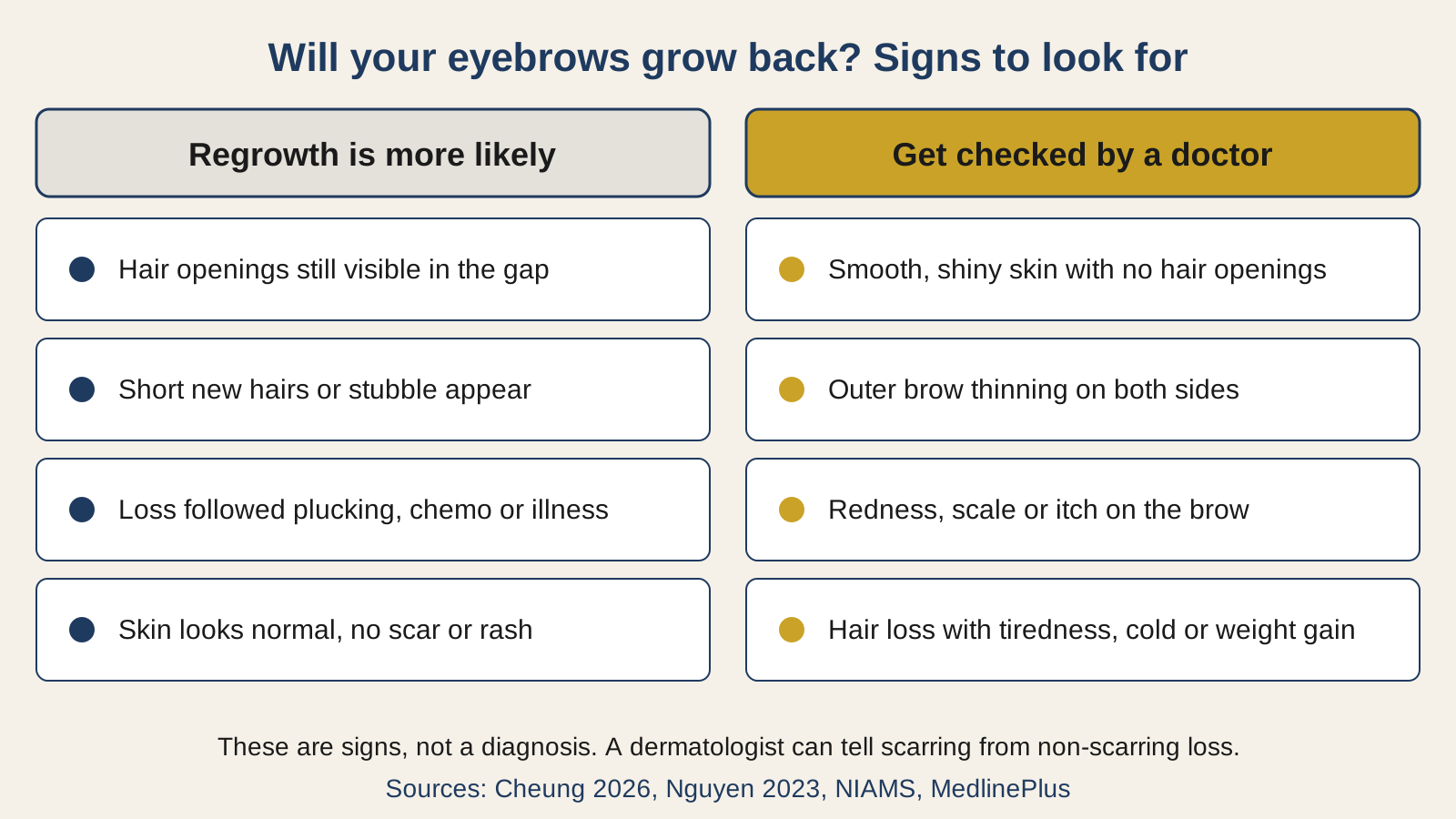
Only a doctor can tell scarring from non-scarring loss, and when hair openings are missing, a small skin biopsy may be needed. Still, some signs make permanent loss more or less likely.
Signs that regrowth is more likely:
Tiny hair openings (pores) are still visible in the gap.
Short new hairs or stubble appear within a few weeks.
The loss followed plucking, chemotherapy or an illness you have recovered from.
The skin looks normal, without redness, scale or a scar.
Signs that need a medical check:
The skin in the gap is smooth and shiny, with no visible hair openings. The 2026 review notes that missing follicle openings point to scarring alopecia.
Both outer ends of the brows are thinning.
The brow is red, scaly or itchy.
Brow loss comes with weight gain, tiredness or feeling cold.
When to See a Doctor
MedlinePlus advises seeing a provider for bald spots on your eyebrows, and for hair loss that comes with weight gain or muscle weakness, intolerance to cold or fatigue. Book an appointment if:
Your brows have not started to fill in after four months.
Patches appear suddenly, or spread.
The skin under the brow is red, scaly, painful or scarred.
You also notice hair loss on the scalp, beard or eyelashes.
You find it hard to stop pulling or plucking.
A dermatologist can examine the skin and follicles and arrange blood tests for thyroid function and iron. Our guide to the reasons for hair loss covers the wider list of causes.
This guide gives general information and does not diagnose eyebrow loss. If you are having cancer treatment, ask your oncology team before using any product on your brows. Sudden patches, a red or scaly brow, or loss with tiredness and weight gain should be checked by a doctor.
Eyebrows After a Transplant
When follicles are gone for good, an eyebrow transplant moves living follicles from the back of the scalp, the area in front of the ears or the nape of the neck into the brow. A review of the technique lists trichotillomania, scars and burns, stable alopecia areata and thyroid-related loss among the reasons people choose it.
Transplanted eyebrows follow their own timeline. Almost all of the grafted hairs fall out at first, new hairs start to appear at 3 to 4 months, and density builds over the following 4 to 6 months. Any touch-up is usually left until at least 9 months. Our hair transplant recovery timeline explains the same stages on the scalp.
Because the hairs come from the scalp, they keep growing like scalp hair and need regular trimming. Between 10% and 15% of hairs may grow in an unwanted direction. Results also depend on the cause: scar tissue can reduce how many grafts take, and in one cohort of 10 patients with FFA, 8 had good early growth, yet the transplanted hairs were lost after 3 to 4 years in all but one patient, so the condition should be stable first.
Frequently Asked Questions
How Long Does It Take for Eyebrows to Grow Back After Plucking?
Hairs usually start to show within a few weeks, and enough grow back to be threaded again in about 3 to 4 weeks. Allow at least two to three months for a gap to fill, and see a dermatologist if nothing has changed after four months.
Do Eyebrows Grow Back After Chemo?
Usually, yes. Most people regrow their brows after treatment ends, sometimes in a different colour or texture. Permanent loss has been reported in about 5% of patients, more often with high-dose docetaxel or taxane and anthracycline combinations.
Do Eyebrows Grow Back Thicker After Shaving?
No. Shaving cuts the hair at the surface and does not change the follicle. Regrowth can look darker because you see the blunt base of the hair rather than its fine tip.
Can Overplucked Eyebrows Grow Back?
In most cases they can, once you stop plucking and give them time. If you plucked the same area for years, some follicles may be damaged, and those hairs may not return.
Do Eyebrows Grow Back After Alopecia Areata?
They often do, within a few months, but the course is unpredictable. New hairs may be white or grey at first before regaining their colour.
Why Are the Ends of My Eyebrows Thinning?
Thinning of the outer third can be linked to an underactive thyroid, atopic dermatitis or frontal fibrosing alopecia. Since these need different treatment, a doctor should check it.
Do Eyebrows Stop Growing With Age?
They often thin and turn white over time. Some people, mainly men, find their brows get thicker with age instead.
Do Eyebrows Grow Back After Radiation?
Sometimes. Radiation loss is more likely to be permanent than chemotherapy loss, and at high doses the follicles can be destroyed.
Do Transplanted Eyebrows Need Trimming?
Yes. They come from the scalp, so they keep growing longer than natural brow hairs and need regular trimming and shaping.
How Many Days Until Eyebrows Grow Back After Shaving?
Because shaving only cuts the hair at the surface and leaves the root untouched, short stubble reappears within a few days. A genuinely full brow takes much longer: a small study reported by Medical News Today found complete regrowth after shaving can take up to about six months, and the pace varies from person to person.
Are Your Brows Still Thin?
If your eyebrows have not filled in after several months, or the skin looks smooth where hair used to be, the pattern of loss is the best guide to what comes next. Send clear photos for a free hair analysis, and the medical team will tell you whether an eyebrow transplant could be an option.
Sources and medical review
Nguyen B, Hu JK, Tosti A. Eyebrow and eyelash alopecia: a clinical review. American Journal of Clinical Dermatology, 2023;24(1):55-67
Talk to our hair team on a free video call, in your language. You receive a written plan with your technique, estimated grafts and all-inclusive price. If a hair transplant isn't right for you, we tell you honestly.
Your information is 100% confidential.
Real People Real Support
Send your photos on WhatsApp
Front, top and both sides, reviewed by the medical team.