Trichotillomania: Hair Pulling, Treatment and Regrowth
Why the urge to pull is hard to resist, how trichotillomania is told apart from other patchy hair loss, which treatments have evidence, and when hair grows back or a transplant fits.
13sources
13in PubMed
12min read
Written by Nazmi Güldeş, Certified Trichologist · Medically reviewed by Dr. Teuku Adifitrian, Sp.BP-RE (Dr. Tompi), Plastic, Reconstructive and Aesthetic Surgeon · Last reviewed 31 October 2026
Reading level
Trichotillomania, also called hair-pulling disorder, means you keep feeling an urge to pull out your own hair and find it very hard to stop. It is a recognised disorder, not a lack of willpower.
The hair loss it causes is usually not permanent, but regrowth depends on the pulling stopping first. This page explains why the urge is so strong, how a doctor tells it apart from other patchy hair loss, which treatments have real evidence and when hair grows back.
1Quick answerThe short answer, in a few sentences
What Is Trichotillomania?
Trichotillomania is a mental health condition in which you repeatedly pull out hair from the scalp, eyebrows, eyelashes or any other part of the body, causing hair loss. It is classed as an obsessive-compulsive related disorder and affects about 1 in 100 people.[1] Behavioural therapy built on habit reversal training has the strongest evidence of any treatment.
The visible problem is hair loss, but the cause is the pulling, so good care brings skin and mental health specialists together.
2Complete guideFrom the first pull to treatment and regrowth
Signs, Causes and Who Gets Trichotillomania
Where People Pull: Scalp, Eyebrows, Eyelashes and Beard
The scalp, eyelashes and eyebrows are the usual sites, but any body hair can be pulled. What you might notice in each area:
Scalp: odd-shaped patches with short hairs broken at different lengths
Eyelashes: gaps, mostly among the longer lashes of the upper lid
Eyebrows: irregular gaps with hairs of uneven length
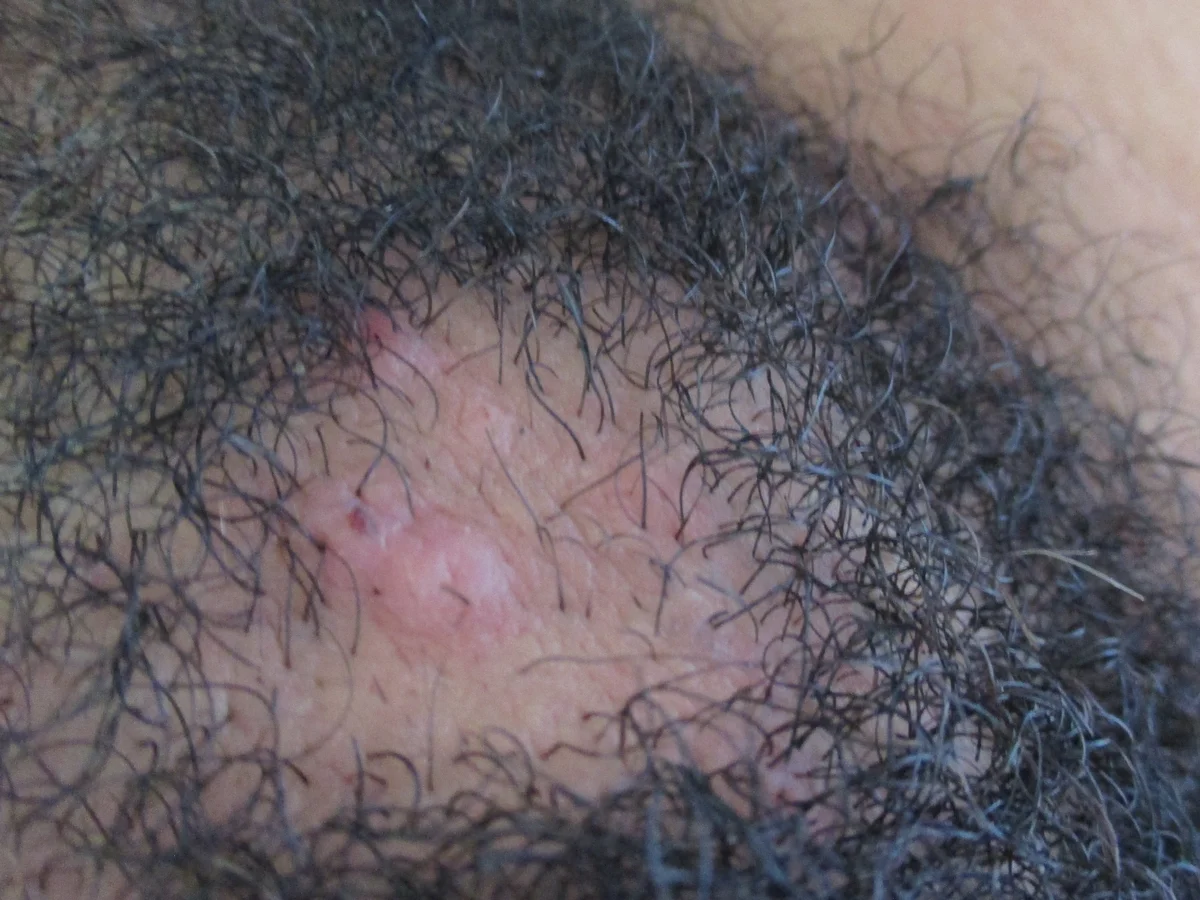
Beard, face and body: patches in any hair your fingers can reach
Researchers describe two styles. Focused pulling is the kind you are aware of and do on purpose. Automatic pulling is the kind you barely notice while it happens.
The difference shows up in treatment. Among 40 young people, habit reversal training clearly improved focused pulling (effect size 0.73) but barely changed automatic pulling (0.10), so the authors call for strategies that build awareness of pulling.[2]
You may recognise yourself in both columns. The table is our summary of what each style means in practice:
Automatic pulling
Focused pulling
How it feels
Automatic pulling
You notice the hair in your hand afterwards
Focused pulling
You feel the urge build and then act on it
How it responded to HRT in the trial
Automatic pulling
Barely changed
Focused pulling
Improved clearly
What to work on first
Automatic pulling
Noticing it: track when it happens, and try barriers such as gloves or plasters on your fingertips
Focused pulling
The urge itself, the part of pulling HRT helped most
Why Does Pulling Feel Good?
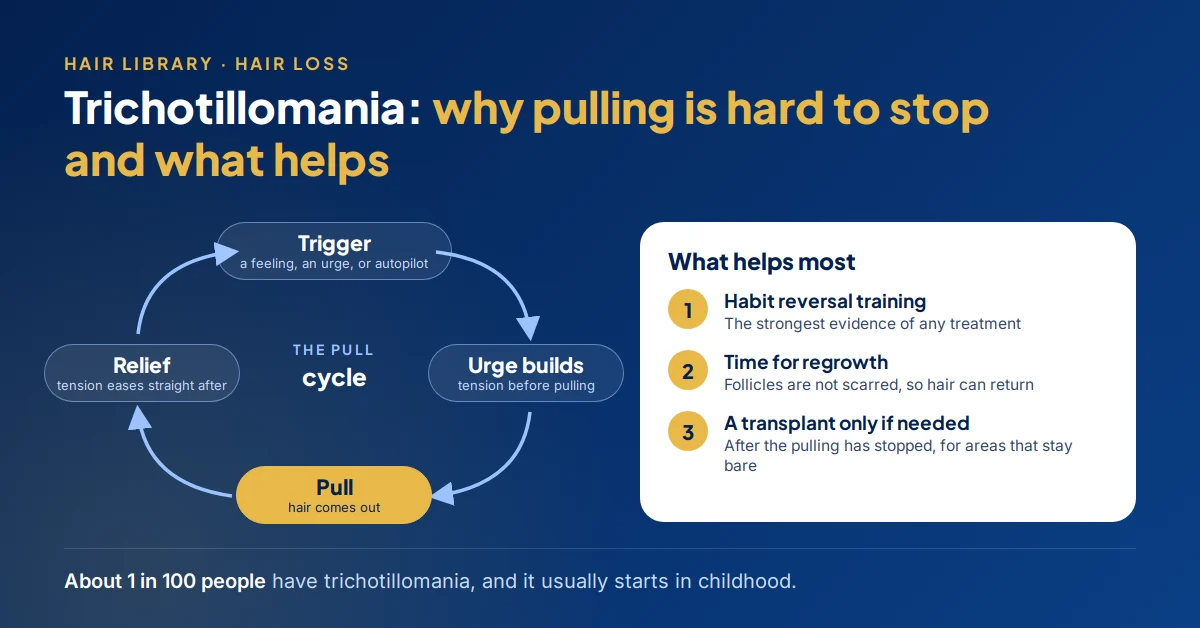
Pulling often brings an instant release of tension and a sense of relief.[3] The urge builds, pulling eases it, and the pulling comes back again and again.
Failing to resist that urge is what defines the disorder[4], so it isn't a matter of trying harder. Treatment works on the urge instead, starting with habit reversal training, covered below.
Is Trichotillomania OCD?
It belongs to the same family but isn't the same thing. Trichotillomania is classed as an obsessive-compulsive or related disorder,[5] and it also counts as a body-focused repetitive behaviour, like skin picking.
Other conditions often come along with it. In one survey of people who pulled hair, picked skin or both, 63% to 82% reported anxiety, 16% to 29% OCD and 12% to 32% ADHD.[6] A good assessment therefore looks at your mood and anxiety, not only your hair.
What Causes Trichotillomania? Genes and Stress
Genes play an important part, and some may be shared with OCD and related conditions. Yet a review of 109 studies found no known high-confidence risk gene.[7]
Stress is harder to pin down. Pulling eases tension, and anxiety often comes with the condition, but neither shows that stress causes it.
When Does It Start? Children and Adults
It usually starts in childhood or the teenage years.[4]
Children. Watch for missing lashes or brows, or a patch with hairs broken at different lengths. Punishing a child for pulling doesn't help, while calm support from the family is an important part of treatment.[5]
Women and men. Most people seen in clinics are women, but population studies found no clear excess of women with trichotillomania itself.[1]
Diagnosis and Treatment of Trichotillomania
Trichotillomania vs Alopecia Areata and Other Patchy Hair Loss
The typical picture is odd-shaped, non-scarring patches with short hairs, and a pull test that comes back negative.[5] A dermatoscope, a lens that magnifies the scalp, adds detail: in one comparison with alopecia areata, every patient with trichotillomania had hairs broken at different lengths.[8]
The table is our summary; the clues in the first two rows come from that comparison.
Condition
What drives it
What the doctor looks for
Trichotillomania
What drives it
Pulling out your own hair
What the doctor looks for
Hairs broken at different lengths, split ends, flame hairs, a V-sign
Alopecia areata
What drives it
An autoimmune process
What the doctor looks for
Exclamation mark hairs, tapered hairs, yellow dots
Tinea capitis
What drives it
A fungal infection of the scalp
What the doctor looks for
Signs of fungus under magnification, sometimes confirmed by a culture
A biopsy is sometimes needed, for instance when it is hard for a patient or parent to accept that the loss is self-inflicted. Our alopecia areata entry explains the autoimmune patches in detail. For loss caused by hairstyles, read our traction alopecia entry.
Habit Reversal Training and Other Therapy
Habit reversal training (HRT) is a set of cognitive-behavioural techniques for reducing hair pulling.[4] Across 24 trials with 857 people, behavioural therapy with HRT had the largest effects and the strongest evidence of any treatment.[9]
Support from the people around you is a key part of making HRT work. Finding a therapist who knows the method can be the hard part, so ask specifically for habit reversal training or behavioural therapy for hair pulling.
Who does what, in our summary:
Who
What they do for you
Dermatologist
What they do for you
Confirms the diagnosis and rules out alopecia areata or a fungal infection
Therapist trained in HRT
What they do for you
Delivers the treatment with the strongest evidence
Psychiatrist or family doctor
What they do for you
Considers medicine and checks for anxiety, low mood or other conditions
Hair transplant surgeon
What they do for you
Only once psychological treatment has stabilised the pulling
Medication: N-Acetylcysteine and Other Drugs
No medicine is FDA-approved for trichotillomania. N-acetylcysteine (NAC), a glutamate-modulating agent, is the one a 2022 review calls a good first-line option, because of its benefits and low risk of side effects.[5]
The trial results are mixed, and each comes from a single small study:
NAC in adults: 56% improved, against 16% on placebo
NAC in children and teenagers: no better than placebo (25% against 21.1%)
Olanzapine: 85% responded, against 17% on placebo
Clomipramine: 40% against 0%, with more people stopping because of side effects
Clinical detail: how firm is the drug evidence?
Not firm. A Cochrane review found too little evidence to confirm or refute any medicine, and it had no usable response data for SSRIs.[10]
Relapse and the Long-Term Outlook
Treatment works, but relapse in adults appears to be fairly common.[4] Children tend to do better: one review describes childhood pulling more often as a habit with a better outlook, while in adults the problem usually runs deeper.[3]
Our view: treat a relapse as a signal to go back to the tools that worked, not as proof that treatment failed. If pulling returns, a few refresher sessions with your therapist are worth asking about.
Four beliefs get in the way of getting better:
"It's just a bad habit, so stop if you really want to." Failing to resist the urge is the condition itself.
"Punishment will stop a child pulling." It won't; calm support works better.
"Pulled hair never grows back." The loss is usually non-scarring.
"A transplant will fix it." Not while you are still pulling.
Will Hair Grow Back After Trichotillomania?
Usually, yes. Trichotillomania causes non-scarring hair loss, so the follicles stay in place and can grow new hair once the pulling stops.
Regrowth only shows if the pulling stops for long enough. That is why treating the pulling is also the best treatment for the hair.
How Long Does Hair Take to Grow Back?
Each area runs on its own hair cycle, and the growth phaseGlossaryAnagen is the growing phase of the hair cycle. For scalp hair it lasts 2 to 6 years according to a Deutsches Ärzteblatt review, and 2 to 7 years according to Cleveland Clinic. Open in the glossary → sets how long a hair can keep growing.[11] The right-hand column is our reading.
Area
Hair cycle
What it means for you
Scalp
Hair cycle
A growth phase of 2 to 8 years
What it means for you
Patches fill in gradually; regaining full length takes much longer
Eyebrows
Hair cycle
2 to 3 months of growth, then 2 to 3 months of rest
What it means for you
Brows refill on a short cycle, though we found no study that timed regrowth after pulling
Eyelashes
Hair cycle
A full cycle of 4 to 11 months
What it means for you
Lashes are slow to return, so give them most of a year
Our guide to how fast hair grows covers scalp growth rates. We found no minoxidil trial after pulling, so the data in our minoxidil entry come from other types of hair loss.
Can Trichotillomania Cause Permanent Hair Loss?
Usually not, because the loss it causes is non-scarring.
If a patch has stayed bare for years even though you've stopped pulling, ask a dermatologist to examine it closely. Our page on whether eyebrows grow back covers signs of lasting brow loss.
Trichophagia and Hairballs
Some people swallow the hair they pull, which is called trichophagia. In a few cases the hair collects into a ball in the stomach, a trichobezoar, that can block the gut and needs surgery.[3]
If you or your child pulls hair and also has stomach or bowel symptoms, tell the doctor about the pulling. It is an easy clue to miss.
Hair Transplant and Trichotillomania
A transplant is not a treatment for trichotillomania. It moves follicles from the donor areaGlossaryThe donor area is the back and sides of the head, where follicles resist DHT. An extracted follicle does not grow back in that spot, so extractions are spread out, and the donor supply is the limit of every plan. Open in the glossary →, and surgeons list trichotillomania among the conditions that make a person an unsuitable candidate. It isn't an absolute bar, but surgery should wait until psychological treatment has stabilised the pulling.[12]
We found no published series of scalp transplants in people with trichotillomania, so there are no outcome figures to quote.
Clinical detail: what a surgeon should check
Asking about hair pulling and examining the bald area for broken hairs should be routine. Some patients deny pulling, and trichotillomania can mimic pattern hair loss or sit on top of it.
It is classed as an obsessive-compulsive related disorder, a relative of OCD rather than OCD itself. In one sample of 50 adults with trichotillomania, nobody had OCD.
Can trichotillomania be cured?
There is no guaranteed cure, but treatment can bring large improvements. Behavioural therapy with habit reversal training has the biggest effects, though relapse in adults appears to be fairly common.
Does hair grow back after trichotillomania?
Usually, because the follicles are not scarred. Scalp patches fill in gradually, while eyelashes can take most of a year.
Is trichotillomania linked to ADHD or autism?
Both are reported alongside it. ADHD was reported by 12% to 32% of people in one survey, and a study of 50 adults found raised rates of probable autism on a screening test.[13]
When does trichotillomania usually start?
Usually in childhood or the teenage years.
Can a hair transplant fix hair loss from trichotillomania?
Only after psychological treatment has brought the pulling under control. Surgeons advise deferring surgery until then.
Is a Hair Transplant Right for You After Trichotillomania?
A transplant is the wrong next step if you are still pulling, or stopped only recently. Treatment for the pulling comes first, and patches that have not scarred can regrow on their own.
A transplant may be considered if treatment has stabilised the pulling, a patch has stayed bare and a doctor confirms the hair loss is inactive.
We do not treat the pulling itself. To find out whether a patch looks recoverable or suits a transplant, send us photos for a free hair analysis, or message us on WhatsApp.
About the Author
Written by: Nazmi Güldeş, Certified Trichologist. Nazmi Güldeş focuses on patient education around androgenetic alopecia, evaluating miniaturization through dermoscopy, and assessing candidates for medical treatments and hair transplants.
Editorial Policy & Trust
This entry was medically reviewed by Dr. Teuku Adifitrian, Sp.BP-RE (Dr. Tompi) on 31 October 2026. Every study cited here was checked against PubMed on 31 October 2026. Key figures are marked with their source, and every source is listed at the end of this entry. Read how we work in our editorial policy.
3 questions
Test yourself
Check what you remember from this entry. Each answer links back to the section that explains it.
Which pulling style improved most with habit reversal training in a trial of young people?
Focused pulling improved clearly (effect size 0.73), while automatic pulling barely changed (0.10). Read the section
What did N-acetylcysteine do in the trial of children and teenagers?
25% responded on NAC against 21.1% on placebo, unlike the positive trial in adults. Read the section
When do surgical reviews say a transplant can be considered after trichotillomania?
Surgery should be deferred until psychological treatment has stabilised the pulling. Read the section
3Scientific evidenceStudy types, references and how to cite this entry
13sources
Evidence behind this entry: 13 publications indexed in PubMed (2006 to 2025): 5 reviews, 4 systematic reviews, 3 clinical studies and 1 randomized trial. 7 sources have free full text.
Randomized trialpeople assigned to treatments by chance
Reviewsummarises many studies
Clinical studya study in people without random groups
Thomson HA, Farhat LC, Olfson E, et al. Prevalence and gender distribution of trichotillomania: A systematic review and meta-analysis. Journal of Psychiatric Research. 2022;153:73-81.Systematic reviewPubMedDOI
McGuire JF, Myers NS, Lewin AB, et al. The Influence of Hair Pulling Styles in the Treatment of Trichotillomania. Behavior Therapy. 2020;51(6):895-904.Randomized trialPubMedDOI
Sehgal VN, Srivastava G. Trichotillomania +/- trichobezoar: revisited. Journal of the European Academy of Dermatology and Venereology. 2006;20(8):911-915.ReviewPubMedDOI
DuBois MC, Feler BM, Flessner CA, et al. Trichotillomania and its treatment: an updated review and recommendations. Expert Review of Neurotherapeutics. 2025;25(11):1335-1345.ReviewPubMedDOI
Melo DF, Lima CDS, Piraccini BM, et al. Trichotillomania: What Do We Know So Far?. Skin Appendage Disorders. 2022;8(1):1-7.ReviewPubMedDOIFree full text
Lin A, Farhat LC, Flores JM, et al. Characteristics of trichotillomania and excoriation disorder across the lifespan. Psychiatry Research. 2023;322:115120.Clinical studyPubMedDOIFree full text
Reid M, Lin A, Farhat LC, et al. The genetics of trichotillomania and excoriation disorder: A systematic review. Comprehensive Psychiatry. 2024;133:152506.Systematic reviewPubMedDOIFree full text
Khunkhet S, Vachiramon V, Suchonwanit P. Trichoscopic clues for diagnosis of alopecia areata and trichotillomania in Asians. International Journal of Dermatology. 2017;56(2):161-165.Clinical studyPubMedDOI
Farhat LC, Olfson E, Nasir M, et al. Pharmacological and behavioral treatment for trichotillomania: An updated systematic review with meta-analysis. Depression and Anxiety. 2020;37(8):715-727.Systematic reviewPubMedDOI
Hoffman J, Williams T, Rothbart R, et al. Pharmacotherapy for trichotillomania. The Cochrane Database of Systematic Reviews. 2021;9(9):CD007662.Systematic reviewPubMedDOIFree full text
Nguyen B, Hu JK, Tosti A. Eyebrow and Eyelash Alopecia: A Clinical Review. American Journal of Clinical Dermatology. 2023;24(1):55-67.ReviewPubMedDOIFree full text
True RH. Is Every Patient of Hair Loss a Candidate for Hair Transplant?-Deciding Surgical Candidacy in Pattern Hair Loss. Indian Journal of Plastic Surgery. 2021;54(4):435-440.ReviewPubMedDOIFree full text
Grant JE, Chamberlain SR. Autistic traits in trichotillomania. Brain and Behavior. 2022;12(7):e2663.Clinical studyPubMedDOIFree full text
Güldeş, N. (2026, October 31). Trichotillomania: Hair pulling, treatment and regrowth. Turkey Hair Center Hair Library. https://turkeyhaircenter.com/trichotillomania/
@misc{guldes2026trichotillomania,
  author       = {Güldeş, Nazmi},
  title        = {Trichotillomania: Hair pulling, treatment and regrowth},
  howpublished = {Turkey Hair Center Hair Library},
  year         = {2026},
  month        = oct,
  url          = {https://turkeyhaircenter.com/trichotillomania/},
  note         = {Last updated 31 October 2026}
}
TY  - ELEC
AU  - Güldeş, Nazmi
TI  - Trichotillomania: Hair pulling, treatment and regrowth
T2  - Turkey Hair Center Hair Library
PY  - 2026
DA  - 2026/10/31
UR  - https://turkeyhaircenter.com/trichotillomania/
N1  - Last updated 31 October 2026
ER  -
Talk to our hair team on a free video call, in your language. You receive a written plan with your technique, estimated grafts and all-inclusive price. If a hair transplant isn't right for you, we tell you honestly.
Your information is 100% confidential.
Real People Real Support
Send your photos on WhatsApp
Front, top and both sides, reviewed by the medical team.