Alopecia Areata: Causes, Types, Treatment and Regrowth
How alopecia areata starts, which types exist, how the SALT score grades it, what steroids and JAK inhibitors can do, and why a hair transplant is rarely the answer.
13sources
10in PubMed
13min read
Written by Nazmi Güldeş, Certified Trichologist · Medically reviewed by Dr. Teuku Adifitrian, Sp.BP-RE (Dr. Tompi), Plastic, Reconstructive and Aesthetic Surgeon · Last reviewed 31 October 2026
Reading level
Alopecia areata is an autoimmune condition in which your immune system turns on your own hair follicles, usually leaving smooth, round bald patches that appear suddenly. The follicles aren't scarred, so the hair can grow back, and in many people it does.
Nobody can promise when it will return or whether new patches will follow, so this page focuses on what you can expect from each treatment and why a hair transplant is rarely the answer.
1Quick answerThe short answer, in a few sentences
What Is Alopecia Areata?
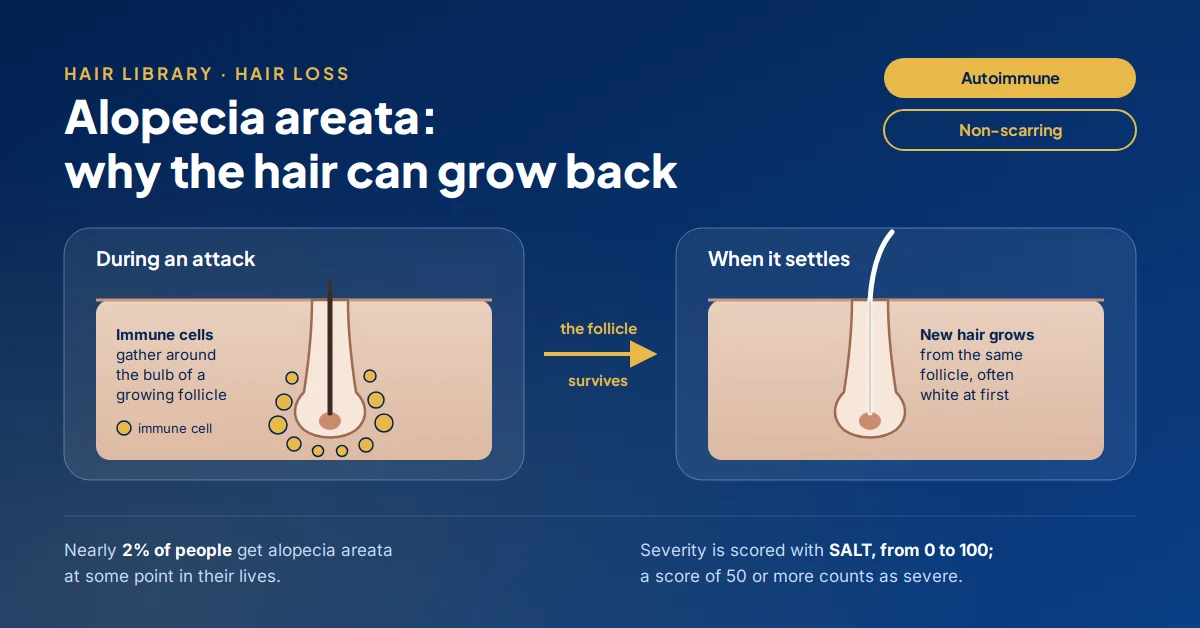
Alopecia areata (AA) is an autoimmune disease in which immune cells gather around the roots of growing hair follicles, causing sudden, non-scarring hair loss, most often in round patches on the scalp. Nearly 2% of people get it at some point in their lives.[1] Because the follicle survives, hair can regrow, though relapses are common.
Regrowth is not the same as cure, though: AA tends to relapse, which is why patches can come back. Shedding all over the head usually has other causes, which our guide to reasons for hair loss walks through.
2Complete guideFrom the first patch to treatment and surgery
Signs, Types and Causes of Alopecia Areata
Early Signs and Symptoms
The usual first sign is a well-defined bald patch that appears abruptly, most often on the scalp. The nails and other hair-bearing areas are also often affected.
Signs to look for:
Round, smooth patches with no scarring.
"Exclamation point" hairs, one of the signs a doctor looks for under magnification.
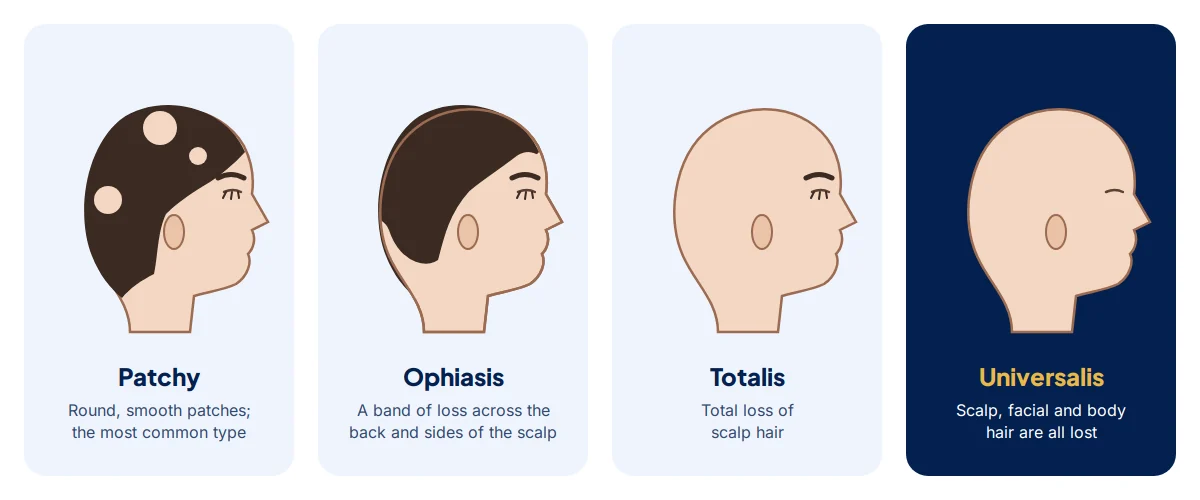
Patchy AA on the scalp is the most common type. The types are named by where, and how much, hair is lost:
Patchy alopecia areata: one or more round patches.
Ophiasis: a band of loss around the back and sides of the scalp. It is uncommon, tends to last longer and regrows less than other types.[2]
Alopecia totalis: all scalp hair is lost.
Alopecia universalis: scalp, facial and body hair are all lost.
The main patterns of alopecia areata. Illustration: Turkey Hair Center.
The type matters because it shapes your outlook. Young age at onset, a larger area of loss, a long episode, the subtype and a family history all point to a harder course.[3] The table is our summary of what that means in practice.
What you have
What it usually means
Your first move
One or a few small patches, first episode
What it usually means
The best outlook; regrowth on its own is possible
Your first move
See a dermatologist; waiting can be reasonable
Several patches, or patches that keep spreading
What it usually means
A larger area, which points to a harder course
Your first move
Start treatment rather than waiting
A band at the back and sides (ophiasis)
What it usually means
Slower and less complete regrowth
Your first move
Treat early and expect a longer course
Half the scalp or more (SALT 50 or more)
What it usually means
Severe disease
Your first move
Ask about tablets, including JAK inhibitors
Eyebrows, eyelashes or nails involved too
What it usually means
Counts towards severity on newer scales
Your first move
Mention it at your appointment
What Causes Alopecia Areata?
The leading explanation is a collapse of the follicle's immune privilege, its usual shelter from immune attack. Immune cells then gather around the bulb of follicles in the growth phaseGlossaryAnagen is the growing phase of the hair cycle. For scalp hair it lasts 2 to 6 years according to a Deutsches Ärzteblatt review, and 2 to 7 years according to Cleveland Clinic. Open in the glossary →. Cytotoxic CD8+ T cells drive the damage, and genetic and drug studies point to a signalling route called the JAK/STAT pathway.[3]
Genes matter too: AA is a complex, polygenic disease, with many genes involved rather than one. For a different, hormone-driven cause of thinning, see our thyroid hair loss guide.
Can Stress Cause Alopecia Areata?
Many people tie their first patch to a hard time. When 100 patients were asked about the two years before onset, 82% reported at least one stressful event, most often a loss of health or a separation. Yet the same authors note that earlier studies on life events and AA reached conflicting results.[4]
Our reading: stress may play a part for some people, but it isn't a proven cause. Living with patches is stressful too, and that strain deserves attention in its own right.
Alopecia Areata in Women, Men and Children
Women. Ophiasis, one of the harder types to treat, shows a female predominance.[2] Guidelines also say everyone with AA should be told about hair replacement and cosmetic options.[5]
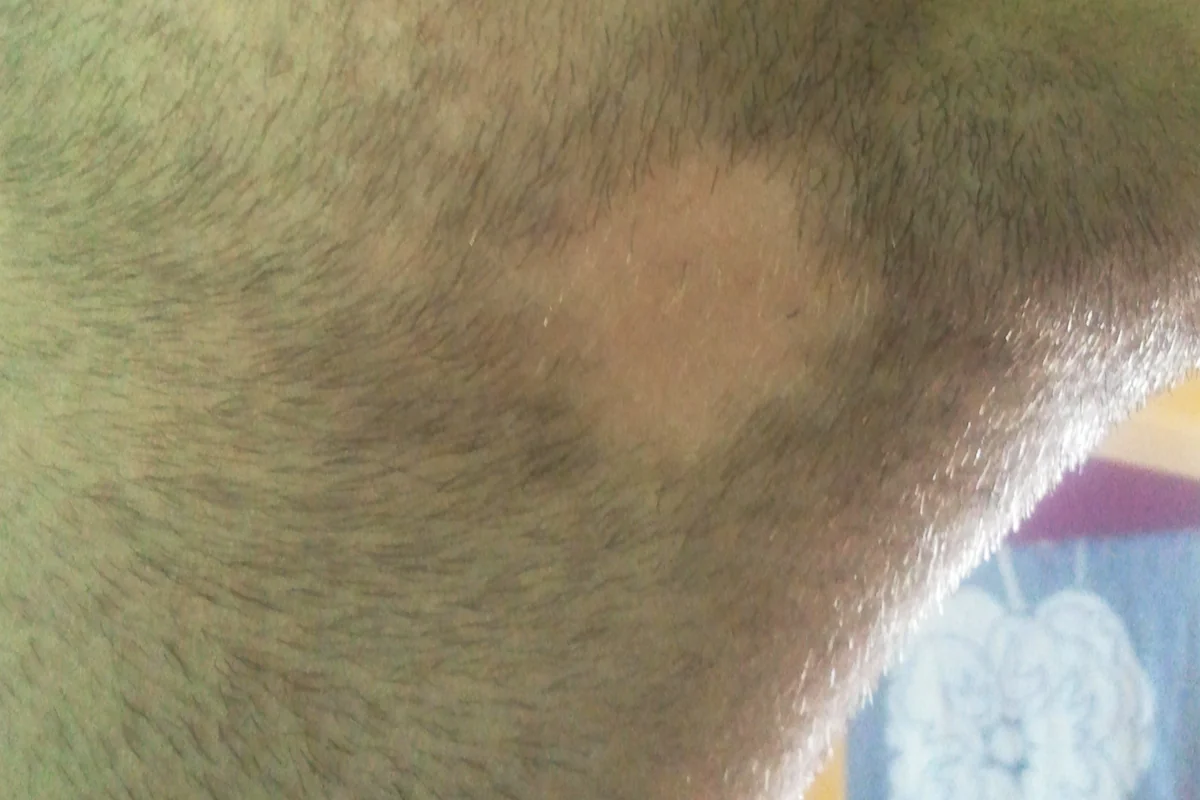
Men. AA can clear patches in the beard as well as on the scalp, and a smooth, round gap in the stubble is worth showing to a doctor.
Children. The outlook is a little less good when AA starts in childhood, as the follow-up table below shows. Treatment choices are narrower too: the German S3 guideline gives its strongest recommendations for whole-body treatment, steroids and JAK inhibitors, only to adults.[5]
Diagnosis and Severity: Alopecia Areata vs Other Hair Loss
How Alopecia Areata Is Diagnosed
The diagnosis usually rests on how the hair loss looks, and dermoscopy and a biopsy can help.[1] A dermatoscope shows typical signs such as black dots and exclamation point hairs, and in ophiasis it often shows many vellus hairsGlossaryVellus hair is the fine, short, pale hair that covers most of the body. It is under 30 micrometres wide and under 2 millimetres long. Open in the glossary → as well.[2]
The SALT Score: How Severity Is Graded
Doctors grade scalp involvement with the Severity of Alopecia Tool (SALT), a score from 0 (no scalp hair loss) to 100 (total scalp hair loss).[6] A score of 50 or more has long defined severe disease and the point at which tablets are considered.[7]
In treatment trials, success usually means SALT 20 or less, which is at least 80% of the scalp covered. Ask your dermatologist for your score: it tells you where you stand.
Alopecia Areata vs Androgenetic Alopecia and Other Hair Loss
Hair loss falls into three broad shapes: patches, a pattern, or thinning all over.[8] AA is the patchy kind, and this is how it differs from the conditions it is most often confused with:
Condition
What it looks like
Cause
First treatment
Alopecia areata
What it looks like
Sudden, well-defined, non-scarring patches
Cause
Autoimmune
First treatment
Corticosteroid injections, or tablets for severe disease
Patches can also come from pulling at the hair; our trichotillomania entry explains how that looks. For pattern hair lossGlossaryAndrogenetic alopecia, or pattern baldness, is the pattern hair loss behind most male and female thinning. It is primarily driven by genetic predisposition and sensitivity to androgen hormones. Open in the glossary → and the hormone behind it, read our page on DHT and hair loss.
Alopecia Areata Treatment, Regrowth and Hair Transplants
No treatment cures alopecia areata. The aim is to calm active disease and help hair regrow, and the choice depends on how much hair you've lost and your age. The last column is our own summary.
Option
Who it suits
If you stop
Evidence, in plain words
Watching and waiting
Who it suits
Small, new patches
If you stop
Not applicable
Evidence, in plain words
Reasonable, because hair can regrow on its own
Corticosteroid cream or injections
Who it suits
Mild to moderate disease (SALT below 50)
If you stop
Relapses are common either way
Evidence, in plain words
First-line; the only topical treatment strongly recommended
Contact immunotherapy
Who it suits
As an alternative or add-on to first-line treatment
If you stop
Unclear
Evidence, in plain words
An option, with a low level of recommendation
JAK inhibitor tablets
Who it suits
Severe disease (SALT 50 or more)
If you stop
Most lose the regrowth
Evidence, in plain words
Large placebo-controlled trials; strongly recommended for adults
Wigs and hair replacement
Who it suits
Anyone, at any stage
If you stop
Not applicable
Evidence, in plain words
Recommended to be discussed with everyone
Patchy Hair Loss: Steroids First
For mild to moderate AA (SALT below 50), first-line treatment is a corticosteroid, applied to the skin or injected into the patch, often alongside topical or oral minoxidilGlossaryMinoxidil is an established medication for certain types of hair loss. It is a drug, not a hair oil, and the FDA-approved label says not to use it for sudden or patchy hair loss. Open in the glossary →. Because hair can regrow on its own, watching and waiting is reasonable in some cases.[7] How minoxidil itself works is explained in our minoxidil entry.
Of all the creams and lotions, corticosteroids are the only topical treatment the German S3 guideline recommends strongly; the others carry a low level of recommendation.[5]
JAK Inhibitors for Severe Alopecia Areata
JAK inhibitors are tablets that block the JAK/STAT pathway behind the immune attack. Three have FDA approval for severe AA, and the labels give these results for the main trials:
The trials measured results at different weeks and ages, so the numbers don't rank the drugs. Your age, other health conditions and the blood tests you'll need decide the choice.
The effect lasts only while you take the drug. When one-year responders on baricitinib were switched to placebo, 80% lost the benefit by week 152, against 7% of those who stayed on it, and most regained it once they restarted.[11]
All three labels carry a boxed warning about serious infections, death, cancer, major heart events and blood clots, based partly on another JAK inhibitor used in rheumatoid arthritis. Common side effects in the AA trials included headache, acne, raised cholesterol and a raised muscle enzyme.
How Long Does Alopecia Areata Last?
Nobody can give you a date, but one cohort followed for at least seven years gives a shape to expect. The right-hand column is our reading.
Time point
What the study found
What it means for you
First episode
What the study found
Shorter in people whose AA started later in life
What it means for you
Adults usually recover faster than children
Relapse
What the study found
52% of childhood-onset, 44% of adult-onset and 30% of late-onset patients relapsed
What it means for you
A relapse is common and doesn't mean treatment failed
First four years
What the study found
79% of relapses happened in this window
What it means for you
The risk falls the longer you stay clear
Seven years on
What the study found
Full or significant regrowth in 74%, 94% and 100% of the three groups
What it means for you
Most people regrow, especially adults
Most patients in that study had mild disease at their first episode, so the outlook is less certain for severe disease. The treatment people received also didn't seem to change the long-term course.[12]
Regrowth Signs to Look For
The first new hairs are often fine and white. White regrowth is usually temporary and the colour returns, but in some people the white hair stays.[13] Judge regrowth by the overall trend over months, comparing your monthly photos, rather than by a single week.
Can You Have a Hair Transplant With Alopecia Areata?
A hair transplant is generally not a treatment for alopecia areata. Two reasons stand out:
The follicles are still there. AA preserves the follicle, so hair in a patch can regrow without surgery.
The disease comes back. Relapses are common, and most happen within the first four years.
AA can also affect any hair-bearing site, so ask a dermatologist before any surgery on an area it has touched. Our eyebrow transplant page covers brow surgery.
Three myths are worth clearing up:
"It's my fault for being stressed." Stress isn't a proven cause.
"Once it grows back, it's gone." Relapses are common, especially in the first few years.
"White regrowth means my hair will stay white." Usually the colour returns.
Frequently Asked Questions
Is alopecia areata an autoimmune disease?
Yes. Cytotoxic CD8+ T cells attack the follicle after its immune privilege collapses.
Can alopecia areata be cured?
Not yet. Treatments calm it and help hair regrow, but even after a year of good regrowth on baricitinib, most people who stopped lost it.
Does hair grow back after alopecia areata?
Often, because the follicle is preserved. In one study with at least seven years of follow-up, 94% of adult-onset patients had full or significant regrowth.
Is alopecia areata genetic?
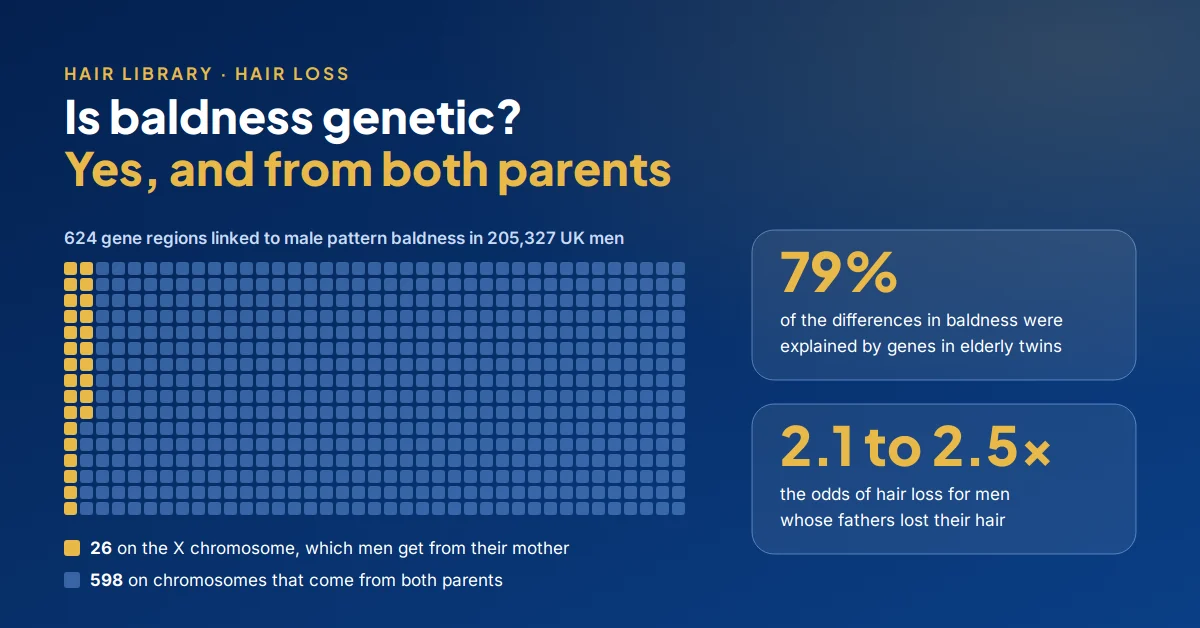
Partly. It is a polygenic disease, and a family history is one of the factors that point to a harder course.
Is alopecia areata contagious?
It is an autoimmune disease, in which your own immune cells target the follicles, rather than an infection. A fungal infection called tinea capitis can look similar, which is one reason to have new patches checked.
Does alopecia areata spread?
It can. Young onset, extensive loss, a long episode, the subtype and a family history point to a harder course.
Does alopecia areata come and go?
Often. In long follow-up, about half of the children and over 40% of the adults relapsed, mostly within the first four years.
Treatment, Waiting or Surgery: What Suits You?
Treatment suits you if your patches are spreading or covering a large area. See a dermatologist: options from steroid injections to JAK inhibitors now have trial evidence.
Waiting can suit you if you have one or a few small patches in a first episode and your dermatologist agrees.
A hair transplant is the wrong answer if alopecia areata is the cause of your hair loss: the follicles are still there and can regrow, and relapses are common.
Not sure whether your loss is alopecia areata or pattern hair loss that a transplant could treat? Send three photos for a free hair analysis, and the medical team will tell you which it looks like and whether to see a dermatologist first. You can also message us on WhatsApp.
About the Author
Written by: Nazmi Güldeş, Certified Trichologist. Nazmi Güldeş focuses on patient education around androgenetic alopecia, evaluating miniaturization through dermoscopy, and assessing candidates for medical treatments and hair transplants.
Editorial Policy & Trust
This entry was medically reviewed by Dr. Teuku Adifitrian, Sp.BP-RE (Dr. Tompi) on 31 October 2026. Every study cited here was checked against PubMed on 31 October 2026. Key figures are marked with their source, and every source is listed at the end of this entry. Read how we work in our editorial policy.
3 questions
Test yourself
Check what you remember from this entry. Each answer links back to the section that explains it.
Which SALT score usually counts as success in alopecia areata treatment trials?
SALT 20 or less means at least 80% of the scalp is covered; 50 or more has long defined severe disease. Read the section
What happened when one-year baricitinib responders were switched to placebo?
80% lost the benefit by week 152, against 7% of those who stayed on baricitinib; most regained it after restarting. Read the section
Why is a hair transplant generally not used for active alopecia areata?
AA preserves the follicle, so patches can regrow without surgery, and relapses are common, most within the first four years. Read the section
3Scientific evidenceStudy types, references and how to cite this entry
13sources
Evidence behind this entry: 10 publications indexed in PubMed (2017 to 2026): 5 reviews, 3 clinical studies, 1 guideline and 1 randomized trial. Plus the FDA prescribing information for Olumiant (baricitinib), Litfulo (ritlecitinib) and Leqselvi (deuruxolitinib). 4 sources have free full text.
Randomized trialpeople assigned to treatments by chance
Reviewsummarises many studies
Clinical studya study in people without random groups
Guideline or labela professional body, or the official drug label
Pratt CH, King LE Jr, Messenger AG, et al. Alopecia areata. Nature Reviews Disease Primers. 2017;3:17011.ReviewPubMedDOIFree full text
Li F, Zhang W, Wang C, et al. Clinical characteristics, subtype classification, and prognostic factors of ophiasis: A retrospective study of 150 patients with therapeutic implications. Journal of the American Academy of Dermatology. 2026;95(2):400-408.Clinical studyPubMedDOI
Maas D, Spindler AJ, Zappi I, et al. Alopecia Areata: Advances in Clinical Evaluation and Pathogenesis. Journal of the American Academy of Dermatology. 2026.ReviewPubMedDOI
Fhager J, Örmon K, Svensson Å, et al. Life Events Preceding Alopecia Areata Onset-a Descriptive Retrospective Cohort Study Focusing on Strain. Clinical, Cosmetic and Investigational Dermatology. 2026;19:567911.Clinical studyPubMedDOIFree full text
Blume-Peytavi U, Constantinou A, Tomova-Simitchieva T, et al. S3 guideline diagnostics and therapy in alopecia areata - Part 2: Therapy, psychosocial and cosmetic support. Journal Der Deutschen Dermatologischen Gesellschaft = Journal of the German Society of Dermatology. 2026;24(8):e1155-e1177.GuidelinePubMedDOIFree full text
U.S. Food and Drug Administration. LITFULO (ritlecitinib) capsules, for oral use: prescribing information. Revised June 2023.Drug labelSource page
Spindler A, Maas D, Zappi I, et al. Alopecia areata: Emerging therapies and up-to-date management strategies. Journal of the American Academy of Dermatology. 2026.ReviewPubMedDOI
Dakkak M, Forde KM, Lanney H. Hair Loss: Diagnosis and Treatment. American Family Physician. 2024;110(3):243-250.ReviewPubMed
U.S. Food and Drug Administration. OLUMIANT (baricitinib) tablets, for oral use: prescribing information. Revised June 2022.Drug labelSource page
U.S. Food and Drug Administration. LEQSELVI (deuruxolitinib) tablets, for oral use: prescribing information. Revised July 2024.Drug labelSource page
King B, Ko J, Kwon O, et al. Baricitinib Withdrawal and Retreatment in Patients With Severe Alopecia Areata: The BRAVE-AA1 Randomized Clinical Trial. JAMA Dermatology. 2024;160(10):1075-1081.Randomized trialPubMedDOIFree full text
Lyakhovitsky A, Aronovich A, Gilboa S, et al. Alopecia areata: a long-term follow-up study of 104 patients. Journal of the European Academy of Dermatology and Venereology. 2019;33(8):1602-1609.Clinical studyPubMedDOI
Asz-Sigall D, Ortega-Springall MF, Smith-Pliego M, et al. White hair in alopecia areata: Clinical forms and proposed physiopathologic mechanisms. Journal of the American Academy of Dermatology. 2023;89(4):758-763.ReviewPubMedDOI
Güldeş, N. (2026, October 31). Alopecia areata: Causes, types, treatment and regrowth. Turkey Hair Center Hair Library. https://turkeyhaircenter.com/alopecia-areata/
@misc{guldes2026alopeciaareata,
  author       = {Güldeş, Nazmi},
  title        = {Alopecia areata: Causes, types, treatment and regrowth},
  howpublished = {Turkey Hair Center Hair Library},
  year         = {2026},
  month        = oct,
  url          = {https://turkeyhaircenter.com/alopecia-areata/},
  note         = {Last updated 31 October 2026}
}
TY  - ELEC
AU  - Güldeş, Nazmi
TI  - Alopecia areata: Causes, types, treatment and regrowth
T2  - Turkey Hair Center Hair Library
PY  - 2026
DA  - 2026/10/31
UR  - https://turkeyhaircenter.com/alopecia-areata/
N1  - Last updated 31 October 2026
ER  -
Talk to our hair team on a free video call, in your language. You receive a written plan with your technique, estimated grafts and all-inclusive price. If a hair transplant isn't right for you, we tell you honestly.
Your information is 100% confidential.
Real People Real Support
Send your photos on WhatsApp
Front, top and both sides, reviewed by the medical team.