Performed at authorized partner hospitals Turkey Hair Center is a Ministry of Health authorized health-tourism intermediary, not a clinic.
Mounjaro can be linked to hair loss, but the label lists it only as a postmarketing report with no rate. Its sister drug Zepbound, the same tirzepatide given for weight loss, reported hair loss in 4% to 5% of trial patients against 1% on placebo, and the label ties those cases to weight reduction.
Cover built on a photo of bare feet on a bathroom scale. Photo: Frank C. Müller, Baden-Baden, CC BY-SA 4.0, via Wikimedia Commons, cropped, text and logo added.
The same split applies to semaglutide: Ozempic lists alopecia without a rate, while Wegovy reports it in 3% to 6% of patients depending on the dose. In most people the shedding is telogen effluvium, a temporary shed that follows rapid weight loss rather than direct damage to the follicle. This guide covers what each label says, why it happens, how long it lasts and when a hair transplant makes sense.
The scale is the real link between these medicines and hair. GLP-1 drugs can cause large weight loss in a few months, and the labels of both weight-management products state that their hair loss cases were associated with weight reduction.
Does Mounjaro Cause Hair Loss?
It can be associated with it. Mounjaro is tirzepatide prescribed for type 2 diabetes, and its prescribing information lists alopecia under Skin and Subcutaneous Tissue in the postmarketing section. Postmarketing reports come from a population of uncertain size, so the label gives no frequency and does not prove that the drug caused each case.
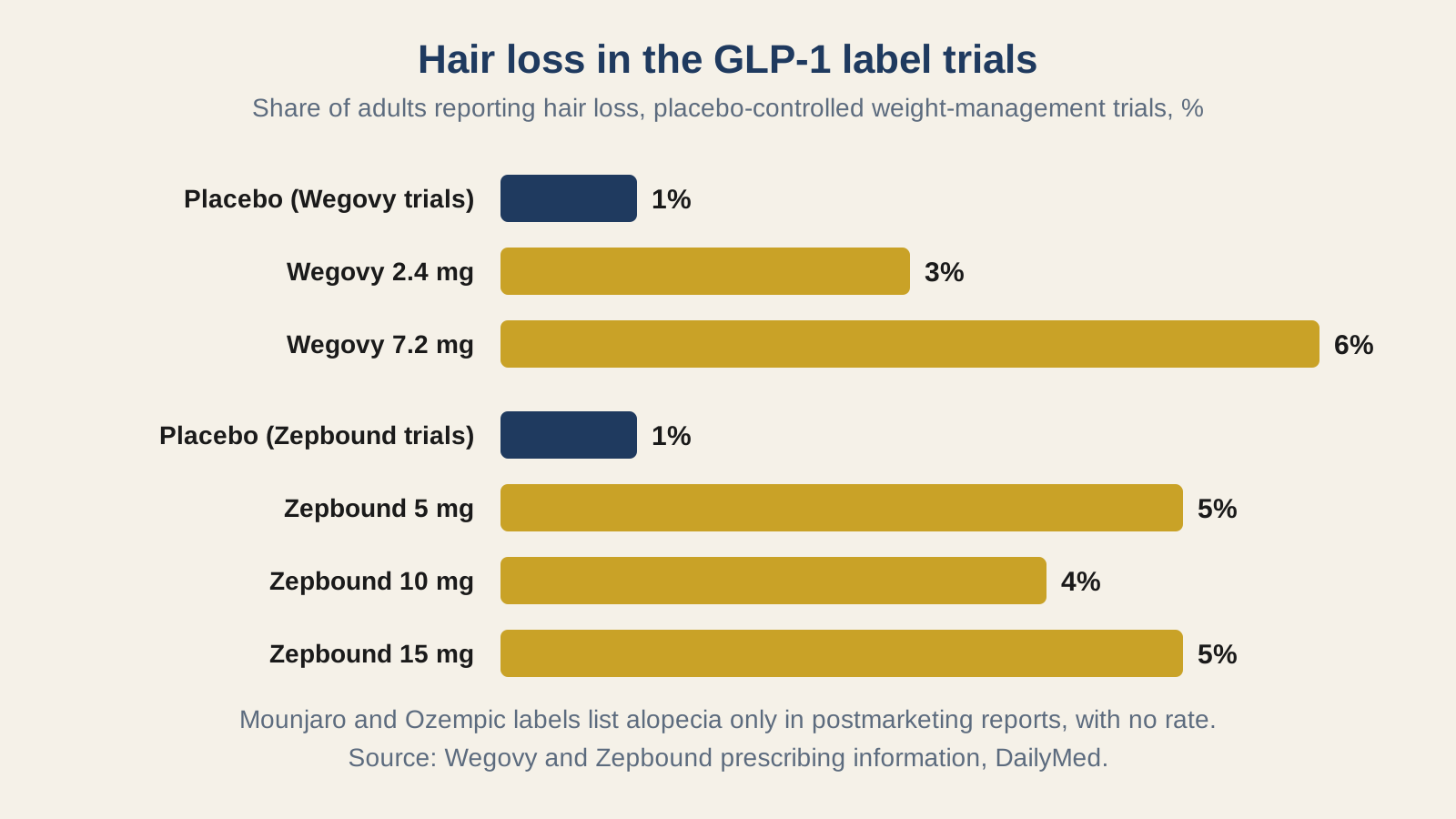
The clearer numbers come from Zepbound, which is also tirzepatide but is approved for weight management. In its placebo-controlled trials, hair loss was reported by:
1% of people on placebo (958 patients)
5% on the 5 mg dose (630 patients)
4% on the 10 mg dose (948 patients)
5% on the 15 mg dose (941 patients)
The Zepbound label adds that hair loss adverse reactions in Zepbound-treated patients were associated with weight reduction. It also reports that no patient on Zepbound stopped treatment because of hair loss, against one patient on placebo.
Does Wegovy or Ozempic Cause Hair Loss?
Semaglutide follows the same pattern. Ozempic, the diabetes product, lists alopecia only among postmarketing reports. Wegovy, the weight-management product, lists hair loss among its most common adverse reactions, those with an incidence of 5% or more in adults or adolescents aged 12 and over.
In the main adult trials, hair loss was reported in 3% of people on Wegovy 2.4 mg against 1% on placebo. In the trials of the higher 7.2 mg dose, it was 6% on 7.2 mg, 3% on 2.4 mg and 1% on placebo. In adolescents aged 12 and over, it was 4% on Wegovy against 0% on placebo. As with Zepbound, the label says the hair loss cases were associated with weight reduction.
Medicine
Active ingredient
Where hair loss appears in the label
Rate in trials vs placebo
Women vs men
Mounjaro
Tirzepatide
Postmarketing reports
No rate given
Not reported
Zepbound
Tirzepatide
Adverse reactions table
4% to 5% vs 1%
7.1% vs 0.5% (placebo 1.3% vs 0%)
Ozempic
Semaglutide
Postmarketing reports
No rate given
Not reported
Wegovy 2.4 mg
Semaglutide
Adverse reactions table
3% vs 1%
4% vs 0.9% (placebo 2% vs 0%)
Wegovy 7.2 mg
Semaglutide
Adverse reactions table
6% vs 1%
8.4% vs 0.2% (placebo 1.5% vs 0%)
These figures come from separate trials with different patients, so they should not be read as a head-to-head comparison of semaglutide and tirzepatide. The Mounjaro and Ozempic labels give no trial rate for hair loss at all, only postmarketing reports.
Why GLP-1 Medicines Can Cause Hair Shedding
The most likely route is telogen effluvium. A sudden stress on the body pushes a larger share of hair follicles than usual into the resting phase at the same time, and those hairs fall out together a few months later. The follicles are not destroyed, which is why this kind of shed usually recovers.
Rapid weight loss is a well known trigger. Cleveland Clinic lists rapid weight loss, and fad diets that do not include enough protein, among the causes of telogen effluvium. The American Academy of Dermatology (AAD) names losing 20 pounds or more as one of the stressors that can lead to excessive shedding.
A 2026 systematic review in Science Progress looked at 24 studies of GLP-1 medicines and hair loss. Its main findings were:
Semaglutide and tirzepatide had the highest reported rates of hair loss among GLP-1 medicines.
Telogen effluvium and androgenetic alopecia were the most common types reported.
Tirzepatide, which produced the greatest weight loss, was most often linked to telogen effluvium.
With semaglutide, hair loss appeared dose-dependent: weekly doses below 2 mg were rarely implicated.
Rapid weight loss emerged as a potential contributor, especially for telogen effluvium.
The authors call for large prospective randomized trials to establish cause and timing. So the evidence points to weight loss as the main driver, but a direct effect of the drugs on hair has not been ruled in or out.
Why Women Seem More Affected
The labels show a striking gap. In the pooled Zepbound trials, hair loss was reported by 7.1% of women and 0.5% of men. In the Wegovy 7.2 mg trials it was 8.4% of women and 0.2% of men. The 2026 review also found that females appeared to be disproportionately affected.
The labels and the review do not explain the reason. Women with existing female pattern hair loss may notice a shed sooner because they have less density to spare, and our guide to the reasons for hair loss covers the other causes that can add to the same picture.
When Does Hair Loss Start and How Long Does It Last?
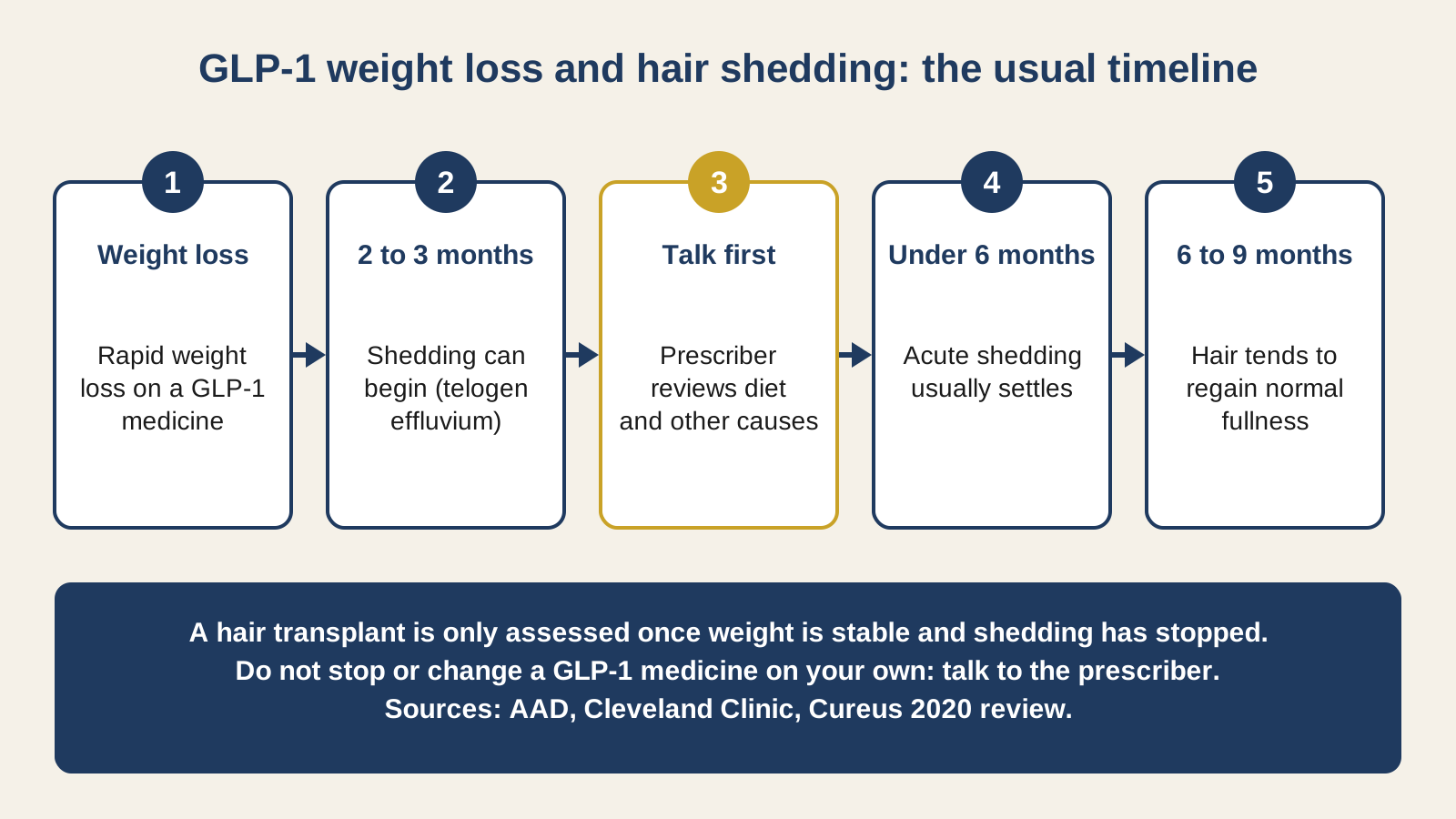
Telogen effluvium is delayed. Cleveland Clinic says acute shedding usually starts two to three months after the trigger and lasts less than six months, and a 2020 review in Cureus describes the same timing. That means hair loss often appears well after someone has started the medicine and is already losing weight.
The AAD says it is normal to shed 50 to 100 hairs a day, and that once the stressor passes, hair tends to regain its normal fullness within six to nine months. New hairs start short, so the scalp can look thin for a while even after the shedding has stopped. Dated photos of the parting and crown in the same light make progress easier to judge.
Some signs point to something other than a weight-loss shed:
Shedding that lasts beyond six months: this may be chronic telogen effluvium or another condition.
Thinning at the temples, crown or a widening parting: this suggests pattern hair loss, which does not recover on its own. The DHT and hair loss guide explains how it works.
Patches, redness, scale or pain on the scalp: these need an examination by a dermatologist.
Should You Stop Mounjaro or Wegovy Because of Hair Loss?
Not on your own. The decision to continue, adjust or stop a GLP-1 medicine depends on blood sugar, weight, heart risk and other factors that only the prescriber can weigh. Hair shedding is a reason to book an appointment, not to change the treatment yourself.
Do not stop, skip or change the dose of a GLP-1 medicine because of hair shedding. Bring dated photos and a note of when the shedding began to your prescriber. They can check whether weight loss, diet, iron or thyroid problems, or pattern hair loss is behind it.
Useful things to bring to that appointment:
When the shedding started, and when the medicine was started or the dose changed
How much weight you have lost and over how many months
What you eat in a typical day, including protein sources
Any illness, surgery or major stress in the three months before the shed
Dry beans, peas and lentils, plant sources of protein and iron. Photo: Bean appreciator, CC0 public domain, via Wikimedia Commons, cropped.
Nutrition and Hair While Losing Weight
The AAD says that too little iron or protein, or too few calories, can cause hair loss, and the Mounjaro label lists decreased appetite among its most common adverse reactions. Eating less is the point of the treatment, but it makes the quality of what you do eat more important. Cleveland Clinic suggests a Mediterranean-style diet that includes lean protein while recovering from telogen effluvium.
Chicken and quail eggs in a wicker basket, a common protein food. Photo: George Chernilevsky, CC BY-SA 4.0, via Wikimedia Commons, cropped.
Ask about blood tests for iron stores and other deficiencies before buying supplements.
Talk to the prescriber or a dietitian about how much protein is right for you, since needs depend on weight, kidney function and other conditions.
Be careful with hair supplements: the AAD notes that supplements are not regulated by the US Food and Drug Administration, and Cleveland Clinic advises asking a provider before taking them.
Gloved laboratory hands holding blood sample tubes with yellow caps. Photo: Governo do Estado de São Paulo, CC BY 2.0, via Wikimedia Commons, cropped.
A hair transplant does not treat telogen effluvium, because shed hair grows back from the same follicles. During an active shed it is also hard to judge true density, both in the thinning area and in the donor area at the back of the head. For that reason the medical team only assesses a hair transplant once weight is stable and the shedding has stopped.
What remains after the shed settles is what matters. If thinning follows a pattern at the hairline or crown, it is likely androgenetic alopecia, and the Norwood scale is the common way to describe how far it has progressed. That kind of loss can be assessed for a transplant; temporary shedding cannot.
Frequently Asked Questions
Does Mounjaro Cause Hair Loss?
The Mounjaro label lists alopecia as a postmarketing report with no frequency. Zepbound, the same active ingredient used for weight management, reported hair loss in 4% to 5% of trial patients against 1% on placebo, and its label links those cases to weight reduction.
Does Wegovy Cause Hair Loss?
Yes, it is a listed side effect. In the main adult trials, 3% of people on Wegovy 2.4 mg reported hair loss against 1% on placebo, and 6% did on the 7.2 mg dose. The label says these cases were associated with weight reduction.
Does Ozempic Cause Hair Loss?
The Ozempic label lists alopecia only in its postmarketing reports, with no rate. Ozempic contains semaglutide, the same active ingredient as Wegovy, and the 2026 systematic review found semaglutide hair loss was rarely implicated at weekly doses below 2 mg.
Does Zepbound Cause Hair Loss?
In the Zepbound trials, hair loss was reported by 5% of people on 5 mg, 4% on 10 mg and 5% on 15 mg, against 1% on placebo. No patient on Zepbound stopped treatment because of it.
Which Causes More Hair Loss, Semaglutide or Tirzepatide?
There is no head-to-head trial on hair loss. The 2026 review found both had the highest reported rates among GLP-1 medicines, and tirzepatide, which produced the most weight loss, was most often linked to telogen effluvium.
Is GLP-1 Hair Loss Permanent?
Usually not. Telogen effluvium leaves the follicles intact, and the AAD says hair tends to regain its fullness within six to nine months once the stressor passes. Permanent loss is more likely to come from pattern hair loss that the shed has made easier to see.
Will My Hair Grow Back After Ozempic or Mounjaro?
In the typical weight-loss shed, yes. Hair grows back from the same follicles once weight loss slows and the trigger passes. If the scalp still looks thin after nine months, ask a dermatologist to check for pattern hair loss.
How Long Does Mounjaro Hair Loss Last?
Acute telogen effluvium usually lasts less than six months, according to Cleveland Clinic. Regrowth takes several more months to fill in. Shedding beyond six months should be checked by a doctor.
When Does Hair Loss Start on Wegovy or Mounjaro?
Telogen effluvium usually starts two to three months after the trigger. With GLP-1 medicines the trigger is the period of fast weight loss, so shedding often shows up a few months into treatment rather than in the first weeks.
Why Do Women Lose More Hair on GLP-1 Medicines?
The labels show a clear gap, for example 7.1% of women against 0.5% of men in the pooled Zepbound trials, but they do not give a reason. The 2026 review also found women appeared to be disproportionately affected.
Should I Stop Mounjaro if My Hair Is Falling Out?
Do not stop or change the medicine yourself. Talk to the prescriber, who can weigh the benefits of treatment against the hair change and check for other causes such as low iron, thyroid problems or diet.
Can I Have a Hair Transplant While Taking a GLP-1 Medicine?
A transplant is only assessed once weight is stable and the shedding has stopped. During a shed it is not possible to judge which loss is temporary and which is permanent, and temporary shedding usually recovers without surgery.
Thinning After Weight Loss? Get a Second Opinion
If the shedding has settled but your hair still looks thinner than before, the question is often whether pattern hair loss sits underneath. Send clear photos of your hairline and crown for a free hair analysis, and the medical team will tell you whether you are looking at temporary shedding or long-term pattern loss. Turkey Hair Center is a Ministry of Health authorized health-tourism intermediary; procedures take place at authorized partner hospitals.
Medical disclaimer: This article is for informational purposes only and is not medical advice. Individual results and recovery vary from person to person. Always follow the written aftercare plan from your own medical team.
Send three photos: front, top and sides. You get a technique recommendation, a graft range and a straight answer about what is achievable, before anyone talks about price.
Your details are with the team
A patient coordinator will get back to you shortly. If you would like to send your photos now, WhatsApp is the fastest way to do it.
We respond quickly, day or night, in your language.
Multilingual team, no obligation
Data protectedKVKK and GDPR compliant, 100% confidential
Authorized Health Tourism Intermediary
Turkey Hair Center is the hair-restoration brand of Healthy Way Tourism, an authorized international health-tourism intermediary. All medical procedures are performed by licensed medical professionals at authorized healthcare facilities in Turkiye, in accordance with the regulations of the Ministry of Health.