
Creatine hair loss is one of the most repeated worries in gyms. It goes back to one hormone result in rugby players, which travelled from forum to forum without its context.[1][2]
Hair Library · Hair Loss
Does Creatine Cause Hair Loss? What the Studies Found
Where the creatine worry started, what the trial that measured hair found, what is still unknown and what to do if your hair is thinning while you train.
6sources
3in PubMed
11min read
Written by Nazmi Güldeş, Certified Trichologist · Medically reviewed by Dr. Teuku Adifitrian, Sp.BP-RE (Dr. Tompi), Plastic, Reconstructive and Aesthetic Surgeon · Last reviewed 4 November 2026
Reading level1Quick answerThe short answer, in a few sentences
Does Creatine Cause Hair Loss?
Creatine does not appear to cause hair loss. A small study found that DHT, a hormone linked to male pattern baldness, rose in rugby players taking creatine, but it never measured hair. A 12-week randomized trial that did measure hair found no change in DHT, hair density, thickness or follicle counts compared with placebo.
Creatine monohydrate is one of the most studied sports supplements. People take it for strength and muscle during resistance training.[3][1]
Free self-check
Is your own hairline changing?
Find your Norwood stage and graft range. Free, no sign-up.
2Complete guideFrom the DHT study to the hair trial, the dose and what to do if you are thinning
Where Did the Creatine Hair Loss Idea Come From?
The idea goes back to one hormone result in college-aged rugby players. Each player took creatine for three weeks and a placebo for three weeks, at different times, and neither the players nor the researchers knew which was which. Each creatine phase began with a one-week loading dose and dropped to a lower maintenance dose for two weeks.[2]
After the loading week, DHT on creatine was about 56% above its starting level, and it was still about 40% higher at the end. The ratio of DHT to testosterone rose by roughly 36% and then 22%. Testosterone itself did not change. Nobody counted, photographed or measured the players' hair.[2] Those percentages come from this one small study, and the values stayed within the normal clinical range for adult men throughout.[3][1]
Our guide to DHT and hair loss explains how DHT shrinks follicles step by step. Many people read the rugby result as proof that creatine causes baldness. A hormone moving in a blood test does not mean follicles are shrinking on the scalp, and the study never looked for that.
What Did the Later Studies Find?
Later research found no evidence that creatine causes hair loss. A review of common creatine myths noted that the rugby result had never been repeated and that no human study had reported creatine causing hair loss.[3]
The strongest evidence comes from a randomized controlled trial in resistance-trained men, the first to examine hair follicles directly after creatine. For 12 weeks the men took either creatine monohydrate or a placebo powder (maltodextrin) and kept their usual diet and training. Blood was tested at the start and the end.[1]
The hair was checked in two ways. A trichogram examines hairs pulled from the scalp. The FotoFinder system works from scalp photos and measures hair density, follicular unit count and total hair thickness.[1]
| Study | Who took part | What was measured | Result |
|---|---|---|---|
| Rugby players study[2] | Male college rugby players | DHT, testosterone, DHT to testosterone ratio | DHT and the ratio rose, hair not measured |
| Creatine myths review[3] | Review of the published evidence | Common creatine questions, including hair loss | Rugby result not repeated, no study reports hair loss |
| 12-week hair trial[1] | Resistance-trained men aged 18 to 40 | DHT, testosterone, trichogram, hair density, follicular units, hair thickness | No difference between creatine and placebo |
Over the 12 weeks, no hormone or hair measure differed between the creatine and placebo groups. The authors call this strong evidence against the claim that creatine contributes to hair loss.[1]
Does Creatine Increase DHT?
The best evidence shows no DHT rise. The trial that measured hair found no DHT difference between creatine and placebo.[1] Nobody has tested why the rugby study came out differently. The review notes that DHT was already lower before the creatine phase than before the placebo phase, and that it dipped a little on placebo. Together, those two details made the rise look larger. It adds that hard resistance training can raise these hormones on its own.[3]
Will 5g of Creatine Cause Hair Loss?
A daily 5 g dose has no known link to hair loss. The trial that measured hair used that dose for 12 weeks and found no change in the hair.[1] The rugby study began with a week of 25 g a day and then dropped to 5 g.[2]
You do not need to load at all. A daily 3 to 5 g fills the muscles with creatine too, though more slowly.[3] The hair trial used no loading phase, and its authors note that a longer study with a higher dose could still turn out differently.[1]
What Is Still Not Proven About Creatine and Hair?
Creatine has only been tested on hair in healthy young men, and only for 12 weeks. Pattern baldness develops over years, and no study has followed hair on creatine for that long.[1]
The trial also did not record whether the men had a family history of hair loss, which is a known risk factor.[1][4] Men who had used finasteride or minoxidil, or had had a hair transplant, were not allowed to take part. Some of the authors disclosed ties to the supplement industry. That alone does not make the result wrong.[1]
Does Creatine Cause Hair Loss in Women?
It has not been tested in women. Only men took part in the hair trial. The researchers chose men because of the link between DHT and male pattern baldness, and they say future work may need to include women.[1] Pattern hair loss also looks different in women. The hair thins on top and the parting widens, while the hairline usually stays where it is.[4] Our page on female pattern hair loss covers it in full.
Does Creatine Affect Hair Loss Medicines Like Finasteride and Minoxidil?
Whether creatine changes how finasteride or minoxidil works is unknown. We found no study that tested the combination, and the hair trial turned away men who had used either medicine.[1] Nothing in the creatine research points to a clash. Missing data still does not prove the two are safe together.
Finasteride is a 5α-reductase inhibitor for male pattern hair loss, approved for men only. It lowers DHT in the scalp and in the blood, and it generally takes three months or more of daily use before any benefit shows.[5] Our finasteride guide covers benefits and side effects. The minoxidil guide covers the topical and oral forms.
If you take either medicine and want to add creatine, or the other way round, tell your doctor or pharmacist. They know your health history and your other medicines. Do not stop a prescribed treatment because of something you read online.
What Else Could Explain Hair Thinning at the Gym?
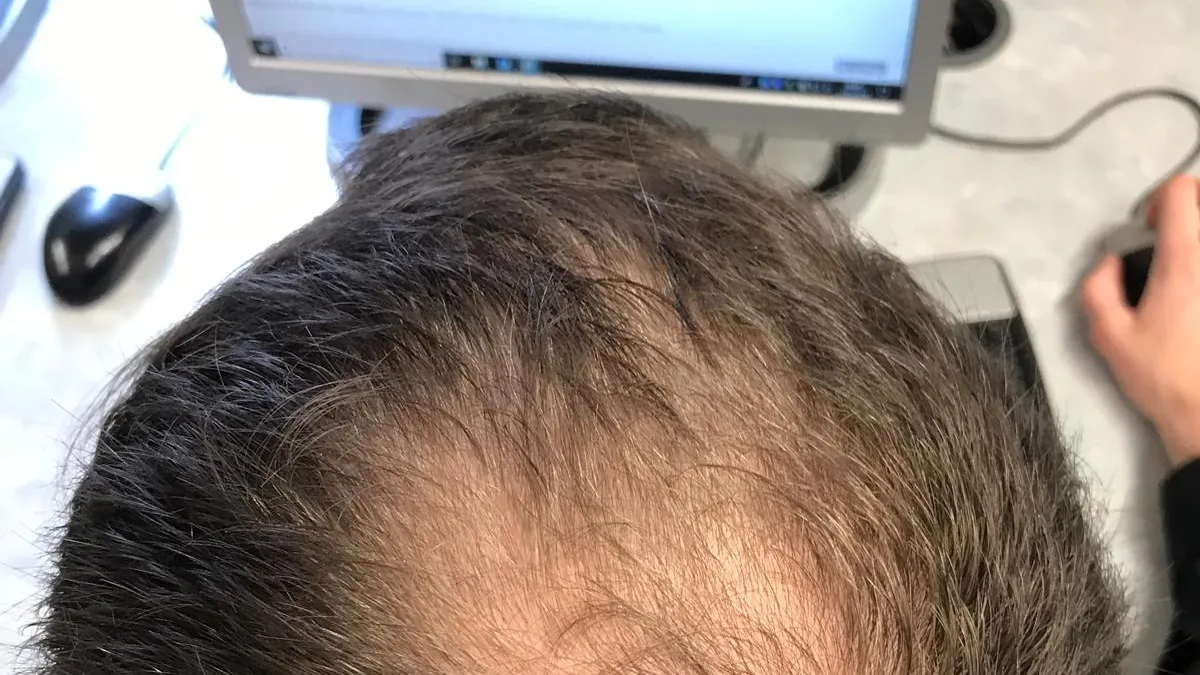
If your hair is thinning while you lift, look at the better-known causes first. Male pattern baldness is the obvious one. It comes from an inherited sensitivity of the follicles to DHT and usually starts above the temples or at the crown. It can begin as early as the teens, the same years many people start training.[4][3] Our male pattern baldness guide explains how it progresses.
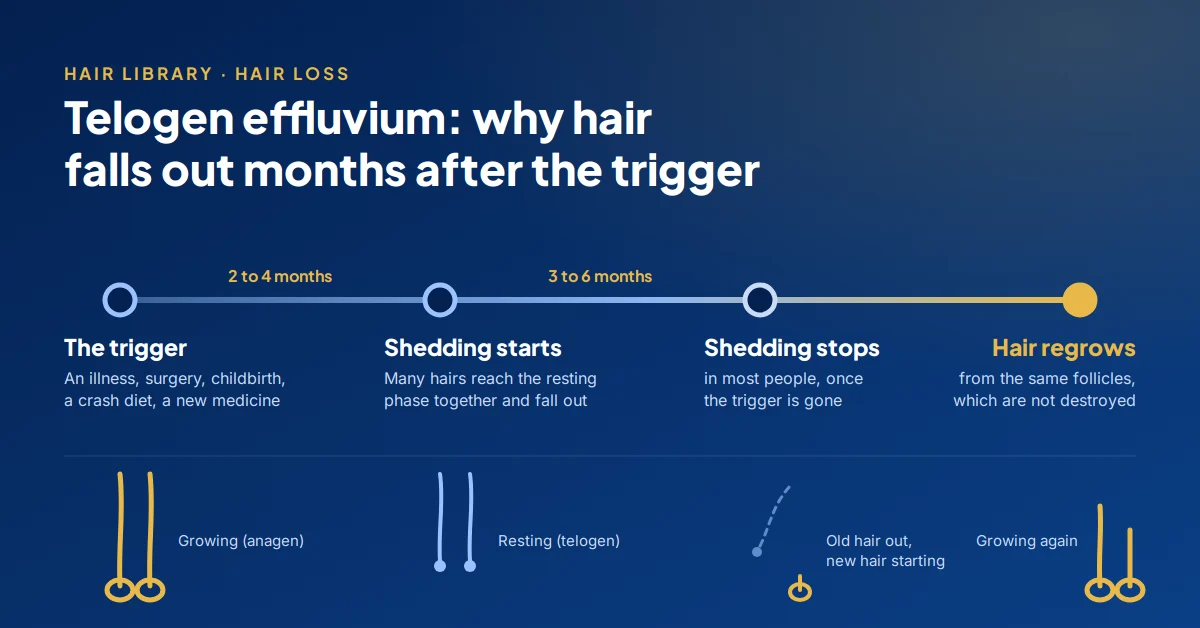
Heavy shedding is common too. Hair can fall out in large amounts a few months after an illness with a high fever, a big weight loss or a hard stretch of stress, and it usually settles once the body recovers.[6] Our telogen effluvium guide explains this kind of shedding.
The timing can also mislead you. Many people start creatine at an age when pattern baldness may begin anyway, and two things that start together are easy to link.[4]
Anabolic steroids are a separate question. They are synthetic versions of testosterone, and creatine is a different substance that works another way.[3] The hair trial excluded men who had used them, and none of its results applies to steroid use.[1] If you use any of these, tell your doctor.
What Should You Do If Your Hair Is Thinning?
Stopping creatine is fine if it makes you feel better, but it is unlikely to change the course of pattern baldness. Finding the real cause helps more, and these steps are where to start.[1]
- Take dated photos of the crown and the hairline each month, in the same light and from the same angle.
- Ask about family history. A close relative with hair loss makes a genetic cause more likely.[4]
- Look for a trigger in the past few months if the hair is falling out quickly.[6]
- See a doctor or dermatologist, who can tell real hair loss from shedding and find the cause. Bring a list of every supplement and medicine you use.[6]
When the loss is clearly genetic and keeps progressing, the next step may be a medical review of treatments, including a hair transplant. A transplant moves your own follicles from the back of the scalp to the thinning areas. Our medical team looks at your photos first and tells you whether you are a candidate.
Frequently Asked Questions
Can creatine cause hair thinning?
Creatine has not been shown to thin hair. After 12 weeks, every hair measure was the same on creatine and on placebo in the only randomized trial that checked. That trial was short and included only healthy young men, and it cannot rule out an effect in everyone.[1]
Does creatine increase testosterone?
Will my hair grow back if I stop taking creatine?
That has not been tested. If the shedding has another cause, such as stress or illness, hair usually recovers once the trigger has passed. Male pattern baldness is different, and stopping creatine will not reverse it.[6]
Is creatine good for hair?
Nothing shows that it helps hair grow. In the hair trial, the hair of men on creatine looked the same as the hair of men on placebo.[1]
Can I take creatine while using finasteride or minoxidil?
Nobody has tested the combination. Ask the doctor who prescribes your hair loss treatment before adding creatine, and do not stop a prescribed medicine on your own.
Does creatine cause baldness in people with a family history of it?
This has not been studied. The hair trial did not record family history and cannot answer the question. If baldness runs in your family, a dermatologist can assess your risk and talk you through the options.[1]
Should I stop creatine if I am losing hair?
You can stop if you feel better without it. The evidence does not show that stopping protects your hair, and a medical exam that finds the real cause will do more for it.
Want to Know Why Your Hair Is Thinning?
If your hair is thinning and you want a clear answer, send photos of your hairline, crown and donor area for a free hair analysis. The medical team will tell you whether it looks like male pattern baldness and what you can do about it.
About the Author
Written by: Nazmi Güldeş, Certified Trichologist. Nazmi Güldeş focuses on patient education around androgenetic alopecia, evaluating miniaturization through dermoscopy, and assessing candidates for medical treatments and hair transplants.
Editorial Policy & Trust
This entry was drafted with the help of AI writing tools and edited by our team, then medically reviewed by Dr. Teuku Adifitrian, Sp.BP-RE (Dr. Tompi) on 4 November 2026. AI is never used as a source: every study cited here was checked against PubMed on 7 November 2026. Key figures are marked with their source, and every source is listed at the end of this entry. Read how we work in our editorial policy.
3 questions
Test yourself
Check what you remember from this entry. Each answer links back to the section that explains it.
- What did the study behind the creatine worry measure?
It measured DHT and testosterone in the blood. Nobody looked at the players' hair. Read the section
- What did the 12-week trial that measured hair find?
Hormones and every hair measure were the same on creatine and placebo. Read the section
- Will stopping creatine reverse male pattern baldness?
Pattern baldness is inherited, and the trial found no link with creatine. Read the section
3Scientific evidenceStudy types, references and how to cite this entry
6sources
Evidence behind this entry: 3 publications indexed in PubMed (2009 to 2025): 1 randomized trial, 1 clinical trial and 1 review. Plus 1 drug label and 2 patient information pages. 2 sources have free full text.
- Randomized trialpeople assigned to treatments by chance
- Reviewsummarises many studies
- Guideline or labela professional body, or the official drug label
- Patient informationhealth information from a hospital, a patient association or a health department
Every source checked against PubMed on 7 November 2026, including corrections and retractions. See the newest studies on PubMed →
References
- Lak M, Forbes SC, Ashtary-Larky D, et al. Does creatine cause hair loss? A 12-week randomized controlled trial. Journal of the International Society of Sports Nutrition. 2025;22(sup1):2495229.Randomized trialPubMedDOIFree full text
- van der Merwe J, Brooks NE, Myburgh KH. Three weeks of creatine monohydrate supplementation affects dihydrotestosterone to testosterone ratio in college-aged rugby players. Clinical Journal of Sport Medicine. 2009;19(5):399-404.Clinical trialPubMedDOI
- Antonio J, Candow DG, Forbes SC, et al. Common questions and misconceptions about creatine supplementation: what does the scientific evidence really show?. Journal of the International Society of Sports Nutrition. 2021;18(1):13.ReviewPubMedDOIFree full text
- MedlinePlus Genetics. Androgenetic alopecia. US National Library of Medicine.Patient informationSource page
- U.S. National Library of Medicine, DailyMed. PROPECIA (finasteride) tablet, film coated: prescribing information. Organon LLC.Drug labelSource page
- American Academy of Dermatology. Do you have hair loss or hair shedding?Patient informationSource page
Cover image: photo by Awkwafaba, CC BY-SA 4.0, via Wikimedia Commons, cropped, text and logo added.
Written byNazmi Güldeş, Certified Trichologist
Sources6 references
Medically reviewed byDr. Teuku Adifitrian, Sp.BP-RE (Dr. Tompi), Plastic, Reconstructive and Aesthetic Surgeon
Last reviewed4 November 2026
Last updated7 November 2026
Cite this entry
Güldeş, N. (2026, November 7). Does Creatine Cause Hair Loss? What the studies found. Turkey Hair Center Hair Library. https://turkeyhaircenter.com/creatine-hair-loss/
@misc{guldes2026creatinehairloss,
  author       = {Güldeş, Nazmi},
  title        = {Does Creatine Cause Hair Loss? What the studies found},
  howpublished = {Turkey Hair Center Hair Library},
  year         = {2026},
  month        = nov,
  url          = {https://turkeyhaircenter.com/creatine-hair-loss/},
  note         = {Last updated 7 November 2026}
}
TY - ELEC AU - Güldeş, Nazmi TI - Does Creatine Cause Hair Loss? What the studies found T2 - Turkey Hair Center Hair Library PY - 2026 DA - 2026/11/07 UR - https://turkeyhaircenter.com/creatine-hair-loss/ N1 - Last updated 7 November 2026 ER -
Spotted an error? See our corrections policy · How we use sources
Next in Hair LossDo Hats Cause Hair Loss?Whether hats thin your hair, when tight headwear leads to traction alopecia and when you can wear a hat after a transplant.Read next →Reading path · step 2 of 4DHT and Hair LossHow genetically sensitive follicles shrink under DHT, the early signs and which treatments can slow it down.Continue the path →
Keep exploring Hair Loss
 Telogen Effluvium
We explain what telogen effluvium is, why shedding starts months after a trigger, how long it lasts, how it differs from pattern loss.
Read more Minoxidil
We explain how minoxidil works, how topical and oral forms compare, how to apply it, when shedding and results appear, and where it fits.
Read more How to Stop Hair Loss
We explain how to stop hair loss step by step: find the cause, start simple habits this week, pick treatments that work.
Read more Norwood Scale Test and Graft Calculator
Am I balding? Pick the picture that looks most like your head. Our free Norwood test shows your stage.
Read more
Get free consultation
Takes less than 10 seconds
Get Your Free Hair Analysis
Talk to our hair team on a free video call, in your language. You receive a written plan with your technique, estimated grafts and all-inclusive price. If a hair transplant isn't right for you, we tell you honestly.
Your information is 100% confidential.
 Real People
Real Support
- Send your photos on WhatsApp
Front, top and both sides, reviewed by the medical team.
Chat now - Call us directly
Speak to a patient coordinator on the phone.
+90 545 249 91 04 - 24/7 patient support
We respond quickly, day or night, in your language.
Multilingual team, no obligation
Data protectedKVKK and GDPR compliant, 100% confidential
Explore the Hair Library
109 entries, 46 glossary terms and every source linked to PubMed. Pick a topic and keep reading.