Male Pattern Baldness: Causes, Age It Starts, Stages and Treatment
Why male pattern baldness happens, the age it usually starts, how to tell it from a mature hairline or shedding, and what medicines and a transplant can and cannot do.
12sources
12in PubMed
11min read
Written by Nazmi Güldeş, Certified Trichologist · Medically reviewed by Dr. Teuku Adifitrian, Sp.BP-RE (Dr. Tompi), Plastic, Reconstructive and Aesthetic Surgeon · Last reviewed 31 October 2026
Reading level
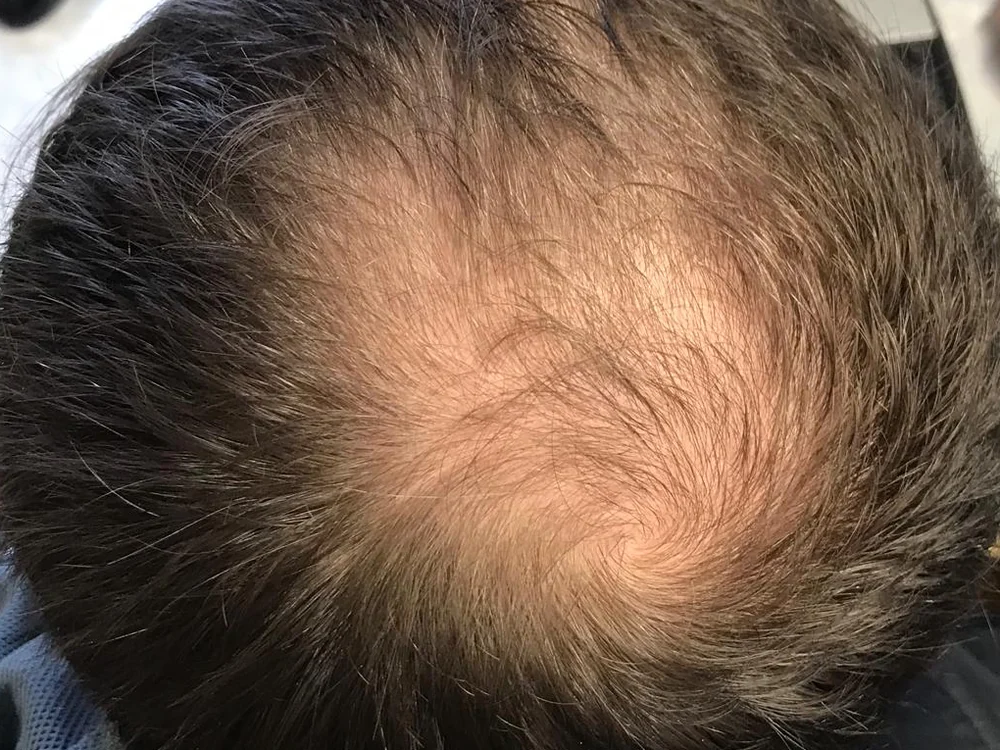
Male pattern baldness is inherited hair loss that follows a set route: the hairline recedes at the temples, the crown thins, and at the most advanced stage only a horseshoe of hair is left at the sides and back. It starts after puberty and moves slowly, which gives you time to act.
The key fact for anyone who notices it early is that treatment is better at stopping loss than at bringing hair back. So the sooner you know what you're dealing with, the more you keep.
1Quick answerThe short answer, in a few sentences
What Is Male Pattern Baldness?
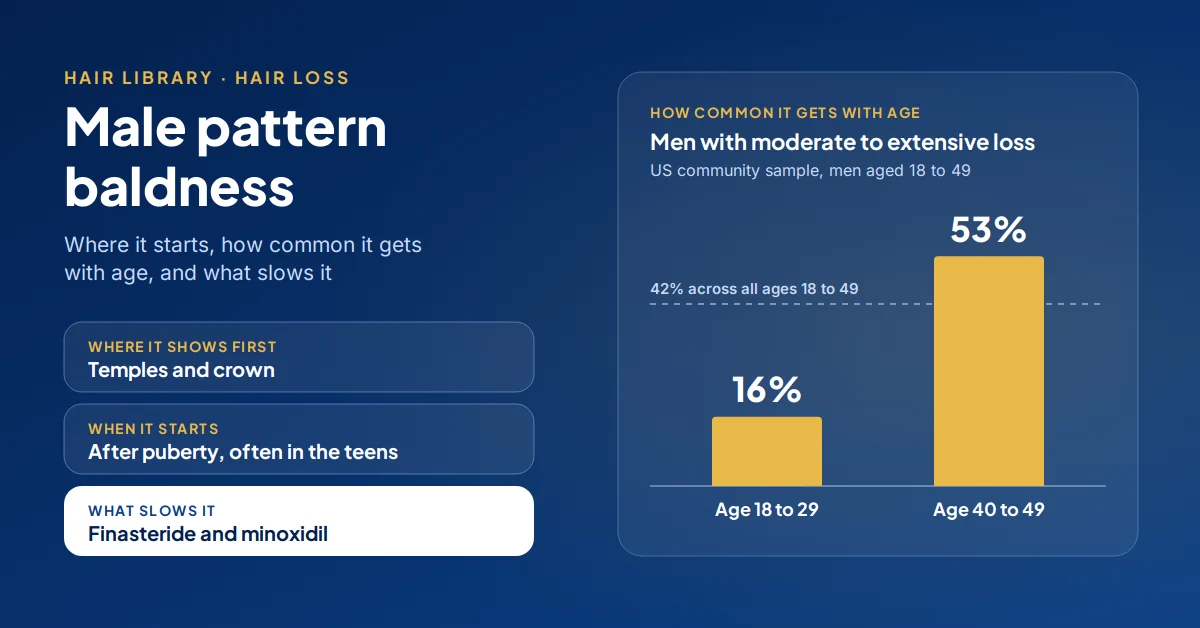
Male pattern baldness, or androgenetic alopeciaGlossaryAndrogenetic alopecia, or pattern baldness, is the pattern hair loss behind most male and female thinning. It is primarily driven by genetic predisposition and sensitivity to androgen hormones. Open in the glossary →, is inherited hair loss in which follicles on the top of the scalp shrink and grow finer, shorter hairs. Male hormones drive the change in follicles that are genetically sensitive to them. It's common: in a US community sample, 42% of men aged 18 to 49 had moderate to extensive loss.[1]
It's the most common form of hair loss in men, and a 2025 review names a hair transplant, finasteride tablets and minoxidil on the scalp as effective treatments. The female form is covered in our female pattern hair loss entry.
2Complete guideFrom causes and first signs to treatment and surgery
Why It Happens and When It Starts
How Genes and DHT Shrink Follicles
Male pattern baldness runs in families, and genes explain most of who gets it. In a study of 205,327 UK men, close-relative data put the genetic share at 62%, spread across 624 gene regions.[2] How it passes down is covered in is baldness genetic?
Not every follicle is affected: in men, those at the front, middle and crown of the scalp are the susceptible ones. In those follicles DHTGlossaryDihydrotestosterone (DHT) is a potent androgen that the body makes from testosterone using an enzyme called 5-alpha reductase. In people who are genetically sensitive to it, DHT makes hair follicles shrink. Open in the glossary →, a hormone made from testosterone, makes each new hair thinner, shorter and paler.[3] Over many hair cycles the follicles miniaturize: thick hairs are replaced by fine vellus-likeGlossaryVellus hair is the fine, short, pale hair that covers most of the body. It is under 30 micrometres wide and under 2 millimetres long. Open in the glossary → ones, and some follicles stop producing hair at all. The hormone itself is explained on our DHT and hair loss page.
When Does Male Pattern Baldness Start?
First signs usually appear in the teenage years, and the condition becomes more common with age, affecting up to 80% of white men at some point.[4] In the US sample, moderate to extensive loss rose from 16% of men aged 18 to 29 to 53% of men aged 40 to 49.
How common it is also varies substantially with ancestry, so figures from one population don't transfer neatly to another.[5] Either way, it becomes more common with age.
Male Pattern Baldness at 18 or in Your 20s
Early loss isn't rare: 16% of men aged 18 to 29 already had moderate to extensive loss in that US sample. If that's you, the advice is the same as at any age, only more pressing, because treatment started early gets better results.[6]
It can also weigh on you. Pattern hair loss harms wellbeing for many men, and prompt diagnosis and treatment can improve how you feel about it. Your age changes the surgery question too, which we cover in the treatment section below.
Early Signs at the Temples and Crown
Thinning usually starts at the temples, at the crown, or both, then slowly spreads across the top of the scalp.[7] Watch for these changes:
Temple corners that recede in matching triangles
A thin patch on the crown while the front changes little, the "vertex" type covered in crown balding
Hairs that grow back finer and shorter than before
A hairline that moves straight back without leaving an island of hair in the middle; 12% of men in the US sample had this frontal "type A" pattern
Doctors grade the pattern on the Hamilton-Norwood scale, the system most used for men. It runs from stage I, with little or no recession, to stage VII, where only a narrow horseshoe of hair remains, and stage III is the first that counts as baldness.
Each stage is shown on our Norwood scale page, and the Norwood test helps you place your own hairline. Treat any single rating as a starting point; the trend over a year tells you more.
Male Pattern Baldness or Something Else?
Several conditions can look like early balding, and each needs a different response. Match what you see to the closest row; the last two columns are our own advice and summary.
What you notice
Most likely
First move
What to expect
Temples receding or crown thinning slowly over years, with finer hairs
A hairline that rises a little as you leave your teens isn't always hair loss, because hairlines change shape as the face matures. Pattern loss, by contrast, makes each new hair thinner and shorter, so finer hairs at the edge are a reason to have it checked. Our mature hairline guide shows how to compare photos over time.
Telogen Effluvium: Shedding, Not Shrinking
Telogen effluviumGlossaryTelogen effluvium is sudden diffuse shedding that follows illness, childbirth or stress. Shedding usually starts two to three months after the trigger, and it is usually self-limiting once the trigger is removed. Open in the glossary → is sudden shedding spread over the whole scalp, not a slow change in pattern. Once its cause is removed, the hair regrows, so the first step is to find the trigger. Our telogen effluvium entry covers the triggers and recovery.
Sudden loss can also be a diffuse form of alopecia areata, which is one more reason to have heavy shedding checked rather than assume it's balding.
How Male Pattern Baldness Is Diagnosed
Doctors usually recognise it from its pattern. Trichoscopy, a magnified look at the scalp, is used routinely to confirm it, rule out other conditions, grade it and follow treatment.[3] If the picture is still unclear, a small scalp biopsy may be needed.
Treatment: What Slows It and What Restores Hair
Medicines can halt the progression, but at best they regrow part of what was lost, and early treatment does better. A transplant works differently, as the last row shows. The last column is our own summary.
Treatment
What it does
Effort
Evidence, in short
Finasteride tablet
A 5-alpha reductase inhibitor
One tablet a day
First-line in Japan's guideline[11]; slows loss and regrows some hair
Dutasteride capsule
Another 5-alpha reductase inhibitor
One capsule a day
Also first-line in Japan's guideline
Minoxidil liquid or foam
Slows loss; regrowth is partial at best
Twice a day on the scalp
First-line in Japan, for men and for women
Minoxidil tablet
The same drug, taken by mouth
One tablet a day
Japan's 2017 guideline advised against it
Low-level laser or LED
Shines light on the scalp
Repeated sessions
Recommended in Japan, but not first-line
PRP injections
Uses a concentrate from your own blood
Clinic visits
An option when medicines haven't worked
Hair transplant
Moves androgen-resistant hair from the back of the scalp
One operation, then medicine
Effective; the native hair around it still needs treatment
Finasteride and Dutasteride
Finasteride and dutasteride are 5-alpha reductase inhibitors, a drug class that Italy's guideline, adapted from the European one, lists for this condition.[3] Their main strength is protection. In the finasteride trials, men on placebo lost hair steadily for five years, so a scalp that looks the same after a year of treatment has already beaten the untreated course. How they work, their side effects and how the two compare are covered in their own entries.
Minoxidil: Solution or Tablet
Minoxidil is used by both men and women. Japan's guideline recommends the 5% solution twice a day as a first-line treatment for men, and the 1% solution for women.
The same 2017 guideline advised against oral minoxidil. Our minoxidil entry weighs the tablet against the liquid.
Laser Devices and PRP
Low-level laser and LED devices are among the treatments Japan's guideline recommends. PRP, injections of a concentrate made from your own blood, is something a 2020 review suggests for men who don't respond to medicine.[6] Neither is among the first-line treatments in Japan's guideline. Our PRP for hair loss entry weighs it in detail.
When a Hair Transplant Fits
A transplant moves follicles from the back of the scalp, which resist androgens, into thinning areas.[5] The condition keeps progressing in the hair you still have, and a candidacy review stresses explaining this to patients, along with the need for ongoing treatment through adult life.[12] That's why it's worth keeping a medicine going after surgery.
Not everyone is a good candidate. A review of surgical candidacy lists these groups as unsuitable:[12]
Very young patients
Men whose hair loss is unstable, or too limited to need surgery
Diffuse thinning without a pattern, or scarring alopecia
Unrealistic expectations, or conditions such as body dysmorphic disorder
Frequently Asked Questions
When does male pattern baldness usually start?
After puberty, often in the teenage years. By 40 to 49, 53% of men in a US survey had moderate to extensive loss.
Does male pattern baldness come from the mother or father?
Both. Some of the genes sit on the X chromosome, which you inherit from your mother, but only 26 of the 624 gene regions found in the large UK study are there. The rest can come from either parent.
Can male pattern baldness be reversed?
Partly. Medicines can stop it progressing, but at best they regrow part of what was lost, and they work better the earlier you start.
Does male pattern baldness ever stop?
Not reliably. It's a slowly progressive condition, and in a five-year trial 75% of men on placebo looked worse on photographs at the end.
How fast does male pattern baldness progress?
Slowly. Over five years on placebo, men lost 239 hairs in the measured area, a 26.3% fall in density.
Does male pattern baldness mean low testosterone?
The leading explanation points the other way. In men, pattern loss is thought to come from increased androgen signalling within susceptible hair follicles.[5]
Medication, Surgery or Both: What Suits You?
The right answer depends on where your hair is now, not only on how much you've lost.
Medication fits if you're still thinning rather than bald and you're ready for a daily routine you'll keep for years. It protects more than it regrows, so earlier is better.
A transplant fits if your loss is stable, your expectations are realistic and you have enough loss to need surgery.
Both together suits loss that is still moving fast: a candidacy review advises 6 to 12 months of medicine first to stabilize it before surgery.
Neither fits shedding that regrows once its trigger is gone; that needs time and a look for the cause.
Send us three photos for a free hair analysis, and the medical team will tell you whether your pattern calls for medication, a transplant or both, with no obligation. You can also message us on WhatsApp.
About the Author
Written by: Nazmi Güldeş, Certified Trichologist. Nazmi Güldeş focuses on patient education around androgenetic alopecia, evaluating miniaturization through dermoscopy, and assessing candidates for medical treatments and hair transplants.
Editorial Policy & Trust
This entry was drafted with the help of AI writing tools and edited by our team, then medically reviewed by Dr. Teuku Adifitrian, Sp.BP-RE (Dr. Tompi) on 31 October 2026. AI is never used as a source: every study cited here was checked against PubMed on 31 October 2026. Key figures are marked with their source, and every source is listed at the end of this entry. Read how we work in our editorial policy.
3 questions
Test yourself
Check what you remember from this entry. Each answer links back to the section that explains it.
In a US community sample, what share of men aged 40 to 49 had moderate to extensive hair loss?
53% of men aged 40 to 49 had stage III or worse, against 16% of men aged 18 to 29. Read the section
What usually tells a doctor that hair loss is male pattern baldness?
Pattern hair loss has a recognizable pattern; trichoscopy, a magnified look at the scalp, is used to confirm it and rule out other causes. Read the section
Why is medicine worth continuing after a hair transplant?
A transplant moves androgen-resistant follicles, but male pattern baldness keeps progressing in the native hair around them unless it is treated. Read the section
3Scientific evidenceStudy types, references and how to cite this entry
12sources
Evidence behind this entry: 12 publications indexed in PubMed (1998 to 2025): 6 reviews, 3 guidelines, 2 clinical studies and 1 randomized trial. 3 sources have free full text.
Randomized trialpeople assigned to treatments by chance
Reviewsummarises many studies
Clinical studya study in people without random groups
Guideline or labela professional body, or the official drug label
Rhodes T, Girman CJ, Savin RC, et al. Prevalence of male pattern hair loss in 18-49 year old men. Dermatologic Surgery. 1998;24(12):1330-1332.Clinical studyPubMedDOI
Yap CX, Sidorenko J, Wu Y, et al. Dissection of genetic variation and evidence for pleiotropy in male pattern baldness. Nature Communications. 2018;9(1):5407.Clinical studyPubMedDOIFree full text
Alessandrini A, Starace M, D'Ovidio R, et al. Androgenetic alopecia in women and men: Italian guidelines adapted from European Dermatology Forum/European Academy of Dermatology and Venereology guidelines. Giornale Italiano Di Dermatologia E Venereologia. 2020;155(5):622-631.GuidelinePubMedDOI
Blumeyer A, Tosti A, Messenger A, et al. Evidence-based (S3) guideline for the treatment of androgenetic alopecia in women and in men. Journal Der Deutschen Dermatologischen Gesellschaft = Journal of the German Society of Dermatology. 2011;9 Suppl 6:S1-57.GuidelinePubMedDOI
Liu Y, Tosti A, Wang ECE, et al. Androgenetic alopecia. Nature Reviews Disease Primers. 2025;11(1):73.ReviewPubMedDOI
York K, Meah N, Bhoyrul B, et al. A review of the treatment of male pattern hair loss. Expert Opinion on Pharmacotherapy. 2020;21(5):603-612.ReviewPubMedDOI
Gupta M, Mysore V. Classifications of Patterned Hair Loss: A Review. Journal of Cutaneous and Aesthetic Surgery. 2016;9(1):3-12.ReviewPubMedDOIFree full text
Kaufman KD, Girman CJ, Round EM, et al. Progression of hair loss in men with androgenetic alopecia (male pattern hair loss): long-term (5-year) controlled observational data in placebo-treated patients. European Journal of Dermatology. 2008;18(4):407-411.Randomized trialPubMed
Rassman WR, Pak JP, Kim J. Phenotype of normal hairline maturation. Facial Plastic Surgery Clinics of North America. 2013;21(3):317-324.ReviewPubMedDOI
Mounsey AL, Reed SW. Diagnosing and treating hair loss. American Family Physician. 2009;80(4):356-362.ReviewPubMed
Manabe M, Tsuboi R, Itami S, et al. Guidelines for the diagnosis and treatment of male-pattern and female-pattern hair loss, 2017 version. The Journal of Dermatology. 2018;45(9):1031-1043.GuidelinePubMedDOI
True RH. Is Every Patient of Hair Loss a Candidate for Hair Transplant?-Deciding Surgical Candidacy in Pattern Hair Loss. Indian Journal of Plastic Surgery. 2021;54(4):435-440.ReviewPubMedDOIFree full text
Güldeş, N. (2026, October 31). Male pattern baldness: Causes, age it starts, stages and treatment. Turkey Hair Center Hair Library. https://turkeyhaircenter.com/male-pattern-baldness/
@misc{guldes2026malepatternbaldness,
  author       = {Güldeş, Nazmi},
  title        = {Male pattern baldness: Causes, age it starts, stages and treatment},
  howpublished = {Turkey Hair Center Hair Library},
  year         = {2026},
  month        = oct,
  url          = {https://turkeyhaircenter.com/male-pattern-baldness/},
  note         = {Last updated 31 October 2026}
}
TY  - ELEC
AU  - Güldeş, Nazmi
TI  - Male pattern baldness: Causes, age it starts, stages and treatment
T2  - Turkey Hair Center Hair Library
PY  - 2026
DA  - 2026/10/31
UR  - https://turkeyhaircenter.com/male-pattern-baldness/
N1  - Last updated 31 October 2026
ER  -
Send three photos: front, top and sides. You get a technique recommendation, a graft range and a straight answer about what is achievable, before anyone talks about price.
Your details are with the team
A patient coordinator will get back to you shortly. If you would like to send your photos now, WhatsApp is the fastest way to do it.