Scalp Micropigmentation (SMP): How It Works, How Long It Lasts and Its Limits
How scalp micropigmentation uses tiny pigment dots to imitate shaved hair, how many sessions it takes, how long it lasts, what goes wrong and how it fits with a hair transplant.
10sources
10in PubMed
13min read
Written by Nazmi Güldeş, Certified Trichologist · Medically reviewed by Dr. Teuku Adifitrian, Sp.BP-RE (Dr. Tompi), Plastic, Reconstructive and Aesthetic Surgeon · Last reviewed 31 October 2026
Reading level
Scalp micropigmentation (SMP) is a cosmetic tattoo for hair loss: thousands of tiny pigment dots are placed in the scalp so that it looks like hair cut close to the skin, or so that thin areas show less pale scalp. It doesn't grow a single hair. What it changes is contrast, which makes it very good at some jobs and the wrong tool for others.
Most of what decides whether SMP works for you is settled before the first dot: the look you want, whether your hair loss has stopped moving and who does the work. We take each in turn, then set SMP against a hair transplant.
1Quick answerThe short answer, in a few sentences
What Is Scalp Micropigmentation (SMP)?
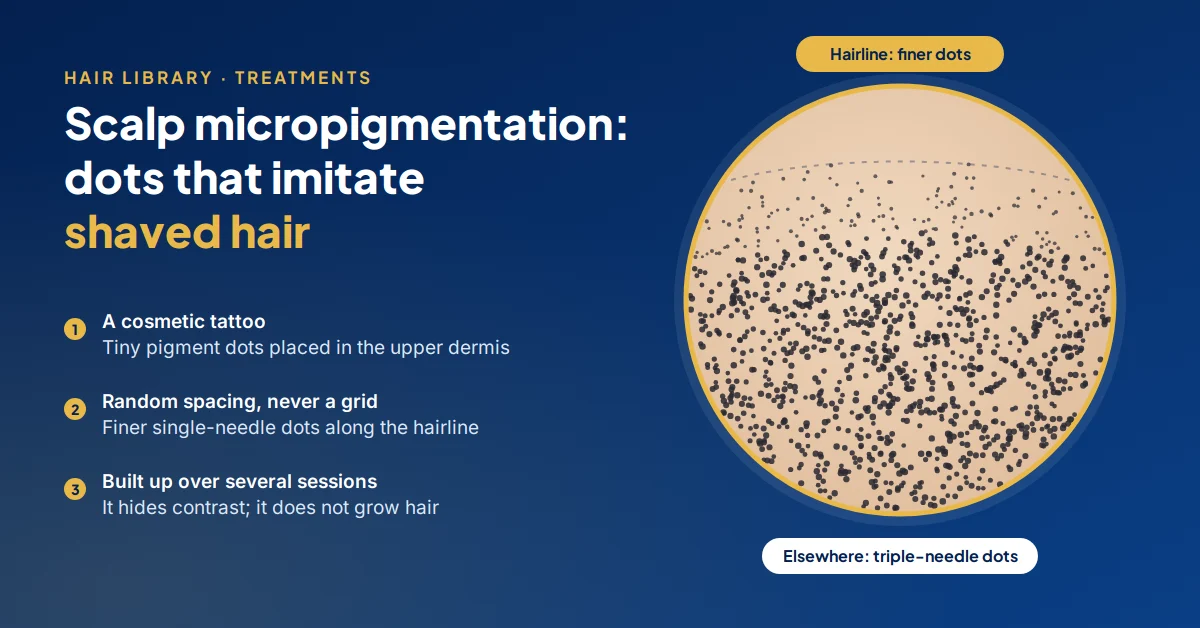
Scalp micropigmentation is a medical tattoo that places tiny pigment dots in the upper dermis of the scalp. The dots copy the look of shaved stubble, or darken the scalp that shows through thin hair. SMP hides hair loss and scars without treating them. It is built up over several sessions, and the look needs touch-ups as it fades.
2Complete guideFrom the dots and sessions to risks, removal and transplants
How SMP Works: Sessions, Healing and How Long It Lasts
Dots, Depth and Colour
Each dot is under 1 mm across and goes in with the needle at a right angle, so it comes out round. A single needle draws the finer dots along the hairline and a three-pronged one fills the rest. The spacing is random, because dots in a line or a grid look artificial.
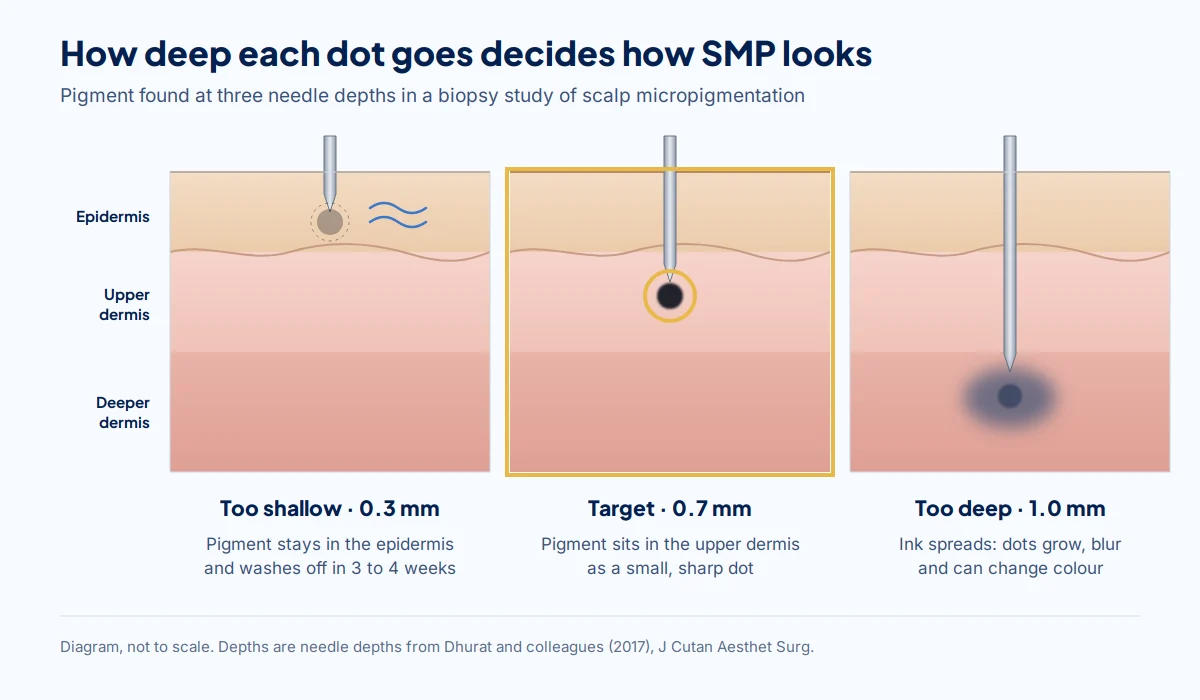
Depth decides most of the result. In a biopsy study, pigment placed 0.3 mm deep stayed in the epidermis and washed off within 3 to 4 weeks, while pigment at 1.0 mm spread through the deeper dermis and blurred. The target lies between them, at about 0.7 mm in the upper dermis.[2]
How needle depth changes an SMP dot. Diagram based on the biopsy findings of Dhurat and colleagues, 2017.
Colour is the other trap. Even pure black pigment seen through skin can take on a bluish tint, in every skin type, and very small dots make that shift harder to notice.[3] If much of your hair is grey, the dots may only blend if you keep dyeing it.
How Many Sessions SMP Takes
SMP is built up in layers, never in one sitting, and the first pass is kept light because ink placed too deep can spread. Most people need two to four sessions, each lasting up to 8 hours.[4] In one series of 80 men with advanced loss, the number ranged from 2 to 7.[5]
Here is the course as you would live it. The last column is our advice.
Stage
What happens
What you can do
Before you book
What happens
A doctor diagnoses the loss; you agree the look and hairline
What you can do
Wait until your hair loss has settled
Session 1
What happens
A sparse first layer, about 30% of the final density
What you can do
Expect it to look patchy
Sessions 2 and 3
What happens
Density is built up to the final look
What you can do
Point out patches that look darker or lighter
First days after each
What happens
Redness and swelling settle
What you can do
Keep the scalp dry for 48 to 72 hours
First 6 months
What happens
The look fades a little, more over scars
What you can do
Protect your scalp from strong sun
Later years
What happens
Touch-ups for fading and for spreading loss
What you can do
Plan for top-ups
Does SMP Hurt, and How Long Does It Take to Heal?
The study that standardized the technique worked without local anaesthetic, while other practitioners numb the scalp first, which one review says makes it pain-free.[6]
The standardization study saw only short-lived redness and swelling. Advice on the first wash ranges from 48 to 72 hours, so ask which rule your practitioner follows, and protect your scalp from the sun, which can fade or shift the pigment.
How Long Does SMP Last?
SMP is often described as permanent, but the look is less stable than that word suggests. In one series, visual density scores fell from 8.7 to 7.7 out of 10 within six months, with more fading over scars.[3]
Slight fading by 8 to 10 months may call for a repeat session[2], and if your hair loss keeps moving, the edge of the tattoo has to follow it. So we'd treat SMP as semi-permanent: a lasting look with upkeep, not a one-off fix.
Common Myths About SMP
"SMP grows hair." It doesn't. It changes colour and contrast, nothing more.
"It's permanent, so one round is enough." The dots fade, and touch-ups are part of the plan.
"The needles damage your follicles." In 80 men followed for at least six months, no folliculitis, scarring or extra thinning was recorded.
"Any tattoo artist can do it." Depth control takes months of practice, and badly placed dots are hard to fix.
Who SMP Suits, and SMP vs Hair Transplant
Men Who Want a Shaved Look
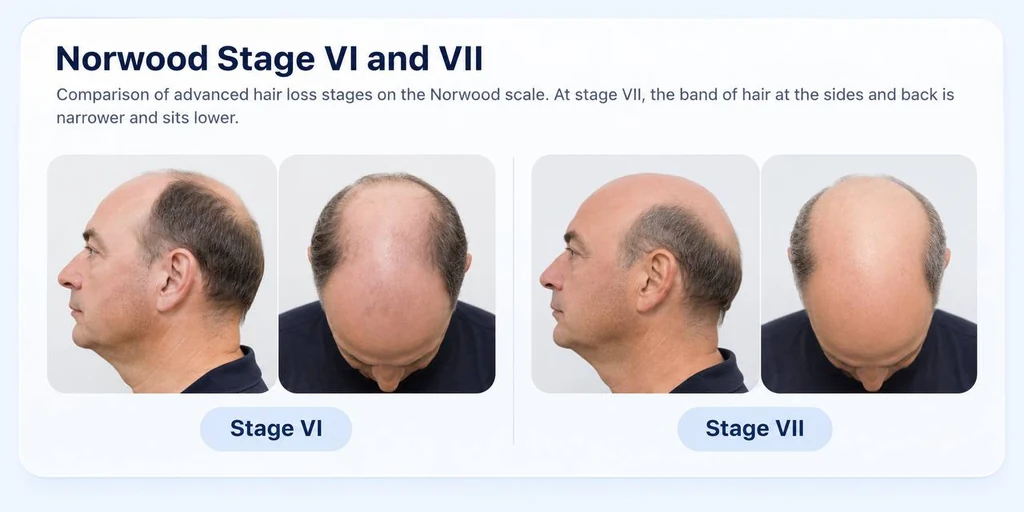
Shaved-style SMP is the classic use: men with advanced loss who are happy with a buzz cut. In 80 men at NorwoodGlossaryThe Norwood scale is the classification most doctors use for male pattern hair loss. It describes the usual ways the loss moves, stage by stage, from Norwood 1 to Norwood 7. Open in the glossary → stages 4 to 7, average satisfaction was 4.8 out of 5 at six months or more, and none said others had noticed the pigment.[5]
The commitment lasts as long as the tattoo, because the sides and back have to stay clipped short to match. For the most advanced stage, see our Norwood 7 hair transplant guide.
Women With Thinning Hair
In women, SMP usually shades the scalp that shows through at the parting or crown instead of drawing stubble. It can't add volume, and in 40 women with female pattern hair loss, hair density decided the choice: SMP at 104.6 hairs per cm² or more, a transplant strongly favoured at about 96 or fewer.[7]
All of those women were East Asian with black hair, so the cut-offs may not transfer. Put simply, if you still have plenty of fine hairs, SMP shades the gaps between them; if the hair itself has gone, see hair transplants for women.
Black Women and Afro-Textured Hair
A review of camouflage options for Black women lists SMP for scarring alopecia, hard-to-treat alopecia areata and scalp scars.[8] The plan has to allow for lower follicle density and finer hair shafts, and for later changes in hair colour and further hair loss.
Scars and Alopecia Areata
Scars from surgery, injury and hair transplants can be blended in with dots, though pigment over scar tissue faded more in one series and may need touch-ups within a few years.[3]
With alopecia areata, get a diagnosis before any tattoo, because the hair can come back. In one reported case, a woman had SMP over her whole scalp and was later diagnosed with alopecia totalis, which improved markedly with JAK inhibitor treatment.[9]
SMP vs Hair Transplant: Side by Side
A transplant moves real hair; SMP changes colour. The last row is our own summary of the evidence.
Using SMP With a Transplant: Density and Donor Scars
Surgeons implant about 20 to 40 grafts per cm², against a natural average of about 200 hairs, so a dotted background makes the grafts look denser.[2] That's the logic of combining the two: the dots fill the background and the grafts add real hair. To estimate your own numbers, see how many grafts you need.
SMP also hides what surgery leaves behind. A strip (FUTGlossaryIn FUT, a thin strip of skin is removed from the back of the head, divided into grafts of 1 to 4 hairs, and the wound is closed with stitches. It leaves a line scar, while FUE leaves tiny dots. Open in the glossary →) scar can be tattooed along with the rest of the scalp, and donor areasGlossaryThe donor area is the back and sides of the head, where follicles resist DHT. An extracted follicle does not grow back in that spot, so extractions are spread out, and the donor supply is the limit of every plan. Open in the glossary → thinned by too many FUEGlossaryFUE (Follicular Unit Extraction) moves hair follicles one by one from the back and sides of the scalp to thinning areas, without the linear scar of the older strip method. Open in the glossary → extractions have been treated the same way. To grow hair into a scar instead, read about hair transplant on scar tissue.
When a Transplant Is the Wrong Answer, and When SMP Is
Match your situation to the closest row. The "better fit" column is our reading of the studies above, not a rule.
Your situation
Better fit
Why
You like a buzz cut and your donor area is weak
Better fit
SMP
Why
With a poor donor area, surgery may not be an option
You want volume or longer hair
Better fit
Transplant
Why
SMP can't add volume
Your hairs are fine but still numerous
Better fit
SMP
Why
Surgery may damage neighbouring follicles
Your skull outline shows through from the front
Better fit
Transplant
Why
SMP can't hide it
The bald area is large for your donor supply
Better fit
Both
Why
Grafts can't cover it all; dots fill the background
The last row is about timing. Medicine such as finasteride or minoxidil is used to slow further loss; plan SMP or surgery once the pattern has settled.
Risks, Signs of Poor SMP and Removal
Side Effects and Infection
Beyond brief redness and swelling, SMP carries a risk of infection and of allergy to the pigment, and needles can pass on hepatitis or HIV.[4] That's one more reason to have it done in a medical setting.
Some pigment may move on to the lymph nodes, and the long-term health effects of that, or of sunlight on the pigment, are not well understood.[3]
Signs of Poor SMP
A few misplaced dots among thousands can be very noticeable. Watch for:
A blue or green tint. Black pigment can drift to bluish grey or bluish green.
Dots that spread. Pigment placed too deep blurs into a patchy look that is hard to reverse.
Rows or a grid. Dots set in lines look artificial.
A smudged hairline. Ink spreading at the front edge blurs it.
Can SMP Be Removed or Corrected?
Yes, but it takes work. In one clinic's series of 120 revisions, 89.2% had first been treated at a tattoo or beauty salon.[10] Most were fixed with a hair transplant to hide the pigment, some with a transplant plus new SMP, and the rest had the old pigment lasered off, usually before fresh SMP.
Choosing a Practitioner
Who should do SMP is debated. Across medical tattooing in general, the systematic review found satisfaction just as high when non-physicians did the work[1], while South Korean law reserves SMP for licensed medical professionals. Before you book, ask:
How many SMP cases the person placing the dots has done.
Whether they test a small patch first, especially over scars.
How many sessions and touch-ups they expect over the years.
Whether a doctor has diagnosed your hair loss first.
Frequently Asked Questions
Does scalp micropigmentation look real?
At a normal distance it can: among 80 men with shaved-style SMP, none reported that others had noticed. Dots in rows, or dots that have blurred, give it away.
Is scalp micropigmentation a tattoo?
Yes. It is a cosmetic tattoo, with dots placed in a stippling pattern to copy hair cut close to the scalp.
Does scalp micropigmentation damage hair follicles?
A series of 80 men found no folliculitis, scarring or faster thinning. In a small survey, though, one of five people treated outside medical settings reported worse hair loss.
Does scalp micropigmentation grow hair?
No. It creates the look of denser hair without adding any.
Can women get scalp micropigmentation?
Yes. It mostly shades the scalp under thin hair, and suits women who still have plenty of fine hairs.
How long does scalp micropigmentation take to heal?
Redness and swelling are short-lived. Protocols keep the scalp unwashed for 48 to 72 hours.
Is scalp micropigmentation worth it?
For the right person it can be: satisfaction is high across the published series, none of them randomized. It's least worth it if you want volume or your loss hasn't settled.
Is Scalp Micropigmentation Right for You?
SMP suits you if you like a shaved look or mainly see scalp through thin hair, your hair loss has settled and you accept touch-ups for years. It's the wrong tool if you want volume or longer hair.
If you're weighing SMP against a transplant, send us three photos for a free hair analysis. The medical team will tell you what a transplant could achieve for your pattern of loss and your donor area. You can also message us on WhatsApp.
About the Author
Written by: Nazmi Güldeş, Certified Trichologist. Nazmi Güldeş focuses on patient education around androgenetic alopecia, evaluating miniaturization through dermoscopy, and assessing candidates for medical treatments and hair transplants.
Editorial Policy & Trust
This entry was medically reviewed by Dr. Teuku Adifitrian, Sp.BP-RE (Dr. Tompi) on 31 October 2026. Every study cited here was checked against PubMed on 31 October 2026. Key figures are marked with their source, and every source is listed at the end of this entry. Read how we work in our editorial policy.
3 questions
Test yourself
Check what you remember from this entry. Each answer links back to the section that explains it.
What happened to pigment placed only 0.3 mm deep in the biopsy study?
At 0.3 mm the pigment stayed in the epidermis and washed off within 3 to 4 weeks; the target is the upper dermis. Read the section
What can SMP not add, according to the study of 40 women?
SMP darkens the scalp but cannot add volume; low hair density pointed to a transplant instead. Read the section
In a series of 120 people treated for unsatisfactory SMP, where had most first had it done?
89.2% had first been treated at a tattoo or beauty salon. Most were then fixed with a hair transplant over the pigment. Read the section
3Scientific evidenceStudy types, references and how to cite this entry
10sources
Evidence behind this entry: 10 publications indexed in PubMed (2017 to 2025): 5 clinical studies, 3 reviews, 1 systematic review and 1 case report. 9 sources have free full text.
Reviewsummarises many studies
Clinical studya study in people without random groups
Becker SJ, Cassisi JE. Applications of Medical Tattooing: A Systematic Review of Patient Satisfaction Outcomes and Emerging Trends. Aesthetic Surgery Journal Open Forum. 2021;3(3):ojab015.Systematic reviewPubMedDOIFree full text
Dhurat RS, Shanshanwal SJS, Dandale AL. Standardization of SMP Procedure and Its Impact On Outcome. Journal of Cutaneous and Aesthetic Surgery. 2017;10(3):145-149.Clinical studyPubMedDOIFree full text
Liu Q, Sun M, Zhang J, et al. Scalp Micropigmentation Is an Effective Treatment for Localized Alopecia: Technical Analysis and a Series of Ten Case Reports. Journal of Cosmetic Dermatology. 2025;24(9):e70375.Case reportPubMedDOIFree full text
Saed S, Ibrahim O, Bergfeld WF. Hair camouflage: A comprehensive review. International Journal of Women's Dermatology. 2017;3(1 Suppl):S75-S80.ReviewPubMedDOIFree full text
Park JH, You SH, Kim N. Shaved hair style scalp medical tattooing technique for treatment of advanced male pattern baldness patients. International Journal of Dermatology. 2019;58(1):103-107.Clinical studyPubMedDOIFree full text
Rassman W, Pak J, Kim J. Combining Follicular Unit Extraction and Scalp Micropigmentation for the Cosmetic Treatment of Alopecias. Plastic and Reconstructive Surgery Global Open. 2017;5(11):e1420.ReviewPubMedDOIFree full text
Park JH, Kim N, You SH. Hair transplantation versus scalp micropigmentation: A retrospective study of treatment selection in persons with female pattern hair loss. Journal of Cosmetic Dermatology. 2024;23(10):3347-3355.Clinical studyPubMedDOIFree full text
Taye M, Kamili NA, Aguh C, et al. Considerations and recommendations on camouflage in alopecia in Black women. International Journal of Women's Dermatology. 2023;9(3):e111.ReviewPubMedDOIFree full text
Kim MJ, Kim HS. Perceptions and Experiences of Scalp Micropigmentation Among Dermatology Outpatients With Hair Loss: A Survey-Based Study. Annals of Dermatology. 2025;37(6):357-362.Clinical studyPubMedDOIFree full text
Park JH, Kim N, Kim DW, et al. Revision for unsatisfactory outcomes of scalp micropigmentation. International Journal of Dermatology. 2025;64(1):136-141.Clinical studyPubMedDOI
Güldeş, N. (2026, October 31). Scalp micropigmentation (SMP): How it works, how long it lasts and its limits. Turkey Hair Center Hair Library. https://turkeyhaircenter.com/scalp-micropigmentation/
@misc{guldes2026scalpmicropigmentation,
  author       = {Güldeş, Nazmi},
  title        = {Scalp micropigmentation (SMP): How it works, how long it lasts and its limits},
  howpublished = {Turkey Hair Center Hair Library},
  year         = {2026},
  month        = oct,
  url          = {https://turkeyhaircenter.com/scalp-micropigmentation/},
  note         = {Last updated 31 October 2026}
}
TY  - ELEC
AU  - Güldeş, Nazmi
TI  - Scalp micropigmentation (SMP): How it works, how long it lasts and its limits
T2  - Turkey Hair Center Hair Library
PY  - 2026
DA  - 2026/10/31
UR  - https://turkeyhaircenter.com/scalp-micropigmentation/
N1  - Last updated 31 October 2026
ER  -
Talk to our hair team on a free video call, in your language. You receive a written plan with your technique, estimated grafts and all-inclusive price. If a hair transplant isn't right for you, we tell you honestly.
Your information is 100% confidential.
Real People Real Support
Send your photos on WhatsApp
Front, top and both sides, reviewed by the medical team.