The Hair Follicle: How It Works & What Makes It Fail
Performed at authorized partner hospitals Turkey Hair Center is a Ministry of Health authorized health-tourism intermediary, not a clinic.
A hair follicle is a tube-like structure in your skin that surrounds the root and strand of a hair and grows it in cycles. A follicle hurt by an injury can repair itself, but scarring alopecia causes permanent hair loss.
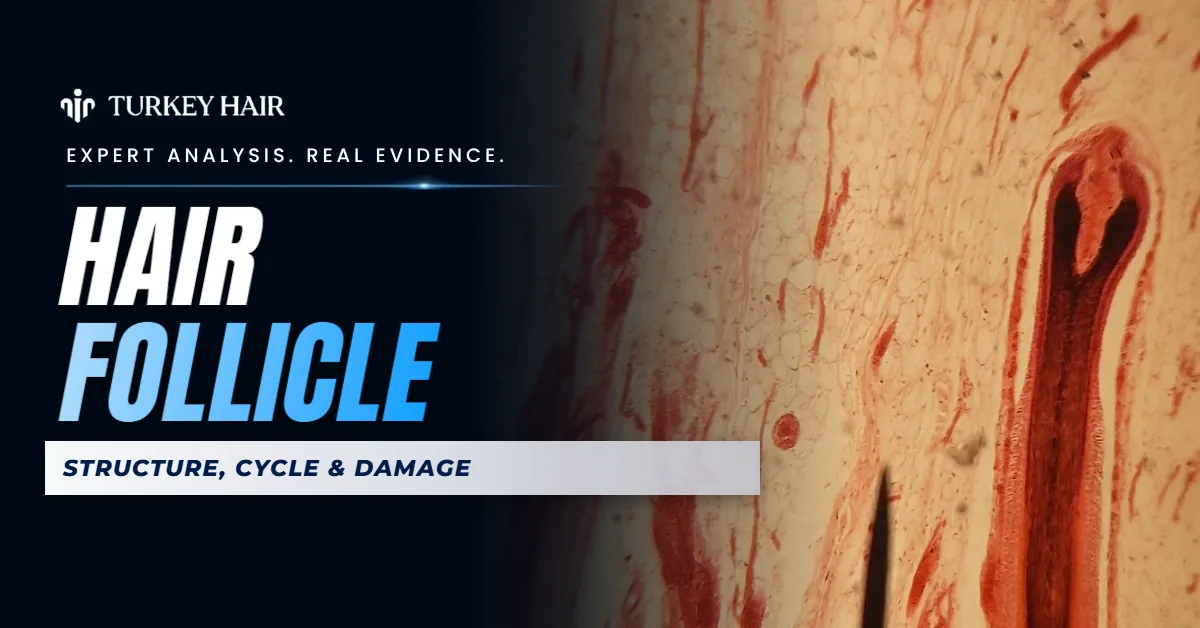
Cover built on a stained tissue slide seen under a microscope. Photo: Deset.apple, CC0, via Wikimedia Commons, cropped, resized, text added.
This guide explains what a follicle is made of, how its growth cycle works, why follicles shrink in pattern hair loss, and which kinds of damage can reverse. It also covers what a follicle does in a hair transplant and answers the questions people ask most.
Hair does not grow from the visible strand. It grows from the follicle underneath the skin, and what happens there decides how thick, how long and how permanent your hair is.
What a Hair Follicle Is
Cleveland Clinic describes a hair follicle as a tube-like structure (pore) that surrounds the root and strand of a hair. It sits in the top two layers of skin, and you cannot see it without a microscope. Its own comparison is a sock: the follicle is the sock, and the hair is the foot inside it.
A follicle does more than grow hair. According to Cleveland Clinic, it also:
grows each hair on your head and body
helps repair the skin after a wound
helps form new blood vessels and neurons
It is also one of a few structures in the body that can stop working and then start again, which is the reason hair can fall out and later return.
Hair Follicle Anatomy, Layer by Layer
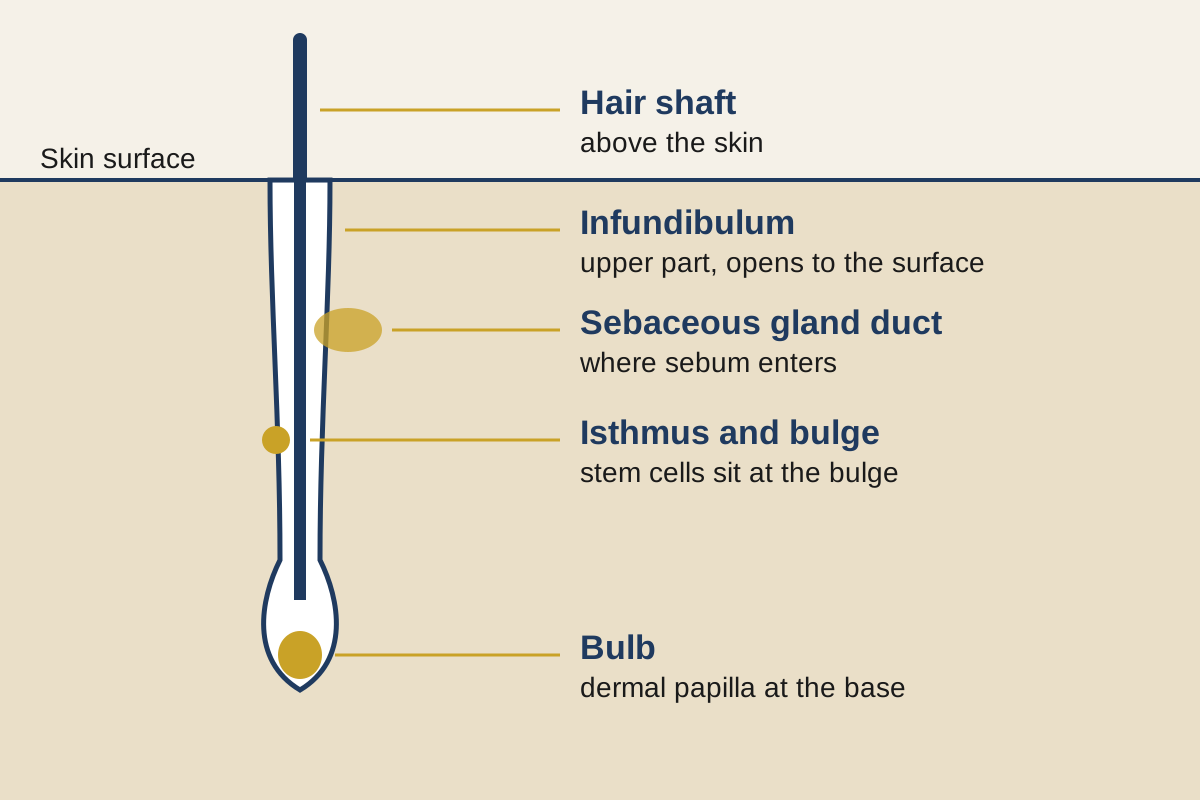
A medical review of hair anatomy in Medscape divides the follicle into three regions, from the bottom of the follicle to the skin surface.
Region
Where it sits
What it does
Lower segment (bulb)
From the base up to where the arrector pili muscle attaches
Houses the dermal papilla and the matrix that build the hair
Middle segment (isthmus)
A short section from the muscle attachment to where the oil duct enters
Contains the bulge, a store of stem cells
Upper segment (infundibulum)
From the oil duct entrance to the opening on the skin
Carries sebum and cell debris out to the skin surface
Three parts deserve a closer look:
Dermal papilla. A cluster of cells at the base that Medscape calls required for hair follicle growth in each cycle.
Matrix. Rapidly dividing cells around the papilla that give rise to the hair shaft and its pigment.
Bulge. The area marked by the muscle attachment. It holds stem cells that are essential for regenerating the follicle and healing wounds.
The hair strand itself is wrapped in sheath layers. The outer root sheath is continuous with the skin surface, and the inner root sheath coats and supports the shaft up to the isthmus.
The bulge matters because it is where the follicle renews itself. Damage that reaches the stem cells there is what separates a follicle that can recover from one that cannot. That is the logic behind the reversible and permanent sections below.
The Hair Growth Cycle in Brief
Every follicle cycles through growth, a short transition and rest. Cleveland Clinic puts the growing phase (anagen) at two to seven years, with hair lengthening about 1 cm a month. The transition phase (catagen) lasts about two weeks, and the resting phase (telogen) up to four months.
Medscape gives scalp figures that are slightly different: anagen about 3 to 4 years, catagen about 2 to 3 weeks and telogen about 3 months. It also says that about 84% of scalp hairs are in anagen, 1% to 2% in catagen and 10% to 15% in telogen at any moment. Because follicles cycle out of step with each other, you lose a few hairs every day without going bald. The NHS says it is normal to lose between 50 and 100 hairs a day.
For the full cycle, the timings and what disturbs it, see our guide to the hair growth cycle.
How Many Hair Follicles Do You Have?
Cleveland Clinic says you are born with over 5 million hair follicles in your body and over one million on your head. That is a count of follicles, and each one grows hair through the cycle described above. For a closer look at how many strands a typical head carries, see how many hairs are on a head.
Why Hair Follicles Shrink
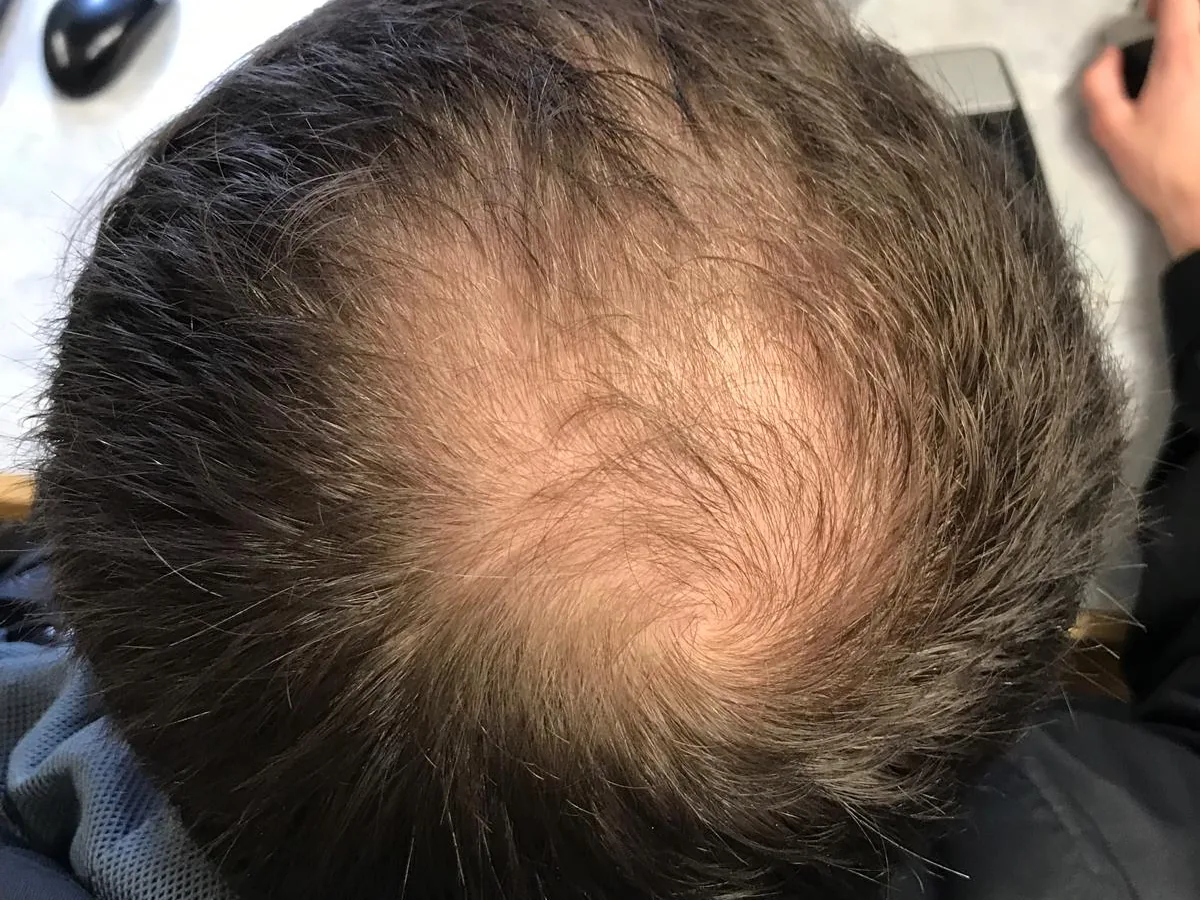
The most common follicle problem is not death but shrinking. Medscape explains that in people who are predisposed to hair loss, terminal hairs on the adult scalp can undergo involutional miniaturization and become vellus, the fine, short, pale hair.
Thinning over the crown, the area where pattern hair loss often shows first. Photo: BlaiserPascal, CC BY-SA 4.0, via Wikimedia Commons, cropped and resized.
MedlinePlus links pattern hair loss in men to the hormone DHT. It states that too much stimulation of hair follicles by androgens may lead to a shorter growth period, resulting in shorter and thinner strands of hair. The growth of new hair to replace shed strands is also delayed. In women, androgens play a role too, but MedlinePlus says other unknown factors are involved.
Miniaturisation is the hallmark of male pattern hair loss, female pattern hair loss and alopecia areata, according to a 2012 study in the International Journal of Trichology. The difference is the outcome. Hair in alopecia areata can regrow fully, while pattern hair loss is either irreversible or shows only partial regrowth. The authors suggest the cause may lie in the muscle attachment, and they present it as a model, not a settled fact.
Whether a follicle can recover depends on what hurt it. The table below sums up what the sources say.
Type of damage
Can the follicle recover?
What to do
Hair pulled out by accident
In most cases the hair grows back (Cleveland Clinic)
Stop pulling; the follicle itself is not removed
Injury or wound
Follicles can repair themselves; regrowth can take up to four years, depending on severity (Cleveland Clinic)
Clean wounds and protect the skin
Repeated injury
Scars form, growing hair becomes difficult and new hair is thinner and more fragile (Cleveland Clinic)
See a doctor before scarring sets in
Alopecia areata
Miniaturised hairs can regrow fully (2012 study)
See a dermatologist for diagnosis
Pattern hair loss
Irreversible or only partial regrowth (2012 study)
Get an assessment early
Long-term traction
Late stages may progress to irreversible scarring alopecia (2018 review)
Stop the pulling and see a dermatologist
Scarring (cicatricial) alopecia
Always results in permanent hair loss (2021 review)
Early diagnosis, since it progresses rapidly
What Damages Hair Follicles
Cleveland Clinic lists the conditions that most often affect follicles: alopecia areata, baldness, folliculitis, hidradenitis suppurativa, stress, telogen effluvium, and whiteheads, blackheads or a dilated pore of Winer.
Pulling and Tension
You cannot pull out a follicle, but you can pull out the hair, and a bulb at the end of the strand is the root. Repeated tension is another matter. A 2018 review in Clinical, Cosmetic and Investigational Dermatology says traction alopecia affects one third of women of African descent who wear traumatic hairstyles for a long time. Risk rises with the amount of pulling, how long it lasts and chemical relaxers. Tight buns, ponytails, weaves, extensions and tight braids carry the highest risk. Our guide to traction alopecia covers early signs and what to change.
Infection and Inflammation
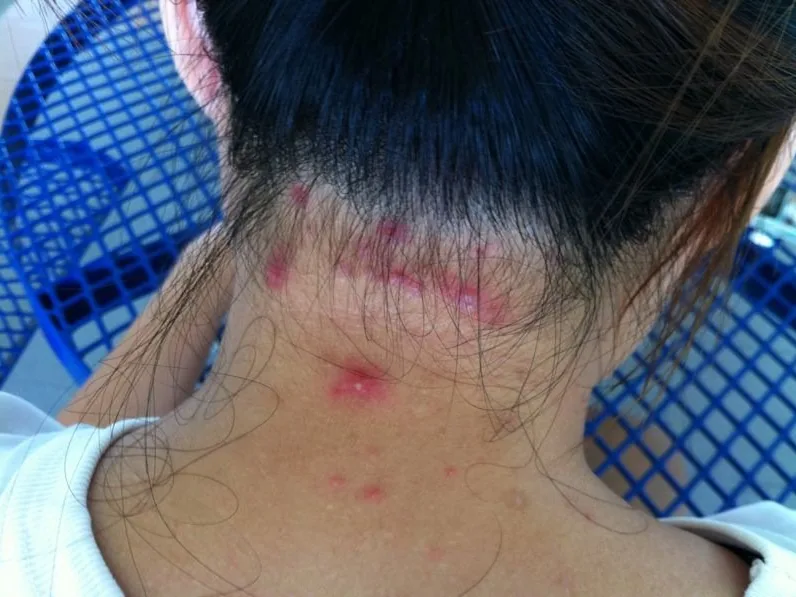
Folliculitis is inflammation of the follicle. Cleveland Clinic lists pimples, fluid-filled bumps, swelling, an itchy rash, and a wound that does not heal, has a yellow crust or leaks white to yellow fluid as signs of infection.
Folliculitis at the nape, with red bumps around the hair follicles. Photo: Lforlav, CC BY-SA 3.0, via Wikimedia Commons, cropped and resized.
A doctor examines the skin and can run a blood test, a biopsy or a pull-and-tug test. Cleveland Clinic lists antibiotics among the treatments for infections, and the choice and the course are for a doctor to decide.
Stress and Shedding
Stress and telogen effluvium are both on Cleveland Clinic's list of follicle conditions. In telogen effluvium, more hairs than usual move into the resting phase and shed together. Read more in our guide to telogen effluvium.
Scarring
Frequent injury to skin and follicles can produce scars that make growing hair difficult, and cicatricial alopecias, the group that destroys follicles, always result in permanent hair loss and progress rapidly, according to a 2021 review in the Indian Journal of Plastic Surgery.
Can Hair Follicles Grow Back?
It depends on whether the follicle is alive and has not scarred. Cleveland Clinic says that when you damage hair follicles in an injury, they can repair themselves and your hair will grow back, with new growth taking up to four years depending on the severity.
A follicle that has shrunk but is still alive is a different case, and so is a follicle in a scar. For the signs and the options, read about dead hair follicles.
How to Keep Hair Follicles Healthy
Cleveland Clinic recommends these steps to keep follicles healthy and strong:
avoid pulling your hair out
eat a healthy, well-balanced diet
reduce stress
wear a helmet when your head is at risk of injury
wear sunscreen
clean wounds so they heal without infection
These steps protect the follicles you have. They are not a treatment for pattern hair loss, which MedlinePlus links to androgens acting on the follicle.
Hair Follicles and Hair Transplants
When pattern hair loss has progressed, the question becomes whether enough healthy follicles remain. Cleveland Clinic lists hair transplant among the treatments for follicle conditions. In a FUE hair transplant, follicles are moved from one area of the scalp to another, so the quality and number of your own follicles shape the plan.
The cause of the loss comes first, so the medical team looks at your photos before discussing any treatment. See what causes hair loss if you are not yet sure what is behind yours.
Frequently Asked Questions
What Is a Hair Follicle?
It is a tube-like structure in the skin that surrounds the root and strand of a hair. Cleveland Clinic notes that follicles are microscopic and sit in the top two layers of skin.
Do Hair Follicles Grow Back?
Often, yes. Cleveland Clinic says that follicles damaged by an injury can repair themselves, with regrowth taking up to four years. If the skin scars, growth becomes difficult, and scarring alopecia causes permanent loss.
What Causes Hair Follicles to Grow?
Hair grows from a cluster of cells called the dermal papilla at the base of the follicle. Medscape describes it as required for hair follicle growth in each cycle. The matrix cells around it divide quickly and build the shaft.
How Do I Strengthen My Hair Follicles?
Avoid pulling your hair out, eat a balanced diet, reduce stress, wear a helmet, wear sunscreen and clean wounds. These steps come from Cleveland Clinic and protect your follicles, but they are not a treatment for pattern hair loss.
What Happens If You Pull Out a Hair Follicle?
You cannot pull out the follicle itself. If you pull a strand out, you may see a bulb on the end, which is the root. In most cases the hair grows back, according to Cleveland Clinic.
Can a Hair Follicle Get Infected?
Yes. Folliculitis is an inflammation of the follicle, and Cleveland Clinic lists pimples, fluid-filled bumps, swelling and an itchy rash among its symptoms. A wound with a yellow crust or leaking fluid points to infection, so see a doctor.
How Many Hair Follicles Are on the Head?
Cleveland Clinic says you are born with over one million hair follicles on your head, out of over 5 million across your body.
Worried About Your Hair Follicles?
If your hair is thinning and you are not sure whether the follicles are shrinking, damaged or scarred, clear photos can show the pattern of loss. Send them for a free hair analysis, and the medical team will tell you what they see.
Medical disclaimer: This article is for informational purposes only and is not medical advice. Individual results and recovery vary from person to person. Always follow the written aftercare plan from your own medical team.
Yazdabadi A, Whiting D, Rufaut N, Sinclair R. Miniaturized hairs maintain contact with the arrector pili muscle in alopecia areata but not in androgenetic alopecia: a model for reversible miniaturization and potential for hair regrowth. International Journal of Trichology, 2012;4(3):154-157
Billero V, Miteva M. Traction alopecia: the root of the problem. Clinical, Cosmetic and Investigational Dermatology, 2018;11:149-159
Singh S, Muthuvel K. Role of hair transplantation in scarring alopecia: to do or not to do. Indian Journal of Plastic Surgery, 2021;54(4):501-506
Deset.apple Hair follicle slide under a microscope (cover image: cropped, text added), CC0 Wikimedia Commons
BlaiserPascal Male-pattern hair loss, body photo (cropped), CC BY-SA 4.0 Wikimedia Commons
Lforlav Folliculitis at the back of the scalp, body photo (cropped), CC BY-SA 3.0 Wikimedia Commons
Send three photos: front, top and sides. You get a technique recommendation, a graft range and a straight answer about what is achievable, before anyone talks about price.
Your details are with the team
A patient coordinator will get back to you shortly. If you would like to send your photos now, WhatsApp is the fastest way to do it.