How to Stop Hair Loss: Treatments That Work, Compared
Most hair loss can be slowed or stopped, but how to stop hair loss depends on the cause. Shedding after an illness, a birth or a hard few months usually stops by itself. Inherited thinning keeps going unless you treat it, and the sooner you start, the more hair you keep.
So the first job is working out which one you have. There's a timing clue most people miss, and we'll start with it.
Can Hair Loss Be Stopped?
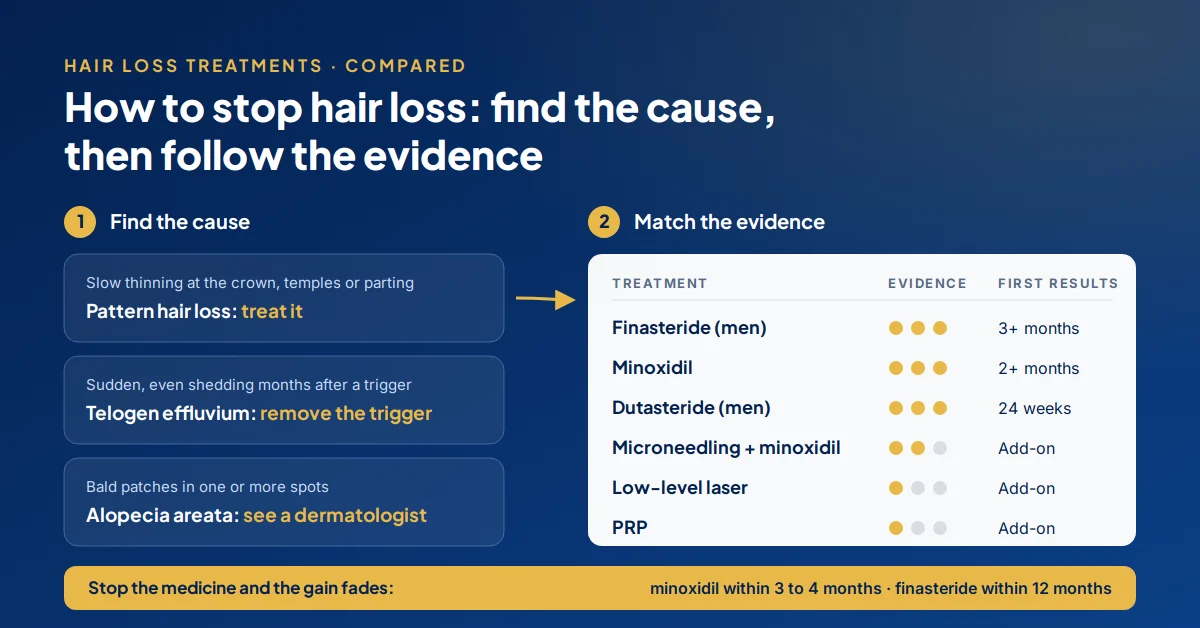
Often, yes. Shedding after a trigger usually stops on its own. Inherited pattern hair loss can be slowed or halted with medicine: after five years, 35% of men taking finasteride had less hair than when they started, compared with 100% of men on placebo. The catch is that the medicine only works while you keep taking it.
It helps to separate two goals. Stopping means keeping the hair you have. Regrowing means thickening what has already thinned. Aim for the first, and count any regrowth as a bonus.
Step 1: Work Out Why Your Hair Is Falling Out
Each common type of hair loss has its own treatment, so buying a product before you know the type wastes time and money. Match what you see in the mirror to the closest row below. Our guide to the reasons for hair loss covers the rarer causes.
What you notice
Most likely cause
Your first move
What to expect
Hairline moving back at the temples, or a thinning crown
Losing 50 to 100 hairs a day is normal. Shedding means more than that falls out, but the hair grows back. Hair loss means something has stopped the hair from growing, and it won't return until that cause is dealt with.
Here's the timing clue: shedding shows up a few months after the event that set it off. So if your hair started falling out this month, think back three months, not last week. Our guide to how much hair loss is normal explains the daily numbers.
When to See a Doctor
You don't need an appointment for every hair in the sink. Get these checked soon:
Round bald patches, or patchy loss with signs of a scalp infection.
Hair loss together with other signs that you're unwell, since several body-wide diseases can cause it.
Thinning that started after a new medicine. Don't stop the drug yourself, because stopping some treatments suddenly can be dangerous.
A doctor will ask about your history, examine your scalp and, where it helps, order blood tests for poor nutrition, autoimmune disease or a hormone problem. See also thyroid hair loss and vitamins for hair loss.
Expert note: Before the appointment, write down three things: when the loss started, what happened in the three months before it, and every medicine or supplement you take. Bring clear photos of your hairline and crown. A clear history is where the doctor starts, and it decides which tests are worth doing.
Step 2: What You Can Start Doing This Week to Prevent Hair Loss
You can't switch off the genes behind pattern hair loss, but you can stop adding damage on top. None of this needs a prescription:
Take the tension off. Tight ponytails, buns, cornrows and heavy weaves pull at the roots. Wear your hair loosely tied and change styles often.
Turn the heat down. Air-dry when you can and keep flat irons and curling tongs to once a week or less. Damaged hair snaps, and ongoing damage can end in thin or bald spots.
Space out colour, perms and relaxers. Leave 8 to 10 weeks or more between touch-ups in dry winter weather, and have one chemical service at a time.
Wash and comb gently. Shampoo the scalp rather than the lengths, use conditioner, blot with a towel and detangle with a wide-tooth comb.
Test before you supplement. If you suspect a deficiency, ask for a blood test instead of buying pills just in case.
Don't wait if it runs in your family. In the finasteride trials, men who started a year late still had fewer hairs than early starters five years on.
Our hair breakage guide shows how to tell a snapped hair from a shed one.
If gentler hair care doesn't help within a few months, your hair care probably isn't the cause. That's the moment to see a dermatologist rather than switch products again.
Three Myths That Can Cost You Months
"Brush 100 strokes a day." Dermatologists call this a myth. Brush only to style, and gently.
"Biotin stops hair loss." It helps people who are short of it, but there isn't enough evidence for healthy adults.
"A natural oil will fix it." A Canadian expert panel reviewed 45 treatments in 2025 and did not recommend rosemary oil or caffeine products, though it came close to recommending ketoconazole shampoo. Our rosemary oil review explains why.
Step 3: How to Stop Hair Loss With Treatments That Work
For inherited thinning, medicine is what changes the outcome. The same panel recommended seven treatments: finasteride and dutasteride tablets, finasteride on the scalp, minoxidil on the scalp or as a tablet, PRP and microneedling. Here is how they compare in practice. The last column is our own summary of the evidence.
The real cost of medicine is commitment. Minoxidil liquid means twice a day for as long as you want the result, and stopping finasteride undoes the gain within a year. A transplant is surgery rather than a daily habit, but you'll probably still need medicine for the hair around it.
Doing nothing is a choice too. After a trigger it's usually the right one. With inherited thinning it means accepting the slow, steady loss seen in the placebo groups. If you'd rather hide thinning than treat it, see scalp micropigmentation.
Minoxidil: The Usual First Step
Minoxidil is where most people start, because it's the standard first treatment for pattern hair loss in both men and women. The hard part is the routine: the liquid goes on twice a day, and the regrowth lasts only as long as you keep it up.
If you can't keep up a scalp routine, ask about low-dose tablets. Doctors prescribe them off-label, and the main side effect is extra hair on the face and body, which becomes more likely as the dose rises.
Finasteride or Dutasteride: Should You Take a Tablet?
For men, these tablets go after the hormone behind pattern loss. Both lower DHT, which is found at higher levels in balding scalp. Finasteride blocks one form of the enzyme that makes it, and dutasteride blocks both.
Finasteride is the approved option for men; give it three months before you judge it. The risk to weigh is sexual side effects. In the main trials they were reported slightly more often than on placebo, and most cleared up.
Dutasteride is approved for hair loss in Japan and South Korea and prescribed off-label elsewhere. A 2024 analysis that compared single treatments for men ranked dutasteride 0.5 mg first for density gains at six months, ahead of oral minoxidil, microneedling and light therapy.
Holding steady is a result. Untreated, the men in the finasteride trials lost hair year after year, so a scalp that looks the same after a year has already beaten the natural course. For the science, see DHT and hair loss.
Do Microneedling, PRP and Laser Help?
They can, but treat them as add-ons, not as your main treatment:
Microneedling pricks the scalp with fine needles on a roller or an electric pen. It is usually combined with minoxidil, and mild redness afterwards is common.
PRP injects a concentrate made from your own blood into the scalp. It raised hair density against salt-water injections, but the studies were rated low in quality.
Low-level laser and LED devices shine light on the scalp at home or in a clinic. Expert panels are still split on how much they add.
All three cost time and clinic visits, and in the analysis above the tablets came out ahead of microneedling and light therapy. We'd use them to support a medicine that is already working, not to replace one.
Stopping Hair Loss as a Woman: What's Different
Your options are narrower, but there are good ones. Finasteride isn't meant for women, and in a year-long trial in women past menopause it did no better than placebo. Minoxidil is the usual first step.
Treatment for inherited thinning is slow, so it's easy to quit too early. This is the timeline to hold yourself to:
Weeks 2 to 6: minoxidil can cause a short burst of shedding. It looks like failure, but it's usually old resting hairs making way for new ones. If it lasts more than two weeks, stop and see a doctor.
Around month 2: the earliest point to expect regrowth from minoxidil liquid.
Month 3: finasteride's benefit starts to show.
Month 6: a fair point for a first photo comparison; dutasteride's lead was measured here.
Around month 9: transplanted hair starts to grow properly.
Month 12: time for an honest verdict. If minoxidil hasn't helped after a year, the label says to stop.
Expert note: Don't judge your hair in the mirror every morning. Take photos of your hairline and crown once a month, in the same light and from the same angle, and compare month 6 with month 0. Small changes are invisible day to day but clear side by side.
Is a Hair Transplant the Answer?
Here's a myth worth clearing up: a transplant stops hair loss. It doesn't. Surgery moves follicles from a well-covered donor area into thinning zones, while pattern loss keeps working on the native hair around them, so most patients also need medicine.
A transplant suits people with pattern hair loss, a good donor area, good general health and realistic expectations. Guidelines urge caution if:
you're very young and your hair loss is still changing
your baldness is very extensive (Norwood VI or VII) and your hair density is poor
your expectations aren't realistic
you have significant health problems
Trigger shedding isn't a reason for surgery: that hair comes back. Our guide to how many grafts you need explains how the donor area sets the limit.
Frequently Asked Questions
What is the most effective way to stop hair loss?
For male pattern hair loss, DHT-blocking tablets come out on top, with dutasteride ranked first for six-month density gains. For women, minoxidil usually comes first.
Can hair loss be stopped naturally?
Shedding after a trigger usually stops once your body settles. Inherited hair loss tends to keep going, and the Canadian panel didn't recommend rosemary oil or caffeine.
Does hair loss eventually stop?
Temporary shedding does, and hair usually regains its fullness within 6 to 9 months. Inherited hair loss tends to keep going without treatment.
How long does minoxidil take to stop hair loss?
Allow at least 2 months of twice-daily use before you expect regrowth, and a year before you judge it.
When does finasteride stop hair loss?
Usually after three months or more of daily use. Keep going if it works: the gain is lost within 12 months of stopping.
How do you stop hair loss from stress?
Deal with the stress, then give it time. Stress shedding usually settles once the cause is gone, but constant stress can keep it going.
Which vitamins stop hair loss?
Only the ones you're short of. Biotin has helped people with an underlying problem, not healthy adults. Get a blood test before you buy supplements.
Your Quick Plan: Which Approach Fits Your Hair Loss?
Your checklist:
Note what you see: even shedding, a widening parting, a receding hairline or patches.
Look three months back for a trigger, and give trigger shedding time.
Take tension, heat and harsh chemicals out of your routine this week.
For inherited thinning, start a proven medicine early and judge it at a year.
Treat microneedling, PRP and laser as add-ons, not replacements.
Consider a transplant only when bare areas remain, your loss has settled and your donor area is good.
If you'd like to plan your next step with a specialist, send us three photos for a free hair analysis. The medical team will tell you whether it looks like a shed, pattern loss or a case for surgery, with no obligation. You can also message us on WhatsApp.
Sources and medical review
U.S. Food and Drug Administration. PROPECIA (finasteride) tablets, for oral use: prescribing information. Revised July 2022
Landells I, Chow E, Gupta AK, et al. A Canadian Consensus on Androgenetic Alopecia: Approach and Management. Journal of Cutaneous Medicine and Surgery, 2025;29(5_suppl):5S-14S
Gupta AK, Talukder M, Williams G. Comparison of oral minoxidil, finasteride, and dutasteride for treating androgenetic alopecia. The Journal of Dermatological Treatment, 2022;33(7):2946-2962
Gupta AK, Bamimore MA, Wang T, et al. The impact of monotherapies for male androgenetic alopecia: A network meta-analysis study. Journal of Cosmetic Dermatology, 2024;23(9):2964-2972
Cruciani M, Masiello F, Pati I, et al. Platelet-rich plasma for the treatment of alopecia: a systematic review and meta-analysis. Blood Transfusion = Trasfusione Del Sangue, 2023;21(1):24-36
Patwardhan N, Mysore V. Hair transplantation: standard guidelines of care. Indian Journal of Dermatology, Venereology and Leprology, 2008;74 Suppl:S46-53
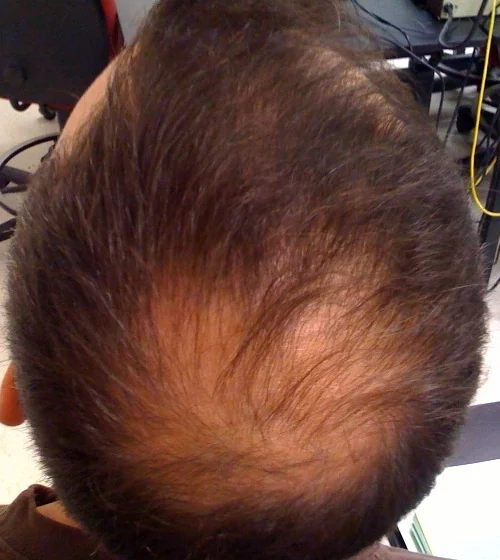
Welshsk Thinning at the crown (cropped), CC BY 3.0 Wikimedia Commons
Send three photos: front, top and sides. You get a technique recommendation, a graft range and a straight answer about what is achievable, before anyone talks about price.
Your details are with the team
A patient coordinator will get back to you shortly. If you would like to send your photos now, WhatsApp is the fastest way to do it.