What Is a Hair Transplant? How It Works, Step by Step
Performed at authorized partner hospitals Turkey Hair Center is a Ministry of Health authorized health-tourism intermediary, not a clinic.
A hair transplant is a surgery that moves hair follicles from a donor area, usually the back of the scalp, to thinning or bald areas. The moved hair keeps growing in its new place, but the operation does not stop the hair you still have from thinning later.
Cover built on a photo of a stained microscope slide of a hair follicle. Photo: Deset.apple, CC0 1.0, via Wikimedia Commons, cropped, text and logo added.
This guide explains how the procedure works in plain terms, which techniques exist, who is and is not a good candidate, what recovery and results look like month by month, and what the risks are. Where a topic has its own page on our site, we keep it short here and link to the full guide.
The short version: the surgeon takes hair from where it is thickest, places it where it is thin, and the new hair grows in over about a year.
What a Hair Transplant Is
Cleveland Clinic describes a hair transplant as surgery that moves hair to bald or thinning areas of the scalp. The grafts come from a donor site, which is usually the back of the scalp because hair is thickest there. Dermatologists or plastic surgeons carry out the procedure, and it is mostly done as an outpatient treatment.
Modern hair restoration is built on follicular unit transplantation. A 2021 overview in the Journal of the American Academy of Dermatology explains that follicular units are the only grafts used today. The American Hair Loss Association adds that a follicular unit holds 1 to 4 terminal hairs, so one graft does not equal one hair.
Three points help to set the right expectations:
A transplant moves hair you already have. It does not create new follicles, so the total number of follicles stays the same.
It is a treatment for the look of thinning areas, not a cure for the cause of hair loss. Better Health Victoria states that a transplant is not a cure for male pattern baldness and does not protect against further loss.
The result depends on how much donor hair you have and how much area needs covering.
Why Transplanted Hair Keeps Growing
The idea behind the operation is called donor dominance. The American Hair Loss Association traces it to Dr. Norman Orentreich in the 1950s: hair taken from the back of the scalp keeps the behaviour of its original site after it is moved. In practice, that hair carries on growing in the new area.
Donor hair is not equally stable in everyone. The same source notes that donor stability varies and that the donor area can also thin through miniaturization or retrograde alopecia, which is one reason the surgeon assesses it before planning.
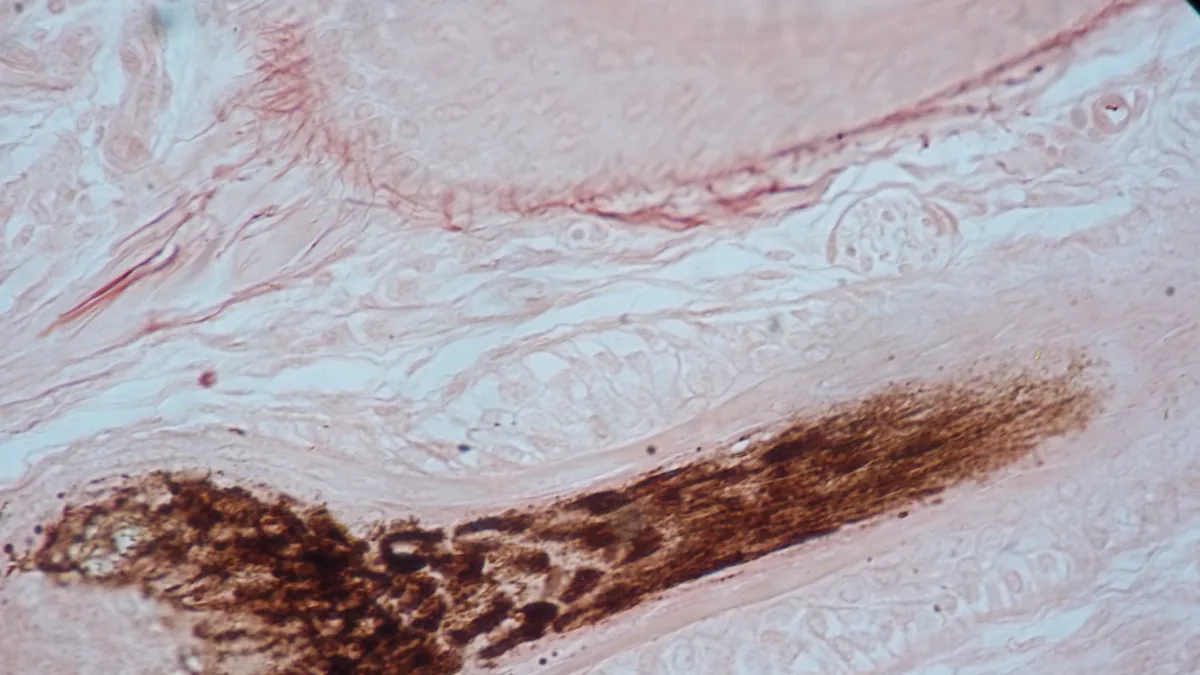
Longitudinal section of a human hair follicle, stained with fuchsin and resorcinol. Photo: Ganímedes, CC BY-SA 3.0, via Wikimedia Commons, cropped and resized.
If you want to know why hair falls out in the first place, read our guide on the reasons for hair loss.
FUE, Sapphire FUE and DHI
Most clinics today use some form of FUE, which stands for follicular unit extraction. A 2017 update on FUE describes it as using small punches of 0.8 to 1 mm to take follicular units one by one. It is an alternative to FUT, the older strip method, and its main advantages are less discomfort at the donor area afterwards and punch scars that are barely visible. The same paper names the drawbacks: it is more laborious and time consuming, and surgeons need a long learning curve to do it well.
Sapphire FUE and DHI are variations of how the grafts are placed, not different ways of taking them. The table below shows the difference.
Technique
How grafts are taken
How the grafts go in
Full guide
FUE
One by one with small punches
Channels are opened in the thinning area first, then grafts are set into them
The method matters less than the planning and the team. If you are comparing the two most common options, our FUE vs DHI guide goes through the differences side by side.
The Procedure Step by Step
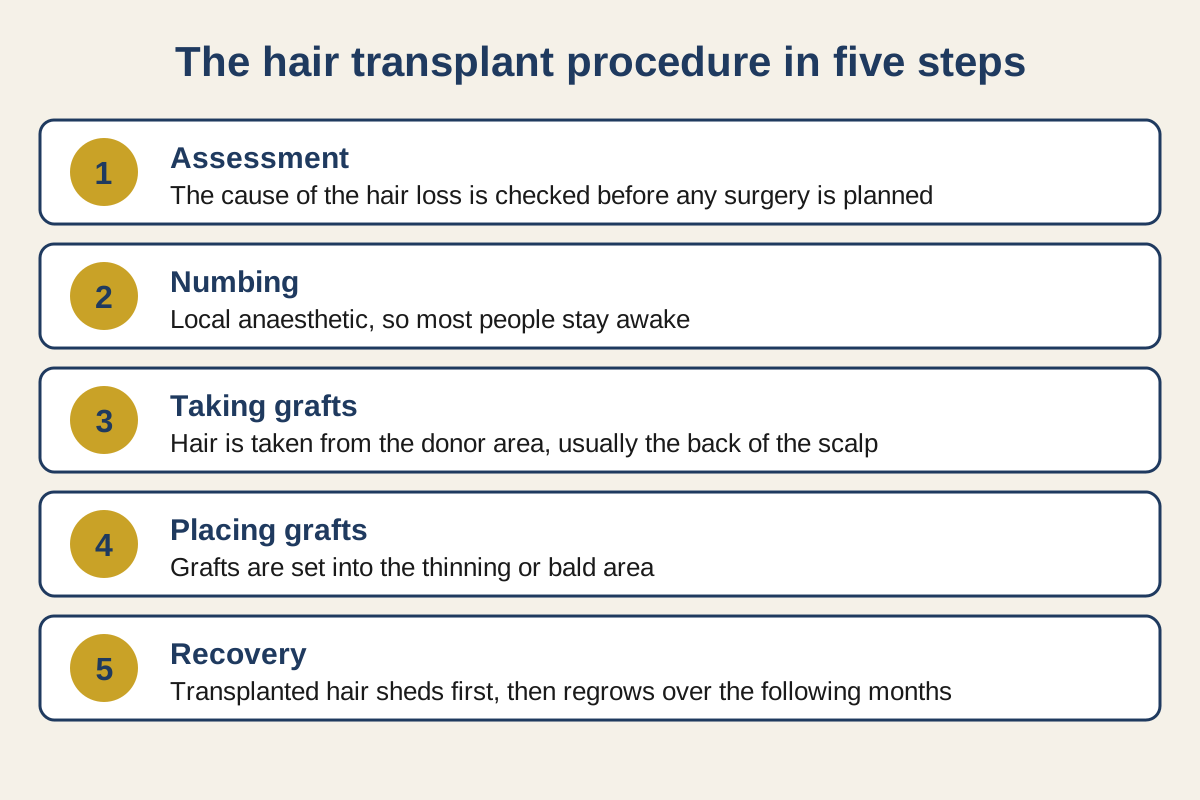
A hair transplant follows the same basic order whichever technique is used:
Assessment. The American Hair Loss Association recommends an assessment of the cause of your hair loss before surgery, since the plan depends on it.
Numbing. The scalp is numbed. Cleveland Clinic says most people stay awake during the procedure.
Taking grafts. Follicular units are taken from the donor area, usually the back of the scalp.
Placing grafts. The grafts are set into the thinning or bald area using the chosen technique.
Recovery. The transplanted hair sheds first and then grows back over the following months.
The number of grafts depends on how much area needs covering and how much donor hair is available. If you want an estimate for your own pattern, see how many grafts do I need.
How Long It Takes
Better Health Victoria says a session usually takes 2 to 8 hours under local anaesthetic. It describes 1,000 to 2,000 follicles per session as common, and up to 4,000 for larger areas. Cleveland Clinic notes that the surgery takes several hours and that several procedures may be needed.
On our own pages, an FUE or DHI operation with our team takes one day of about 6 to 8 hours. That is a single operation, not a hospital stay, and the exact length depends on the number of grafts.
Who Is a Good Candidate
The 2021 overview in the Journal of the American Academy of Dermatology gives guidelines on good and bad candidates, and its main focus is male androgenetic alopecia and female pattern hair loss. Cleveland Clinic lists two practical points: realistic expectations and areas of thick hair to take grafts from.
Signs that a person may be a good candidate:
The hair loss follows a recognisable pattern, such as a receding hairline or a thinning crown.
There is enough healthy donor hair at the back and sides of the head.
The loss has been assessed and the cause is known, which the American Hair Loss Association recommends before surgery.
Expectations are realistic: the goal is better coverage, not the hair of your teens.
You are willing to follow aftercare instructions and, if a doctor advises it, to keep up medical treatment alongside surgery.
Many people start by finding their stage on the Norwood scale. If your thinning is mainly at the back of the top of the head, read about crown balding.
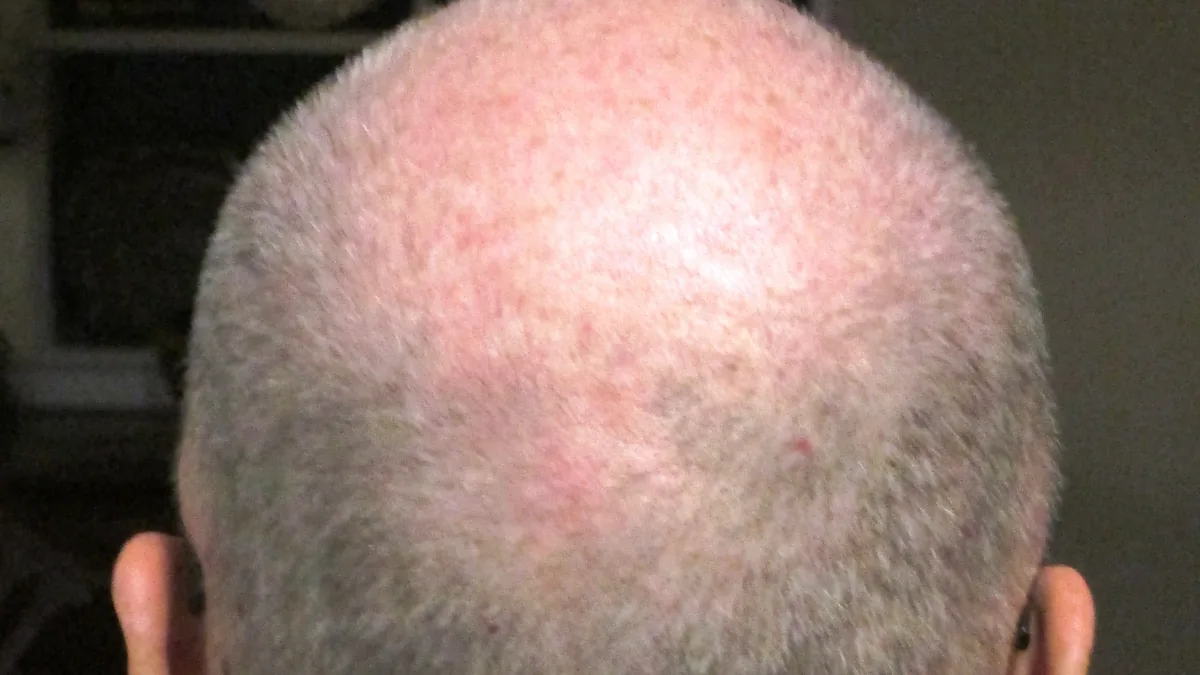
Back of a shaved head with thinning at the crown, a typical look of male pattern baldness. Photo: Beyond My Ken, CC BY-SA 3.0, via Wikimedia Commons, cropped and resized.
Who Is Not a Candidate
Not everyone with hair loss should have surgery. The same 2021 overview describes which scalp conditions are and are not suitable for transplantation, which is why the cause is checked first.
A transplant is usually not the first step in these situations:
Shedding that may reverse by itself. Temporary shedding after illness, stress or a medicine change is a different problem from pattern hair loss. Our telogen effluvium guide explains how to tell the two apart.
Patchy loss from an autoimmune cause. Read about alopecia areata before thinking about surgery.
Not enough donor hair. Cleveland Clinic names areas of thick hair as a requirement, because the grafts have to come from somewhere.
A cause that has not been identified. The American Hair Loss Association recommends assessing the cause before surgery.
If you are unsure which group you fall into, a doctor can look at the pattern and tell you. Our medical team can also review clear photos, as described at the end of this guide.
What Recovery Looks Like
Recovery is covered in full in our hair transplant recovery timeline. In brief, Cleveland Clinic says the surgery is mostly outpatient, and that transplanted hair may fall out as the graft heals. This is normal, and the hair should grow back.
The American Hair Loss Association adds that shedding in the first weeks is common, and that shock loss in nearby native hairs is often temporary.
Cleveland Clinic lists warning signs that need medical attention:
A fever that does not go away.
Excessive bleeding.
Severe redness or pain.
Green or yellow pus.
When You See Results
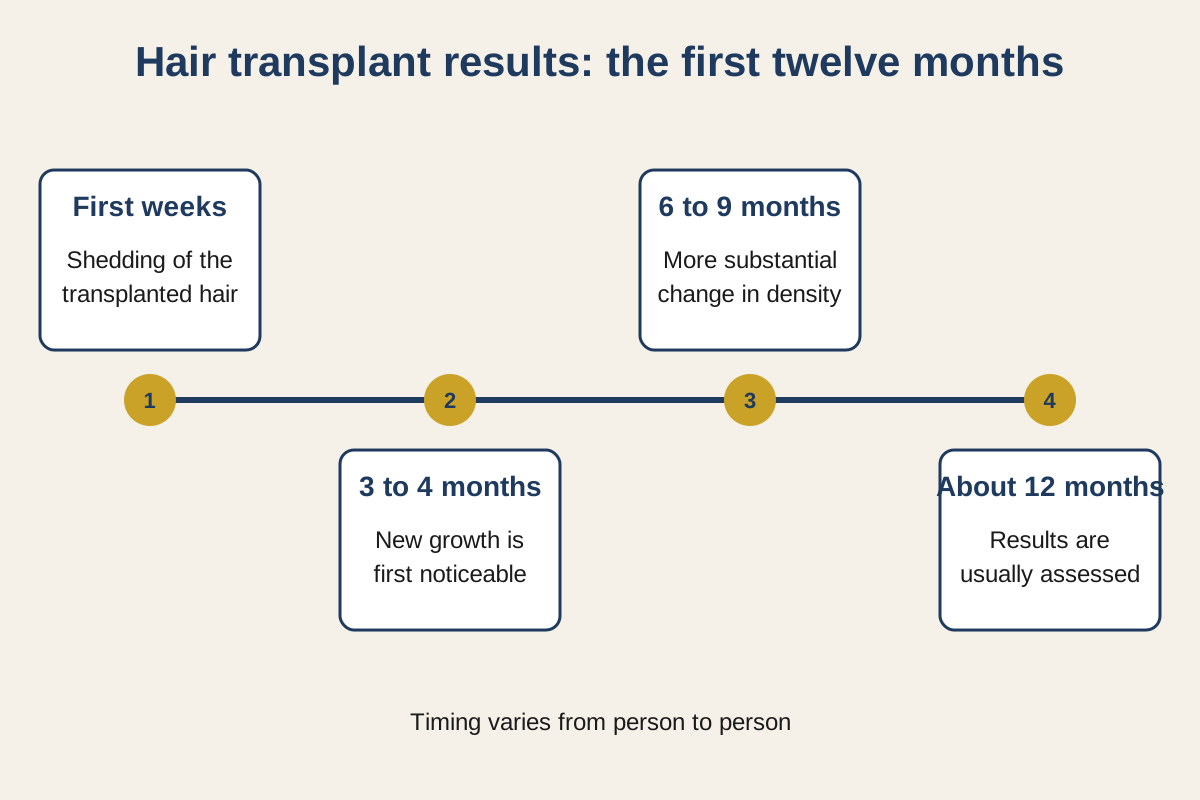
Results come slowly, and the first months can look worse before they look better. According to the American Hair Loss Association, new growth is noticeable at about 3 to 4 months, more change appears at 6 to 9 months, and results are commonly assessed around 12 months. Better Health Victoria says it can take up to nine months for the hair to take root and fill in, and Cleveland Clinic says full results can take up to a year.
The timeline in the picture is a guide, not a promise. Hair grows at different speeds in different people, so judge your result at the 12 month mark rather than week by week.
What It Costs
Our hair transplant packages range from $2,550 to $4,500, depending on the technique package you choose. Flights are not included. Prices differ widely between clinics and countries, and what a package contains matters as much as the headline number, so see our hair transplant cost guide for a full breakdown.
Risks and Complications
A hair transplant is surgery, so it carries risks. Better Health Victoria lists bleeding or infection, and scars that may be raised, reddened or itchy. It also notes that smokers have a higher risk of complications.
A 2025 scoping review of 43 publications gives a more detailed picture. It reports overall complication rates of 1.2% and 4.7% in two large series, and these maximum rates for individual problems across the studies:
Bleeding that needed intervention: up to 8%.
Persistent numbness: up to 11%.
Infection: up to 11%.
Hair shedding at the donor and recipient sites: up to 4.1% and 6.5%.
Hypertrophic scarring or keloid after FUT: up to 15.1%.
Crusting at the recipient site: up to 54.8%.
Swelling of the forehead: up to 50%.
Sterile folliculitis: up to 53.3%.
The review concludes that serious complications are rare in experienced hands. Many of the more common problems are temporary and settle with time. Our hair transplant side effects page covers what is normal and what is not.
Does It Last?
Because the moved hair keeps the behaviour of the donor area, transplanted hair is generally long lasting. See how long hair transplants last for the details.
The part that can change is the hair around the transplant. Better Health Victoria notes that a transplant does not protect against further loss, and recommends considering a combination with medical treatment. That is why a surgeon plans the hairline with your future hair loss in mind.
Hair Transplant vs Other Options
Surgery is one route, not the only one. Better Health Victoria names these alternatives:
Prescription medication.
Over-the-counter minoxidil.
Accepting yourself the way you are.
Medication and surgery are not rivals. The same source suggests combining a transplant with medical treatment. Which medicines suit you is a decision for a doctor, who can also tell you whether surgery adds anything.
How to Choose a Clinic
Cleveland Clinic says hair transplants are performed by dermatologists or plastic surgeons, and the FUE update points to a long surgeon learning curve. The 2025 review concludes that serious complications are rare in experienced hands. So the team matters.
Questions worth asking any provider, including us:
Who takes the grafts and who places them, and how much experience does that person have?
Will the cause of your hair loss be assessed before a plan is made?
Which technique is proposed, and why that one for your hair?
What is included in the price, and what is not?
What follow-up is there if something does not go as expected?
Will you receive a written plan with the area to be covered and the number of grafts?
To be clear about who we are: Turkey Hair Center is a health-tourism intermediary authorized by the Turkish Ministry of Health. We are not a clinic. Our own team carries out procedures at partner hospitals and polyclinics in Istanbul.
This guide is general information and not medical advice. It cannot tell you whether you are a candidate for surgery. See a doctor if you are losing hair and do not know why.
Frequently Asked Questions
How Long Will a Hair Transplant Last?
The transplanted hair is taken from an area that keeps growing hair, and it generally keeps that behaviour in its new place. The hair around it can still thin over time, because a transplant does not stop further loss.
Is a Hair Transplant Painful?
The scalp is numbed with local anaesthetic, and Cleveland Clinic says most people stay awake during the procedure. The 2017 FUE update reports less discomfort at the donor area afterwards than with the strip method. Ask your team how they manage pain afterwards.
What Is Actually Done in a Hair Transplant?
Hair follicles are taken from a donor area, usually the back of the scalp, and placed in the thinning or bald area. They are moved as follicular units of 1 to 4 hairs. The moved hair sheds, then grows back over the following months.
Is There a Downside to a Hair Transplant?
Yes. Risks include bleeding, infection and scarring, and a transplant does not stop the rest of your hair from thinning. Results also take up to a year to show. Complications are described in the risks section above.
How Much Does a Hair Transplant Cost?
Our packages range from $2,550 to $4,500. Flights are not included. The full breakdown is in our hair transplant cost guide.
How Many Sessions Will I Need?
It depends on the area to be covered and the donor hair available. Cleveland Clinic notes that several procedures may be needed. The grafts guide explains how the number is worked out.
Thinking About a Hair Transplant?
If you want to know whether a transplant could work for you, send clear photos of your hairline, crown and the back of your head for a free hair analysis. The medical team will review them and tell you what they see.
Medical disclaimer: This article is for informational purposes only and is not medical advice. Individual results and recovery vary from person to person. Always follow the written aftercare plan from your own medical team.
Send three photos: front, top and sides. You get a technique recommendation, a graft range and a straight answer about what is achievable, before anyone talks about price.
Your details are with the team
A patient coordinator will get back to you shortly. If you would like to send your photos now, WhatsApp is the fastest way to do it.