Microneedling for Hair Loss: Does It Work and Is It Safe?
What microneedling does to the scalp, what the trials found when it was added to minoxidil, which devices and needle lengths they used, its side effects and where a hair transplant fits.
12sources
12in PubMed
12min read
Written by Nazmi Güldeş, Certified Trichologist · Medically reviewed by Dr. Teuku Adifitrian, Sp.BP-RE (Dr. Tompi), Plastic, Reconstructive and Aesthetic Surgeon · Last reviewed 31 October 2026
Reading level
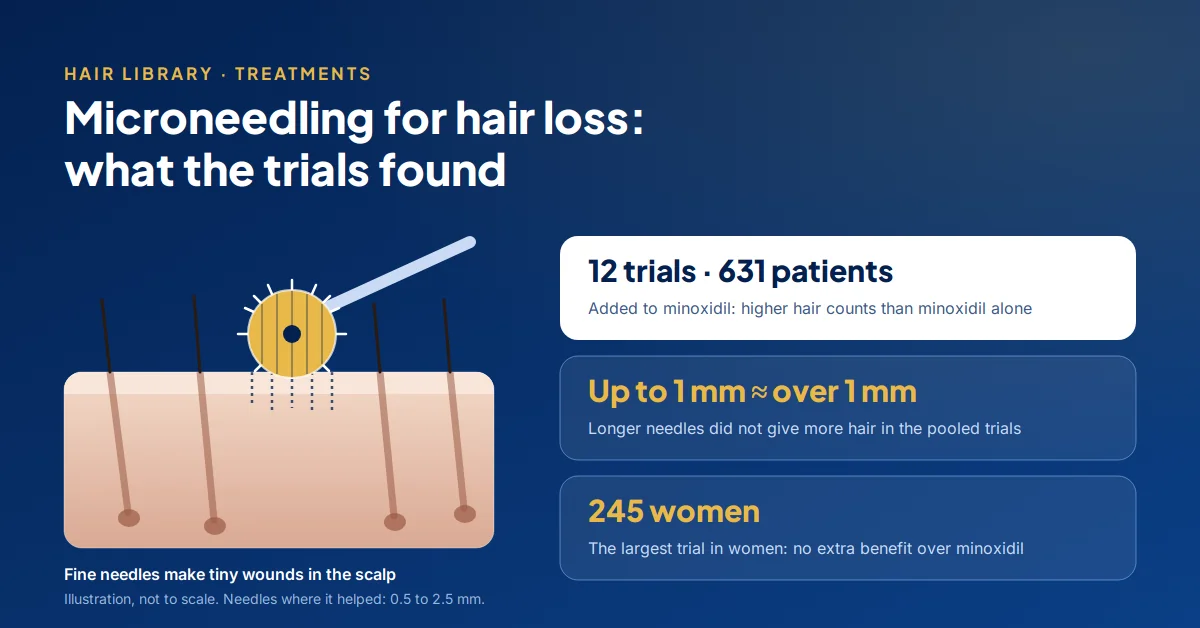
Microneedling for hair loss means running rows of fine needles over thinning areas to make tiny, controlled wounds in the scalp. It works best as an add-on: with minoxidil, it raised hair counts more than minoxidil alone across 12 randomized trials with 631 patients.[1] Used on its own, the evidence is thin.
Most questions are about the details: needle length, how often to needle and when minoxidil goes back on. The trials answer some of these clearly and leave others open, and we show which is which.
1Quick answerThe short answer, in a few sentences
What Is Microneedling for Hair Loss?
Microneedling uses fine needles to make controlled wounds in the scalp, which the skin then repairs. For pattern hair lossGlossaryAndrogenetic alopecia, or pattern baldness, is the pattern hair loss behind most male and female thinning. It is primarily driven by genetic predisposition and sensitivity to androgen hormones. Open in the glossary → it is mainly used as an add-on to minoxidil, where pooled trials found more and thicker hair than with minoxidil alone. On its own the evidence is thin, and there is no standard needle length or schedule.
A Canadian expert panel reviewed 45 treatments for pattern hair loss in 2025 and recommended seven, microneedling among them.[2] We'd put it plainly: a reasonable second step once you are on minoxidil, not a first treatment in itself.
2Complete guideFrom how it works to devices, safety and surgery
How Microneedling Works and What the Trials Found
How Microneedling Stimulates Hair Growth
The dermal papillaGlossaryThe dermal papilla is a cluster of cells at the centre of the hair bulb. It signals the bulb and helps decide how thick, how long and what colour each hair grows. Open in the glossary →, at the base of each follicle, sends the signals that tell a follicle to grow. Needling makes small wounds, and as the skin heals it releases growth factors and activates the stem cells in the follicle, two of the ways reviewers explain the extra growth.
There is a practical side too: the tiny channels are thought to let more of a drug through the skin.[3] That's why microneedling is so often paired with minoxidil, and why it changes what you should put on your scalp afterwards. For why follicles shrink in the first place, read our entry on DHT and hair loss.
Does Microneedling Work? What Studies Measured
As an add-on, it helps on average. The best-known trial gave 100 men weekly microneedling plus 5% minoxidil, and after 12 weeks hair counts had risen by 91.4, against 22.2 with minoxidil alone.[4]
Not every trial was as striking. A later trial in 68 men also favoured the combination, but its authors judged the gain not cosmetically significant.[5] Pooled together, the trials point the same way, with wide differences in how much each one found.
Used alone, it has less support. A network meta-analysis of single treatments for men ranked finasteride and dutasteride tablets above microneedling on its own.[6] In pattern hair loss, the positive studies almost all paired the needles with another treatment.
Microneedling Results Timeline
Most trials ran for 12 to 24 weeks, so three months is the earliest fair test.[1] The right-hand column is our advice for each stage.
When
What the trials recorded
What you can do
Before you start
What the trials recorded
Hair counted in a fixed spot in the main trial
What you can do
Take photos of your crown and hairline in the same light
Weeks 1 to 12
What the trials recorded
Sessions every one or two weeks, with minoxidil twice daily
What you can do
Keep both going; skip minoxidil only on needling days
About 6 weeks
What the trials recorded
First new hair in the best-known trial, against about 10 weeks on minoxidil alone
What you can do
Don't judge yet
12 weeks
What the trials recorded
The measuring point in the two best-known trials in men
What you can do
Compare your photos with week 0
24 weeks
What the trials recorded
The measuring point in the largest trial in women
What you can do
Decide whether it adds enough to keep going
Microneedling for Women
The evidence in women points in two directions. A 2025 network meta-analysis ranked microneedling plus minoxidil first among seven combination treatments for women.[7]
The largest trial, published after it, didn't confirm that: in 245 women, needling at about 0.5 mm every two or four weeks added nothing to 2% minoxidil after 24 weeks.[8] We'd call microneedling an option for women, but a less certain one than for men. Other options are covered in our female pattern hair loss entry.
Derma Roller, Stamp or Pen: Needle Length and Home Use
Derma Roller vs Derma Stamp vs Derma Pen
Hair studies have used hand rollers, hand stamps and motorised pens, at home or in a clinic.[3] Here is how they compare in practice; the last row is our own take.
Derma roller
Derma stamp
Derma pen
How it works
Derma roller
A drum of needles rolled across the scalp
Derma stamp
Needles pressed straight down, patch by patch
Derma pen
A motor moves the needles in and out
Use in hair trials
Derma roller
The device in the best-known trials
Derma stamp
One small study
Derma pen
Several trials
Hair results
Derma roller
More hair with minoxidil than minoxidil alone
Derma stamp
No effect at 0.25 mm in that study
Derma pen
Similar hair counts to rolling across trials
Our take
Derma roller
The tested home option
Derma stamp
Too little data to choose it for hair
Derma pen
No proven advantage over a roller
Needle Length and How Often to Microneedle
In the hair studies where it helped, needles ran from 0.5 to 2.5 mm and sessions from weekly to monthly. Longer was not better: in the pooled trials, depths up to 1 mm and over 1 mm gave similar hair counts.[1]
None of the studies needled every day, so there is no evidence that more sessions mean more hair. A schedule of once a week or every two weeks matches what the main trials did.
How to Microneedle Your Scalp at Home
The two best-known roller trials followed a simple routine:
Clean the scalp first. The first trial prepared it with an antiseptic and saline.
Roll over the thinning area in several directions, lengthwise, vertically and diagonally.
Stop when the skin turns mildly red, the end point in that trial.
Skip minoxidil that day and restart it 24 hours later.
Put nothing on needled skin unless it is made to go into the skin.
Microneedling and Minoxidil: When to Apply
Advice online is split between applying minoxidil straight after needling and waiting. Waiting makes sense, because needled skin is thought to let more of a drug through, but we found no trial that compared timings directly, and reviewers say best practices are still to be worked out.
Microneedling Myths
"Longer needles work better." Pooled trials found no extra hair from needles over 1 mm.
"Every day is better than once a week." No hair study needled daily.
"Put minoxidil on straight away so more gets in." The trials that worked waited 24 hours.
"A roller can regrow a bald patch on its own." In pattern hair loss, the trials enrolled people with thinning hair, and most paired the needles with another treatment.
Side Effects, PRP and Where a Hair Transplant Fits
Side Effects and Who Should Avoid It
Most side effects are brief. A safety review of 85 papers found the usual ones were redness, swelling and pain lasting up to seven days, plus dark marks, dry skin and irritation.[9]
Rarer problems include lasting dark marks, track-like scars and stubborn inflammatory lumps called granulomas. Reviewers advise caution with any product not approved for use inside the skin.
The safety review and the trials' exclusion rules point to these reasons to take extra care, or skip it:
An active infection on the scalp
A rash or skin disease where you would needle
A personal or family history of keloid scars
A bleeding disorder, or you take blood thinners
A metal allergy
Darker skin, where reviewers advise caution
Microneedling vs PRP
PRP, platelet-rich plasma, is a concentrate of your own plasma with more platelets than whole blood, injected into the scalp or applied after needling.[10] The two have been compared and combined, and the 2025 Canadian consensus recommends both. The "time" row is our summary.
Microneedling
PRP
What it involves
Microneedling
Fine needles make controlled wounds
PRP
Plasma from your blood, injected or applied after needling
Time
Microneedling
A session every 1 to 4 weeks; a roller can be used at home
PRP
A course of injection sessions, with a later booster in one study
Evidence, in short
Microneedling
Adds to minoxidil in pooled trials
PRP
Recommended by the Canadian panel
Needling has also helped when PRP was applied to the scalp alongside it. Our PRP for hair loss entry weighs up the injection side. For light-based devices, read about red light therapy for hair loss.
Microneedling With Finasteride or Dutasteride
Microneedling has improved hair in people whose results had stalled for at least six months on other treatments.[3] In the best-known trial, men who had been unhappy with finasteride and minoxidil also responded, so it is worth raising with your doctor if your progress has stalled.[4]
Microneedling followed by a dutasteride solution is used to avoid the side effects of tablets. It shows some benefit, but standard protocols and large trials are still missing.[11]
Microneedling and a Hair Transplant
In pattern hair loss, microneedling has been tested on thinning hair. The main trials enrolled men at NorwoodGlossaryThe Norwood scale is the classification most doctors use for male pattern hair loss. It describes the usual ways the loss moves, stage by stage, from Norwood 1 to Norwood 7. Open in the glossary → III vertex and IV, with mild to moderate loss.
A transplant works differently. It moves follicles from the donor areaGlossaryThe donor area is the back and sides of the head, where follicles resist DHT. An extracted follicle does not grow back in that spot, so extractions are spread out, and the donor supply is the limit of every plan. Open in the glossary →, and they keep their genetic traits in the new spot.[12] How many you would need depends on your stage, covered in how many grafts do I need.
Around surgery there is little to go on. We found no trial on when needling can resume over new graftsGlossaryA graft is a follicular unit taken from the donor area and placed in the thinning area. It holds one to four hairs, rarely more, so 2,000 grafts is roughly 3,600 to 4,600 hairs. Open in the glossary →, so ask your surgeon first; the healing stages are in our hair transplant recovery timeline.
Frequently Asked Questions
Does microneedling for hair loss hurt?
Brief pain is one of the most common side effects. In one trial of motorised needling, pain averaged about 4.5 out of 10.
How long does microneedling take to grow hair?
In the best-known trial, new hair appeared at about 6 weeks with needling plus minoxidil. Trials judged results at 12 to 24 weeks, so give it at least three months.
Is microneedling better than PRP for hair loss?
They are often combined rather than chosen between, and the 2025 Canadian consensus recommends both.
Does derma rolling at home work for hair growth?
With minoxidil, the roller trials found more hair than minoxidil alone. On its own, the evidence is limited, and tablets ranked higher.
Is microneedling safe for the scalp?
Mostly. Hair studies reported no serious adverse events in 657 people, though granulomas and scarring have been reported after microneedling in general.
Can microneedling help a receding hairline?
There is little evidence for it; the best-known trial measured hair at the crown. Where the hairline is already smooth skin, a transplant moves in follicles that keep their traits in the new spot.
Are microneedling results permanent?
No one has followed people long enough to say. Most trials stopped at 12 to 24 weeks, so nobody knows how long gains last once you stop.
Is Microneedling Right for You?
It fits some people better than others. This split is our reading of the trials above.
Microneedling suits you if
Look elsewhere first if
You have early to moderate pattern thinning
Look elsewhere first if
Your crown or hairline has gone smooth
You already use minoxidil and want an add-on
Look elsewhere first if
You haven't started a proven medicine yet
Your results on medicine have stalled
Look elsewhere first if
Your hair loss hasn't been diagnosed yet
You can keep a weekly or fortnightly routine
Look elsewhere first if
You have a scalp infection, keloids or a bleeding disorder
Sudden shedding and round bald patches need a diagnosis before any add-on, and if your crown or hairline has gone smooth, a transplant is the option that adds hair there.
Send us three photos for a free hair analysis, and the medical team will tell you whether your pattern suits medication, surgery or both. You can also message us on WhatsApp.
About the Author
Written by: Nazmi Güldeş, Certified Trichologist. Nazmi Güldeş focuses on patient education around androgenetic alopecia, evaluating miniaturization through dermoscopy, and assessing candidates for medical treatments and hair transplants.
Editorial Policy & Trust
This entry was medically reviewed by Dr. Teuku Adifitrian, Sp.BP-RE (Dr. Tompi) on 31 October 2026. Every study cited here was checked against PubMed on 31 October 2026. Key figures are marked with their source, and every source is listed at the end of this entry. Read how we work in our editorial policy.
3 questions
Test yourself
Check what you remember from this entry. Each answer links back to the section that explains it.
In the 2025 meta-analysis, how did needle depth affect hair counts?
Depths up to 1 mm and over 1 mm gave similar hair counts when added to minoxidil. Read the section
What did the largest trial of microneedling in women find?
In 245 women, needling every two or four weeks added nothing to 2% minoxidil after 24 weeks. Read the section
Which side effects are most common after microneedling?
A review of 85 papers found redness, swelling and pain lasting up to seven days were the usual problems. Read the section
3Scientific evidenceStudy types, references and how to cite this entry
12sources
Evidence behind this entry: 12 publications indexed in PubMed (2013 to 2026): 5 systematic reviews, 3 randomized trials, 2 reviews, 1 guideline and 1 clinical study. 6 sources have free full text.
Randomized trialpeople assigned to treatments by chance
Reviewsummarises many studies
Clinical studya study in people without random groups
Guideline or labela professional body, or the official drug label
Ahmed KMA, Kozaa YA, Abuawwad MT, et al. Evaluating the efficacy and safety of combined microneedling therapy versus topical Minoxidil in androgenetic alopecia: a systematic review and meta-analysis. Archives of Dermatological Research. 2025;317(1):528.Systematic reviewPubMedDOIFree full text
Landells I, Chow E, Gupta AK, et al. A Canadian Consensus on Androgenetic Alopecia: Approach and Management. Journal of Cutaneous Medicine and Surgery. 2025;29(5_suppl):5S-14S.GuidelinePubMedDOI
English RS Jr, Ruiz S, DoAmaral P. Microneedling and Its Use in Hair Loss Disorders: A Systematic Review. Dermatology and Therapy. 2022;12(1):41-60.Systematic reviewPubMedDOIFree full text
Dhurat R, Sukesh M, Avhad G, et al. A randomized evaluator blinded study of effect of microneedling in androgenetic alopecia: a pilot study. International Journal of Trichology. 2013;5(1):6-11.Randomized trialPubMedDOIFree full text
Kumar MK, Inamadar AC, Palit A. A Randomized Controlled, Single-Observer Blinded Study to Determine the Efficacy of Topical Minoxidil plus Microneedling versus Topical Minoxidil Alone in the Treatment of Androgenetic Alopecia. Journal of Cutaneous and Aesthetic Surgery. 2018;11(4):211-216.Randomized trialPubMedDOIFree full text
Gupta AK, Bamimore MA, Wang T, et al. The impact of monotherapies for male androgenetic alopecia: A network meta-analysis study. Journal of Cosmetic Dermatology. 2024;23(9):2964-2972.Systematic reviewPubMedDOI
Xia Y, Chen H, Chen Y, et al. Relative efficacy of minoxidil in combination with other treatments for androgenic alopecia: a network meta-analysis based on randomized controlled trials. Frontiers in Medicine. 2025;12:1638496.Systematic reviewPubMedDOIFree full text
Liu Y, Luo H, Yang S, et al. Microneedle frequency adjunct to 2% minoxidil in female androgenetic alopecia: A randomized controlled trial. Journal of the American Academy of Dermatology. 2026.Randomized trialPubMedDOI
Chu S, Foulad DP, Atanaskova Mesinkovska N. Safety Profile for Microneedling: A Systematic Review. Dermatologic Surgery. 2021;47(9):1249-1254.Systematic reviewPubMedDOI
Gkini MA, Kouskoukis AE, Tripsianis G, et al. Study of platelet-rich plasma injections in the treatment of androgenetic alopecia through an one-year period. Journal of Cutaneous and Aesthetic Surgery. 2014;7(4):213-219.Clinical studyPubMedDOIFree full text
Ding Y, Wang C, Bi L, et al. Dutasteride for the Treatment of Androgenetic Alopecia: An Updated Review. Dermatology (Basel, Switzerland). 2024;240(5-6):833-843.ReviewPubMedDOI
Queen D, Avram MR. Hair Transplantation: State of the Art. Dermatologic Surgery. 2025;51(9):874-881.ReviewPubMedDOI
Güldeş, N. (2026, October 31). Microneedling for hair loss: Does it work and is it safe?. Turkey Hair Center Hair Library. https://turkeyhaircenter.com/microneedling-for-hair-loss/
@misc{guldes2026microneedlingforhairloss,
  author       = {Güldeş, Nazmi},
  title        = {Microneedling for hair loss: Does it work and is it safe?},
  howpublished = {Turkey Hair Center Hair Library},
  year         = {2026},
  month        = oct,
  url          = {https://turkeyhaircenter.com/microneedling-for-hair-loss/},
  note         = {Last updated 31 October 2026}
}
TY  - ELEC
AU  - Güldeş, Nazmi
TI  - Microneedling for hair loss: Does it work and is it safe?
T2  - Turkey Hair Center Hair Library
PY  - 2026
DA  - 2026/10/31
UR  - https://turkeyhaircenter.com/microneedling-for-hair-loss/
N1  - Last updated 31 October 2026
ER  -
Talk to our hair team on a free video call, in your language. You receive a written plan with your technique, estimated grafts and all-inclusive price. If a hair transplant isn't right for you, we tell you honestly.
Your information is 100% confidential.
Real People Real Support
Send your photos on WhatsApp
Front, top and both sides, reviewed by the medical team.