Does Rosemary Oil Stop Hair Loss? What the Research Shows
One small trial, a lot of social media, and a guideline that does not recommend it. What rosemary oil has, and has not, been shown to do for thinning hair.
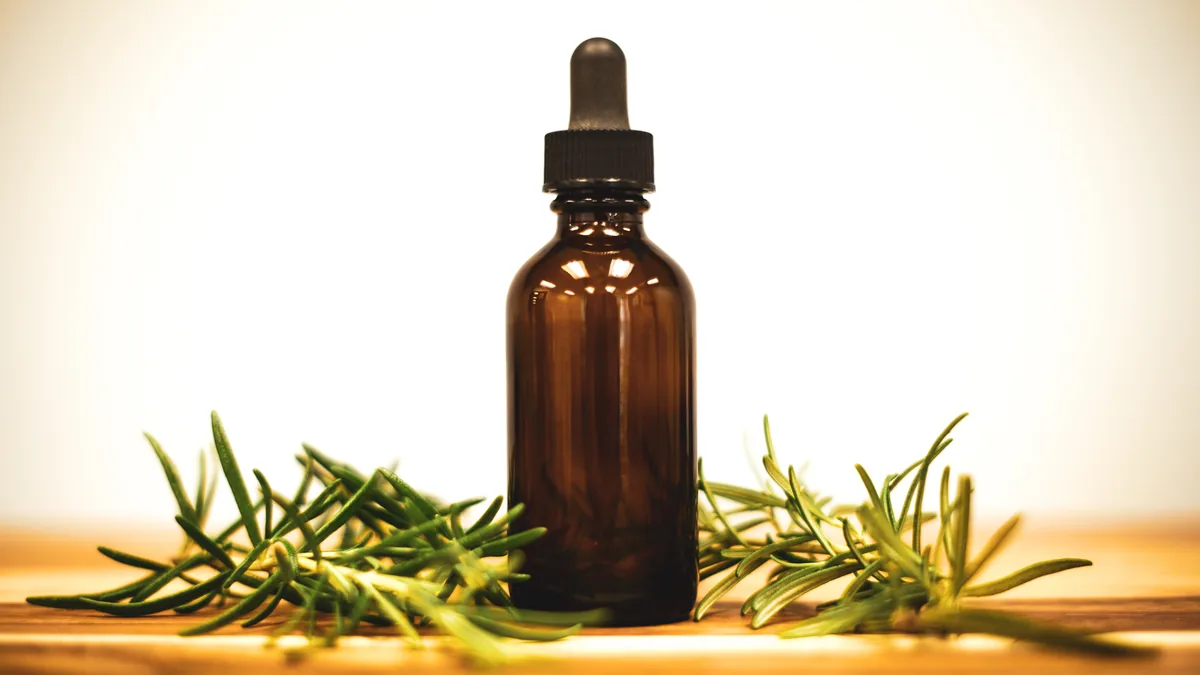
Rosemary oil in a dropper bottle with fresh rosemary. Photo: formulatehealth, CC BY 2.0, via Wikimedia Commons, cropped.
21sources
21in PubMed
24min read
Written by Nazmi Güldeş, Certified Trichologist · Every source checked against PubMed · Last updated 29 October 2026
Reading level
1Quick answerThe short answer, in a few sentences
No. Rosemary oil has not been shown to stop hair loss. The case for rosemary oil for hair loss rests on one randomized trial: 100 men with pattern hair loss used rosemary oil or minoxidil 2% twice a day.[1][2][3] At 6 months both groups had higher hair counts, with no significant difference.[1]
That one small trial is the whole case. It has not been repeated, it compared rosemary with the weaker 2% strength of minoxidil, and a 2025 Canadian expert consensus placed rosemary oil on its list of treatments it does not recommend for pattern hair loss.[4][5] If you try it, give it at least 6 months, dilute it, and do not let it delay a proven treatment while your hair loss progresses.
2Complete guideEvery study, how to use it and who should avoid it
What Is Rosemary Oil?
Rosemary oil is the essential oil of Rosmarinus officinalis, an evergreen shrub native to the eastern Mediterranean that has been used in cooking and folk medicine for centuries.[2] It contains compounds such as rosmarinic acid, caffeic acid, camphor and 12-methoxycarnosic acid, which are studied for antioxidant, anti-inflammatory and antimicrobial effects.[2]
In the United States, rosemary is classed as generally recognized as safe (GRAS) as a food ingredient.[2] That label covers rosemary in food. It says nothing about a concentrated essential oil rubbed into the scalp twice a day.
Oil, Extract or Water: Not the Same Thing
Rosemary products for hair come in several forms, and a study of one does not tell you about the others:
Rosemary essential oil: the concentrated oil distilled from the plant. This is what the hair loss trial used.[1]
Rosemary leaf extract: a concentrate of the leaves. This is what the best-known lab and mouse study used.[6]
Rosemary hair oils and serums: products that mix a small amount of essential oil or extract into a base such as jojoba oil.
Rosemary water: leaves steeped in hot water. No study has tested it on hair loss (see below).
Does Rosemary Oil Work for Hair Loss? Every Study, Side by Side
A PubMed search for rosemary and hair returned 53 records on 29 October 2026. Most are lab studies, animal studies or reviews. Only a handful tested rosemary in people with hair loss, and only one tested rosemary oil on its own against an established treatment.[3] This table sets out every study in people that matters, plus the lab work behind the DHT claim:
Better regrowth in mice; blocked 5-alpha reductase in the lab
Not evidence in people
Reviews from 2024 and 2025 agree: the early results are promising, but they rest on small, short studies, and larger randomized trials are needed.[2][10][11]
The 2015 Trial, Step by Step
Because so much rests on this one study, it is worth knowing exactly what it did and did not show.
Who Took Part
The trial, published in Skinmed in 2015, enrolled 100 men aged 18 to 49 with androgenetic alopeciaGlossaryAndrogenetic alopecia, or pattern baldness, is the pattern hair loss behind most male and female thinning. It is primarily driven by genetic predisposition and sensitivity to androgen hormones. Open in the glossary →, the medical name for pattern hair loss.[1][2]
What They Used
Half were assigned by chance to rosemary oil and half to minoxidilGlossaryMinoxidil is an established medication for certain types of hair loss. It is a drug, not a hair oil, and the FDA-approved label says not to use it for sudden or patchy hair loss. Open in the glossary → 2% solution. Both were applied to the thinning areas of the scalp twice a day for 6 months.[1][11]
What Changed, and When
Hair was counted from standardised close-up photographs at the start, at 3 months and at 6 months.[1]
StartBaselineStandardised close-up photos and hair count in both groups.
Month 3No changeNeither rosemary oil nor minoxidil 2% had changed hair count.
Month 6More hairBoth groups had higher hair counts, with no significant difference between them.
At 3 months, neither group had a significant change in hair count. At 6 months, both groups had significantly more hair than at the start, and the difference between rosemary oil and minoxidil was not significant.[1]
Side Effects in the Trial
Scalp itching became more common in both groups, but it was less frequent with rosemary oil than with minoxidil at both check-ups. Dry hair, greasy hair and dandruff did not change.[1]
What the Trial Cannot Tell Us
No placebo group. Rosemary was compared only with minoxidil, so there is no measure of what would have happened with no treatment.[1]
A weak comparison. It used minoxidil 2%; in another trial, minoxidil 5% produced 45% more regrowth than 2%.[4]
Partly blinded. It was single-blind, so not everyone involved was unaware of who used what.[2]
Not repeated. No second trial of rosemary oil alone has been published.[3]
No size of effect in the summary. The published abstract gives P values but not the number of hairs gained.[1]
Clinical detail: how the trial was run, and a common misreading
Randomised, single-blind comparison of rosemary oil (n = 50) and minoxidil 2% (n = 50), applied twice daily for 24 weeks, with standardised microphotographic assessment at baseline, 3 and 6 months.[1][2][3] No significant within-group change in mean hair count at 3 months; a significant increase at 6 months compared with baseline and month 3 in both arms; no significant between-group difference at either point. Pruritus rose from baseline in both arms and was more frequent with minoxidil (P < .05).[1] A 2025 systematic review states that hair count rose significantly at both 3 and 6 months; the trial abstract reports no significant change at 3 months, so cite the primary report.[11][1]
Rosemary Oil vs Minoxidil: Which Works Better?
The claim that rosemary oil works as well as minoxidil comes from this one trial, and it needs a footnote: the comparison was with minoxidil 2%. In a 48-week randomized trial in men, minoxidil 5% was clearly better than 2%, producing 45% more hair regrowth and an earlier response.[4]
Minoxidil also stands on far more evidence. It is recommended for pattern hair loss by the European S3 guideline and by the 2025 Canadian consensus, a Cochrane review found it works in women, and it ranked among the effective treatments in the 2025 network meta-analysis.[12][5][13][3]
Where rosemary oil did better was comfort: scalp itching was less frequent than with minoxidil 2%.[1] That matters for people who stop minoxidil because of itching, which is more common with the 5% strength.[4]
Plan for at least 6 months. In the trial, hair counts had not changed at 3 months in either group and rose only by the 6-month check.[1] Some popular articles promise results in 6 weeks, or in 2 to 3 months; the trial they rely on does not show that.
A practical way to judge it is to photograph your scalp in the same light and from the same angles before you start, at 3 months and at 6 months, the same points at which the trial measured.[1] Hair changes slowly, and day-to-day mirror checks are misleading.
Rosemary Oil Before and After: How to Read the Photos
Search for rosemary oil before and after and you will find plenty of dramatic photos. Before you trust one, compare it with how the trial measured: standardised close-up photographs of the scalp, taken at the start, at 3 months and at 6 months, with the hairs counted.[1] A phone photo can show a big change without a single new hair.
What to Check in a Before-and-After Photo
The same light. Strong overhead light shows more scalp than soft light, so a change of room can look like a change of hair.
Dry hair, styled the same way. Wet hair clumps together and shows more scalp; volume products and a new haircut hide it.
The same angle and distance. Tilting the head or moving the camera changes how much scalp you see.
Enough time. In the trial, neither group had more hair at 3 months.[1] A dramatic change after a few weeks points to something other than new hair.
One treatment only. Ask whether minoxidil, finasteride or another product was used at the same time. If it was, the photo cannot show what rosemary did.
How to Take Your Own Before-and-After Photos
1. Use the same room, the same light and the same phone every time.
2. Photograph clean, dry hair, combed the same way, with no styling products.
3. Take the same shots each time: the front with the hairline visible, the top and both sides; add the crown if it is thinning.
4. Keep the phone at the same distance. A second person makes the top and crown shots easier.
5. Repeat at 3 months and at 6 months, the points at which the trial measured.[1]
Nobody has shown how rosemary oil acts on human hair follicles. The proposed explanations come from lab and animal work:
Antioxidant, anti-inflammatory and antifungal effects on the scalp.[3][2]
Better blood flow through small vessels, which the trial authors gave as their reason for testing it.[1]
Blocking 5-alpha reductase, the enzyme that makes DHT, shown with a leaf extract in the lab.[6]
A 2023 study in mice found more hair growth with a 1% lotion of rosemary extract than with minoxidil 2%.[14] Mouse skin, and an extract of the whole plant above ground, are a long way from rosemary oil on a human scalp.
None of these was measured in the people who took part in the trial, so they remain hypotheses.
Does Rosemary Oil Block DHT?
Not that anyone has shown in people. The DHT claim goes back mainly to a 2013 study from Japan. A rosemary leaf extract blocked 5-alpha reductase, the enzyme that makes DHTGlossaryDihydrotestosterone (DHT) is a potent androgen that the body makes from testosterone using an enzyme called 5-alpha reductase. In people who are genetically sensitive to it, DHT makes hair follicles shrink. Open in the glossary →, in the test tube, and improved hair regrowth in mice whose regrowth had been suppressed with testosterone.[6]
Three things limit that result: it used a leaf extract, not the essential oil sold for hair; it was done in mice and cells; and we found no study that measured DHT in the scalp or blood of people using rosemary. If DHT is behind your hair loss, the medicines that lower it, finasterideGlossaryFinasteride blocks the enzyme that turns testosterone into DHT, the hormone that shrinks follicles in male pattern hair loss. It is a prescription medicine with possible side effects, so it should be started and followed by a doctor. Open in the glossary → and dutasteride, are covered in our DHT and Hair Loss entry.
Clinical detail: the 5-alpha reductase data
Topical rosemary leaf extract (2 mg/day per mouse) improved regrowth in C57BL/6 mice whose regrowth had been interrupted by testosterone. The extract inhibited 5α-reductase by 82.4% and 94.6% at 200 and 500 µg/mL; 12-methoxycarnosic acid was identified as an active constituent. Extract and compound also inhibited androgen-dependent proliferation of LNCaP cells, which the authors read as interference with DHT binding to the androgen receptor.[6] No human pharmacodynamic data exist for rosemary essential oil.
Which Types of Hair Loss Has It Been Tested On?
Hair loss has many causes, and rosemary has been tested in very few of them.
Pattern Hair Loss
One trial of rosemary oil alone, in men,[1] and one small trial of a herbal mix added to minoxidil (see below).[8]
Alopecia Areata
In a 1998 double-blind trial, 86 people with alopecia areataGlossaryAlopecia areata is an autoimmune condition that can cause round patches of hair loss in the eyebrows, beard or scalp. Hair often regrows within a few months and may look white or grey at first before the natural colour returns. Open in the glossary → massaged a blend of four essential oils (thyme, rosemary, lavender and cedarwood) in jojoba and grapeseed oil into the scalp every day for 7 months. 44% improved, against 15% of those who used the carrier oils alone.[7] Because rosemary was one of four oils, the result cannot be credited to rosemary alone.
Clinical detail: the aromatherapy trial in alopecia areata
Randomised, double-blind, 7 months, follow-up at 3 and 7 months. Active group: thyme, rosemary, lavender and cedarwood essential oils in jojoba and grapeseed carrier oils, massaged in daily; control: carrier oils only. Response on sequential photographs assessed by two dermatologists: 19 of 43 (44%) vs 6 of 41 (15%), P = .008; interobserver agreement kappa 0.84.[7]
Shedding After Illness or Stress
Telogen effluviumGlossaryTelogen effluvium is sudden diffuse shedding that follows illness, childbirth or stress. Shedding usually starts two to three months after the trigger, and it is usually self-limiting once the trigger is removed. Open in the glossary → is the diffuse shedding that can follow a trigger such as illness or stress. We found no trial of rosemary oil for it. The useful first step is finding the trigger.
Scarring Hair Loss
We found no trial of rosemary in scarring hair loss. These conditions need a dermatologist's diagnosis.
Can Women Use Rosemary Oil for Hair Loss?
They can, but there is no good evidence that it helps. The 2015 trial enrolled only men.[2] In our PubMed search we found no independent trial of rosemary oil in women with pattern hair loss. Newer trials of rosemary products were funded by their makers and enrolled healthy adults rather than people diagnosed with hair loss.[9]
For female pattern hair loss, minoxidil is the treatment with the best evidence: a Cochrane review found it worked better than placebo.[13]
If you are pregnant or breastfeeding, ask a doctor first. A 2025 safety review urges caution with long-term, high doses of rosemary, including possible effects in pregnancy.[15]
How to Use Rosemary Oil for Hair Loss
There is no tested routine beyond the trial. This is what the trial did, and how to copy it safely:
1.Apply it where the hair is thinning, twice a day. That is how the trial used it, for 6 months.[1][11]
2.Do not use undiluted essential oil. Essential oils are concentrated, and rosemary can cause allergic skin reactions.[16] Use a product made for the scalp, or mix the essential oil into a carrier oil.
3.Test it first. Put a small amount on a small patch of skin and see whether redness or itching appears before using it on your scalp.
4.Massage it gently into the scalp, not the lengths of the hair. The trial participants applied it with gentle massage.[11]
5.Photograph your scalp at the start, at 3 months and at 6 months.[1]
6.Stop if your scalp becomes red, itchy, sore or flaky.
How Much Should You Dilute It?
No peer-reviewed study gives a tested dilution for the scalp, and the trial summary does not state the concentration it used.[1] Rather than mixing a strong blend yourself, use a product made for the scalp and follow its label.
Can You Leave It in Overnight?
The trial did not compare leaving it on with washing it off, so there is no evidence either way. If your scalp is sensitive, washing it out after a few hours limits how long it stays on the skin.
Does Rosemary Shampoo Work?
We found no trial of rosemary oil added to shampoo for hair loss. Shampoo is rinsed off within minutes, unlike the leave-on oil used in the trial.
Common Mistakes That Waste the 6 Months
Giving up at 3 months. Nothing had changed at 3 months in either group of the trial.[1]
Putting essential oil straight on the scalp. Rosemary can cause allergic skin reactions.[16]
Oiling the hair instead of the scalp. The trial applied it to the thinning areas of the scalp.[1][11]
Counting on shampoo or rosemary water. Neither has been tested for hair loss; the trial used an oil left on the scalp.
Expecting it to fill bald areas. The trial measured hair counts in thinning men; it did not report hair returning to smooth, bald skin.[1]
Letting it replace a proven treatment. If your hair loss is progressing, 6 months on an oil is 6 months without minoxidil or finasteride, which guidelines recommend.[12][5]
Can You Use Rosemary Oil With Minoxidil?
One small trial tested a combination. 24 men with mild to moderate pattern hair loss used minoxidil 5% for 9 months, with or without a herbal solution containing rosemary, olive and saw palmetto extracts. Hairs became thicker in the combination group; hair density rose in both groups, and the difference between the groups was not significant.[8][11]
Because the solution mixed three plants and only 24 men took part, it does not show that rosemary oil adds anything to minoxidil. If you use minoxidil, ask the doctor who recommended it before adding oils to the same area.
Clinical detail: the combination trial
Double-blind RCT, 24 men (mean age 33) with mild to moderate AGA selected from 44 volunteers, 1:1 to minoxidil 5% plus topical herbal solution or minoxidil 5% alone, 1 mL morning and evening for 9 months. Hair diameter at weeks 12, 24 and 36: significantly greater with the combination at week 36 (P = .001). Density at baseline and week 36: significant within-group increase only with the combination; between-group difference not significant (P = .153).[8][11] Registered as NCT03753113.
Rosemary Oil vs Rosemary Water
Rosemary water, made by steeping rosemary leaves in hot water, has spread on social media as a gentler alternative to the oil. We searched PubMed for rosemary water and found five records, none of them about hair. The only hair loss trial used rosemary oil.[1]
Rosemary water may be pleasant to use as a rinse, but there is no evidence that it grows hair.
Rosemary Oil Side Effects, and Who Should Avoid It
On the scalp, rosemary oil is usually well tolerated. In the trial, itching increased in both groups but was less frequent with rosemary than with minoxidil 2%.[1] A 2025 safety review describes rosemary as generally safe in food and on the skin, with allergic reactions and dermatitis reported in some people.[15]
Allergic Reactions
Rosemary can cause allergic contact dermatitis, an itchy, red rash where it touches the skin. Published cases involve both rosemary extracts and the plant itself. A compound called carnosol is thought to be a common cause, and some people react to thyme as well. The authors suspect these reactions are under-diagnosed.[16]
Seizures
Rosemary is one of 11 plants whose essential oils are known to be able to trigger seizures, because they contain compounds such as camphor and cineole. A neurology report described three previously healthy people, including a child, who had seizures after using such oils as remedies.[17] Do not swallow essential oils, keep them away from children, and if you have epilepsy, ask your doctor before using rosemary oil.
Who Should Ask a Doctor First
People with epilepsy, or who have had a seizure.[17]
Anyone who has reacted to rosemary, thyme or similar herbs before.[16]
Anyone with a red, broken or inflamed scalp.
Parents thinking of using it on a young child.
Clinical detail: allergens, convulsant compounds and systemic toxicity
Carnosol, a phenolic diterpene, is the constituent most often implicated in allergic contact dermatitis to rosemary, with reported cross-reactivity to thyme.[16] Rosemary essential oil is among the oils listed as convulsant because of monoterpene ketones such as camphor and cineole.[17] The 2025 toxicity review summarises liver, kidney, reproductive and teratogenic signals at chronic high doses, mainly from experimental data, and flags possible drug interactions.[15]
Why Is My Hair Falling Out After Using Rosemary Oil?
The trial did not report extra shedding with rosemary oil. The side effect that increased was scalp itching; dry hair, greasy hair and dandruff did not change.[1] If you are losing more hair after starting it, the usual explanations are:
The hair loss is progressing. Pattern hair loss gets worse over time, with or without an oil,[12] and rosemary oil had no measurable effect at 3 months in the trial.[1]
Your scalp is reacting. Rosemary can cause allergic contact dermatitis.[16] A red, itchy or flaking scalp needs a break from the product, and a doctor if it does not settle.
Another cause started at the same time. Shedding after illness or stress can coincide with a new product (see shedding after illness or stress).
Hair that comes out in clumps or round patches, or hair loss with other symptoms, is a reason to see a doctor rather than to keep going with the oil.
Does Rosemary Oil Cause Grey Hair?
There is no evidence that it does. A recent online survey of 994 people in Saudi Arabia, most of them young women, looked at exactly this. 22.8% of rosemary users reported grey hair, but once age and other factors were taken into account, using rosemary oil was linked to a lower, not a higher, chance of greying.[18] A survey like this cannot prove cause in either direction.
For what does cause grey hair, see our entry on gray hair.
What Do Dermatology Guidelines Say?
The most recent expert consensus does not recommend rosemary oil. In 2025 a Canadian panel of 11 physicians reviewed 45 treatments for androgenetic alopecia. It recommended seven: oral and topical finasteride, oral dutasteride, topical and oral minoxidil, platelet-rich plasma and microneedling. Rosemary oil was among the 17 treatments it did not recommend.[5]
The data point the same way. The 2025 network meta-analysis confirmed that dutasteride, minoxidil and finasteride work for male pattern hair loss and ranked oral dutasteride highest, while rosemary rested on a single trial.[3] The European S3 guideline is built on the same kind of systematic review of each treatment's evidence.[12]
Clinical detail: how the consensus and the meta-analysis were done
Canadian consensus: Delphi process, 11 physicians, 45 interventions; 7 recommended, 5 recommended with near consensus (intralesional dutasteride, ketoconazole shampoo, low-level laser therapy, aminexil, and as part of a regimen), 17 not recommended, including rosemary oil and topical herbal formulations. Four of the 15 authors are listed with L'Oréal Canada.[5] Network meta-analysis: Bayesian, fixed effect, primary outcome change in total hair density at 24 weeks; rosemary data came only from Panahi 2015; oral dutasteride 0.5 mg had the highest SUCRA (95.8%).[3]
Why Did Rosemary Oil Become So Popular?
Much of rosemary oil's fame comes from social media. A 2023 review of hair loss advice on TikTok found that it included herbs and natural extracts such as rosemary oil, rice water, onion juice and garlic gel, and set out to check the evidence behind them.[19] A 2024 review describes rosemary oil as having gained mass popularity as a natural alternative.[2]
Most posts repeat the 2015 trial's headline, as good as minoxidil, without its footnotes: one trial, 100 men, the 2% strength, and nothing to see before 6 months.
When Rosemary Oil Is Not Enough
See a doctor rather than spending 6 months on an oil if:
your hair falls out suddenly, or in round patches;
your scalp is red, scaly, sore or itchy;
you can see more scalp month by month;
the hair loss came with other symptoms, such as tiredness or weight change.
The treatments with the strongest evidence are minoxidil, finasteride and dutasteride; platelet-rich plasma, microneedling and oral minoxidil are also recommended by the 2025 Canadian consensus.[5][3] Our guide to why hair falls out covers the common causes, and the Norwood scale shows how male pattern hair loss progresses.
When the Hair Is Already Gone
There is no evidence that rosemary oil regrows hair on smooth, bald skin.[1] Where the hair is already gone, a hair transplant is the option that puts hair back: follicles are moved from areas where hair is not thinning and keep that resistance in their new place, a principle called donor dominance. Medical treatment is often continued alongside it to protect the hair that is still there.[20]
Rosemary oil is a reasonable experiment for early, mild thinning if you accept that its benefit is uncertain, use it correctly for 6 months and watch your scalp for irritation. It is not a substitute for a diagnosis, or for minoxidil or finasteride, when hair loss is progressing.
Find out the cause of your hair loss first.
Use a diluted product made for the scalp, and test it on a small patch of skin.
Apply it to the thinning areas twice a day.
Take photos at the start, at 3 months and at 6 months.
Stop if you get a rash or an itchy, inflamed scalp.
If there is no visible difference at 6 months, talk to a doctor about treatments with stronger evidence.
Frequently Asked Questions
How often should I apply rosemary oil for hair loss?
The trial used it twice a day on the thinning areas, for 6 months.[1][11] Less frequent use has not been tested.
Can I put rosemary essential oil directly on my scalp?
Not undiluted. Essential oils are concentrated, and rosemary can cause allergic skin reactions.[16] Use a product made for the scalp, or mix the oil into a carrier oil, and try it on a small patch of skin first.
Does rosemary oil regrow hair on bald areas?
There is no evidence that it does. The trial enrolled men with pattern hair loss and measured hair count over 6 months; it did not report hair returning to smooth, bald skin.[1]
Is rosemary oil better than castor oil for hair growth?
Rosemary oil has one human trial for pattern hair loss. For castor oil, a 2022 systematic review found no strong evidence that it helps hair grow.[21] Our Oils for Hair Growth entry compares every popular oil.
Can rosemary oil make hair loss worse?
No trial has reported that. An allergic reaction can make the scalp red, itchy and inflamed, though, so stop using it if that happens.[16]
Does rosemary oil work for women's hair loss?
It has not been properly tested in women. For female pattern hair loss, minoxidil is the treatment with the best evidence.[13]
Is rosemary water as good as rosemary oil?
Rosemary water has no evidence for hair at all: we found no study testing it on hair loss. The only trial used the oil.
Can rosemary oil stop hair fall immediately?
No. In the trial, neither rosemary oil nor minoxidil had changed hair counts at 3 months; both had by 6 months.[1]
Should I apply rosemary oil to wet or dry hair?
No study has compared the two. The trial applied it to the thinning areas of the scalp twice a day.[1][11] Follow the directions on the product you use.
Can I make my own rosemary oil at home?
You can steep rosemary in a carrier oil, but that makes an infused oil, not the essential oil used in the trial, and its strength is unknown.[1] Patch-test any blend first, because rosemary can cause allergic skin reactions.[16]
Does rosemary oil make hair thicker?
It has not been shown to. The 2015 trial reported hair counts, not hair thickness.[1] In a smaller trial, hairs became thicker with minoxidil 5% plus a solution of three plants including rosemary, so the effect cannot be credited to rosemary.[8]
Can I use rosemary oil after a hair transplant?
Ask your surgical team before you put any oil on the grafts or the donor area, and follow your written aftercare plan. Our aftercare guide covers the first weeks.
3 questions
Test yourself
Check what you remember from this entry. Each answer links back to the section that explains it.
In the rosemary oil trial, when did hair counts first rise?
Neither group had changed at 3 months; both had more hair at 6 months. Read the section
Which strength of minoxidil was rosemary oil compared with?
It was compared with minoxidil 2%, the weaker strength; 5% works better than 2%. Read the section
What did the 2025 Canadian consensus say about rosemary oil for pattern hair loss?
Rosemary oil was among the 17 treatments the panel did not recommend. Read the section
3Scientific evidenceStudy types, references and how to cite this entry
21sources
Evidence behind this entry: 21 publications indexed in PubMed (1998–2026): 6 reviews, 5 randomized trials, 4 systematic reviews, 2 guidelines, 2 animal studies, 1 case report and 1 clinical study. 8 have free full text. One has a published correction, shown in the references.
Randomized trialpeople assigned to treatments by chance
Reviewsummarises many studies
Clinical studya study in people without random groups
Guidelinean expert panel's recommendations
Case reportdescribes individual patients
Animal studytested in mice or in cells, not in people
A 2025 trial compared two rosemary oil blends (with lavender, and with castor oil) against coconut oil. It was funded by the maker of the products, its 90 participants were described as healthy adults, and a correction to it was published in 2026. It appears in the table above so you can see it, but no conclusion in this entry relies on it.[9]
References
Panahi Y, Taghizadeh M, Marzony ET, et al. Rosemary oil vs minoxidil 2% for the treatment of androgenetic alopecia: a randomized comparative trial. Skinmed. 2015;13(1):15-21.Randomized trialPubMed
Bin Rubaian NF, Alzamami HFA, Amir BA. An Overview of Commonly Used Natural Alternatives for the Treatment of Androgenetic Alopecia, with Special Emphasis on Rosemary Oil. Clinical, Cosmetic and Investigational Dermatology. 2024;17:2495-2503.ReviewPubMedDOIFree full text
Gupta AK, Bamimore MA, Talukder M. Relative Efficacy of Conventional Monotherapies and Select Nonconventional, Over-the-Counter Products for Male Androgenetic Alopecia: A Network Meta-Analysis Study. Journal of Cosmetic Dermatology. 2025;24(10):e70483.Systematic reviewPubMedDOIFree full text
Olsen EA, Dunlap FE, Funicella T, et al. A randomized clinical trial of 5% topical minoxidil versus 2% topical minoxidil and placebo in the treatment of androgenetic alopecia in men. Journal of the American Academy of Dermatology. 2002;47(3):377-385.Randomized trialPubMedDOI
Landells I, Chow E, Gupta AK, et al. A Canadian Consensus on Androgenetic Alopecia: Approach and Management. Journal of Cutaneous Medicine and Surgery. 2025;29(5_suppl):5S-14S.GuidelinePubMedDOIFour of the 15 authors are listed as working for L'Oréal Canada; the paper declares no conflicts of interest.
Murata K, Noguchi K, Kondo M, et al. Promotion of hair growth by Rosmarinus officinalis leaf extract. Phytotherapy Research. 2013;27(2):212-217.Animal studyPubMedDOI
Hay IC, Jamieson M, Ormerod AD. Randomized trial of aromatherapy. Successful treatment for alopecia areata. Archives of Dermatology. 1998;134(11):1349-1352.Randomized trialPubMedDOI
Masoud F, Alamdari HA, Asnaashari S, et al. Efficacy and safety of a novel herbal solution for the treatment of androgenetic alopecia and comparison with 5% minoxidil: A double-blind, randomized controlled trial study. Dermatologic Therapy. 2020;33(6):e14467.Randomized trialPubMedDOI
Patel MN, Tuli N, Patel N, et al. Rosmagain™ as a Natural Therapeutic for Hair Regrowth and Scalp Health: A Double-Blind, Randomized, Three-Armed, Placebo-Controlled Clinical Trial. Cureus. 2025;17(6):e85906.Randomized trialPubMedDOIFree full textA correction to this article was published: Cureus. 2026;18(6):c452 (PubMed).
Ahmed A, Alali AM, Abdullah E, et al. Herbal Remedies for Hair Loss: A Review of Efficacy and Safety. Skin Appendage Disorders. 2025;11(4):360-371.ReviewPubMedDOIFree full text
Allam AT, El-Shiekh RA, El-Dessouki AM, et al. Pathophysiology, conventional treatments, and evidence-based herbal remedies of hair loss with a systematic review of controlled clinical trials. Naunyn-Schmiedeberg's Archives of Pharmacology. 2025;398(12):16311-16354.Systematic reviewPubMedDOIFree full text
Kanti V, Messenger A, Dobos G, et al. Evidence-based (S3) guideline for the treatment of androgenetic alopecia in women and in men - short version. Journal of the European Academy of Dermatology and Venereology. 2018;32(1):11-22.GuidelinePubMedDOI
van Zuuren EJ, Fedorowicz Z, Schoones J. Interventions for female pattern hair loss. Cochrane Database of Systematic Reviews. 2016;2016(5):CD007628.Systematic reviewPubMedDOIFree full text
Begum A, S S, N AK, et al. Evaluation of Herbal Hair Lotion loaded with Rosemary for Possible Hair Growth in C57BL/6 Mice. Advanced Biomedical Research. 2023;12:60.Animal studyPubMedDOIFree full text
Ghasemzadeh Rahbardar M, Hosseinzadeh H. Toxicity and safety of rosemary (Rosmarinus officinalis): a comprehensive review. Naunyn-Schmiedeberg's Archives of Pharmacology. 2025;398(1):9-23.ReviewPubMedDOI
Miroddi M, Calapai G, Isola S, et al. Rosmarinus officinalis L. as cause of contact dermatitis. Allergologia et Immunopathologia. 2014;42(6):616-619.ReviewPubMedDOI
Burkhard PR, Burkhardt K, Haenggeli CA, et al. Plant-induced seizures: reappearance of an old problem. Journal of Neurology. 1999;246(8):667-670.Case reportPubMedDOI
Aldhafiri HJ, Alshalhoob H, Alshreef SM, et al. Hair greying associated with rosemary use: a cross-sectional study in Saudi Arabia. Dermatology Reports. 2026;18(2):10126.Clinical studyPubMedDOIFree full text
Azhar AF. The Evidence Behind Topical Hair Loss Remedies on TikTok. Cutis. 2023;111(2):E25-E26.ReviewPubMedDOI
Queen D, Avram MR. Hair Transplantation: State of the Art. Dermatologic Surgery. 2025;51(9):874-881.ReviewPubMedDOI
Phong C, Lee V, Yale K, et al. Coconut, Castor, and Argan Oil for Hair in Skin of Color Patients: A Systematic Review. Journal of Drugs in Dermatology. 2022;21(7):751-757.Systematic reviewPubMedDOI
Image credits: Rosemary oil in a dropper bottle with fresh rosemary. Photo: formulatehealth, CC BY 2.0, via Wikimedia Commons, cropped.
Written byNazmi Güldeş, Certified Trichologist
Sources checked29 October 2026, against PubMed
Last updated29 October 2026
Cite this entry
Güldeş, N. (2026, October 29). Does rosemary oil stop hair loss? What the research shows. Turkey Hair Center Hair Library. https://turkeyhaircenter.com/rosemary-oil-for-hair-loss/
@misc{guldes2026rosemary,
  author       = {Güldeş, Nazmi},
  title        = {Does rosemary oil stop hair loss? What the research shows},
  howpublished = {Turkey Hair Center Hair Library},
  year         = {2026},
  month        = oct,
  url          = {https://turkeyhaircenter.com/rosemary-oil-for-hair-loss/}
}
TY  - ELEC
AU  - Güldeş, Nazmi
TI  - Does rosemary oil stop hair loss? What the research shows
T2  - Turkey Hair Center Hair Library
PY  - 2026
DA  - 2026/10/29
UR  - https://turkeyhaircenter.com/rosemary-oil-for-hair-loss/
ER  -
Send three photos: front, top and sides. You get a technique recommendation, a graft range and a straight answer about what is achievable, before anyone talks about price.
Your details are with the team
A patient coordinator will get back to you shortly. If you would like to send your photos now, WhatsApp is the fastest way to do it.
Turkey Hair Center is the hair-restoration brand of Healthy Way Tourism, an authorized international health-tourism intermediary. All medical procedures are performed by licensed medical professionals at authorized healthcare facilities in Turkiye, in accordance with the regulations of the Ministry of Health.