Rice Water for Hair: Does It Work, How to Make It and Who Should Skip It
How to make rice water by washing, boiling or fermenting rice, how to use and store it, what the research does and does not show for hair growth, and who should skip it.
11sources
11in PubMed
11min read
Written by Nazmi Güldeş, Certified Trichologist · Medically reviewed by Dr. Teuku Adifitrian, Sp.BP-RE (Dr. Tompi), Plastic, Reconstructive and Aesthetic Surgeon · Last reviewed 31 October 2026
Reading level
Rice water for hair is the cloudy water left after you wash, soak, boil or ferment rice, used as a rinse after shampoo. Rice extract is classed as a hair-conditioning ingredient in cosmetics, but rice water hasn't been shown to grow hair. We found no human trial of it, and the one rice trial in pattern hair loss used a rice bran extract, not kitchen rice water.
Below: what each method puts in the water, how to use and store it safely, and where it fits if your hair is actually thinning.
1Quick answerThe short answer, in a few sentences
Does Rice Water Help Hair Grow?
Not on current evidence. We found no human trial of rice water for hair growth. The closest is a trial of a rice bran extract in people with pattern hair loss, where men gained hair density and thickness over 16 weeks.[1] That extract is not homemade rice water, so treat the rinse as a cosmetic habit.
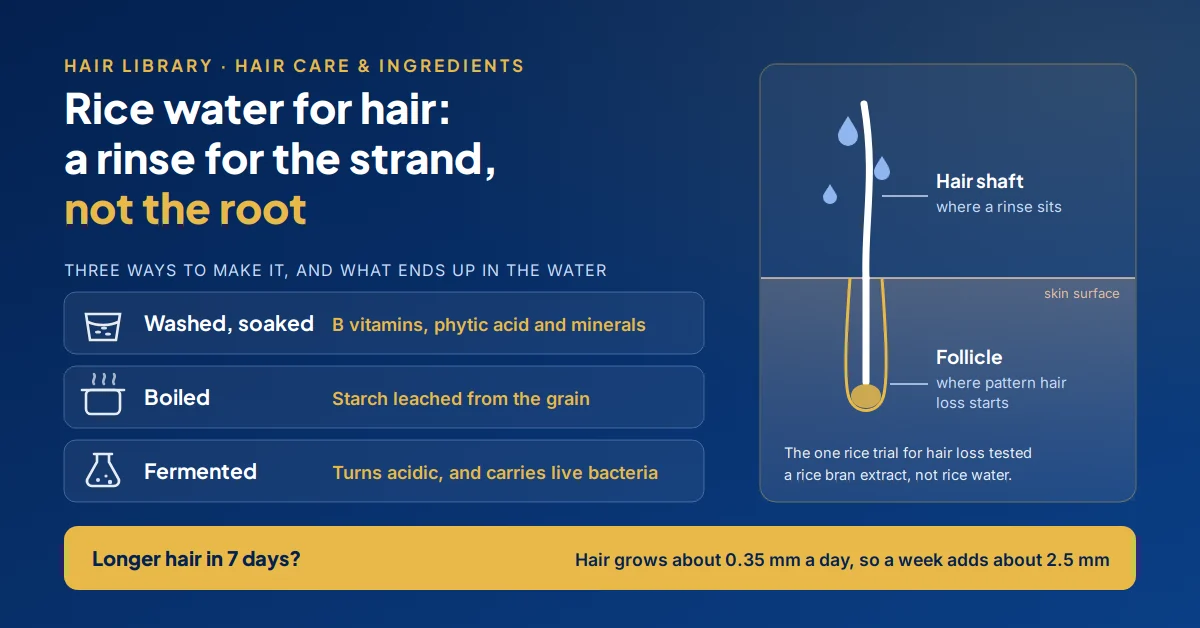
Pattern hair loss starts below the skin, where genes and androgen signalling in the dermal papillaGlossaryThe dermal papilla is a cluster of cells at the centre of the hair bulb. It signals the bulb and helps decide how thick, how long and what colour each hair grows. Open in the glossary → slowly shrink the follicle.[2] A rinse sits on the hair shaftGlossaryThe hair shaft is the visible part of a hair above the skin, made of keratin in three layers: the cuticle, the cortex and, in thicker hairs, a central medulla. It forms in the follicle and cannot repair itself after it leaves the scalp. Open in the glossary → above it, which is why we treat rice water as hair care rather than hair loss treatment.
2Complete guideFrom the kitchen recipe to hair loss and surgery
How to Make Rice Water: Washed, Boiled or Fermented
What Is in Rice Water?
Washing rice draws B vitamins, phytic acid and minerals such as zinc and iron out of the grain, while soaking mainly draws out thiamine (vitamin B1).[3] Boiling adds starch, which leaches into the cooking water.[4]
We found no study showing that any of these get inside the hair.
Washed, Boiled or Fermented: How They Compare
Method
How to make it
What the water picks up
Our note
Washed or soaked
Soak rice in water for about 30 minutes, then strain
B vitamins, phytic acid and minerals
The simplest; use it fresh
Boiled
Cook rice in extra water, pour off the liquid, let it cool
Starch from the grain
Thicker; rinse it out fully
Fermented
Leave soaked water at room temperature until it smells sour, then refrigerate
Organic acids; a lab batch reached pH 4 in 6 hours[5]
Acidic and full of microbes; dilute it
In the lab, fermentation made rice water acidic within hours. Diluting it with plain water and rinsing it out fully is our own cautious advice, not a tested rule: no study has tested fermented rice water on hair.
How to Use Rice Water Step by Step
Shampoo and squeeze the excess water out of your hair.
Pour or spray the rice water over your hair and scalp.
Leave it a few minutes, then rinse it out completely.
Use your usual conditioner if your hair feels stiff.
Storing Rice Water
Rice water is rich in nutrients, so microbes multiply in it easily; batches left to ferment carried bacteria such as Pseudomonas, Enterobacter and Clostridium alongside Lactobacillus.[6] Make a fresh batch for each use, or keep a few days' worth in a closed jar in the fridge, and pour it away if it smells rotten rather than sour.
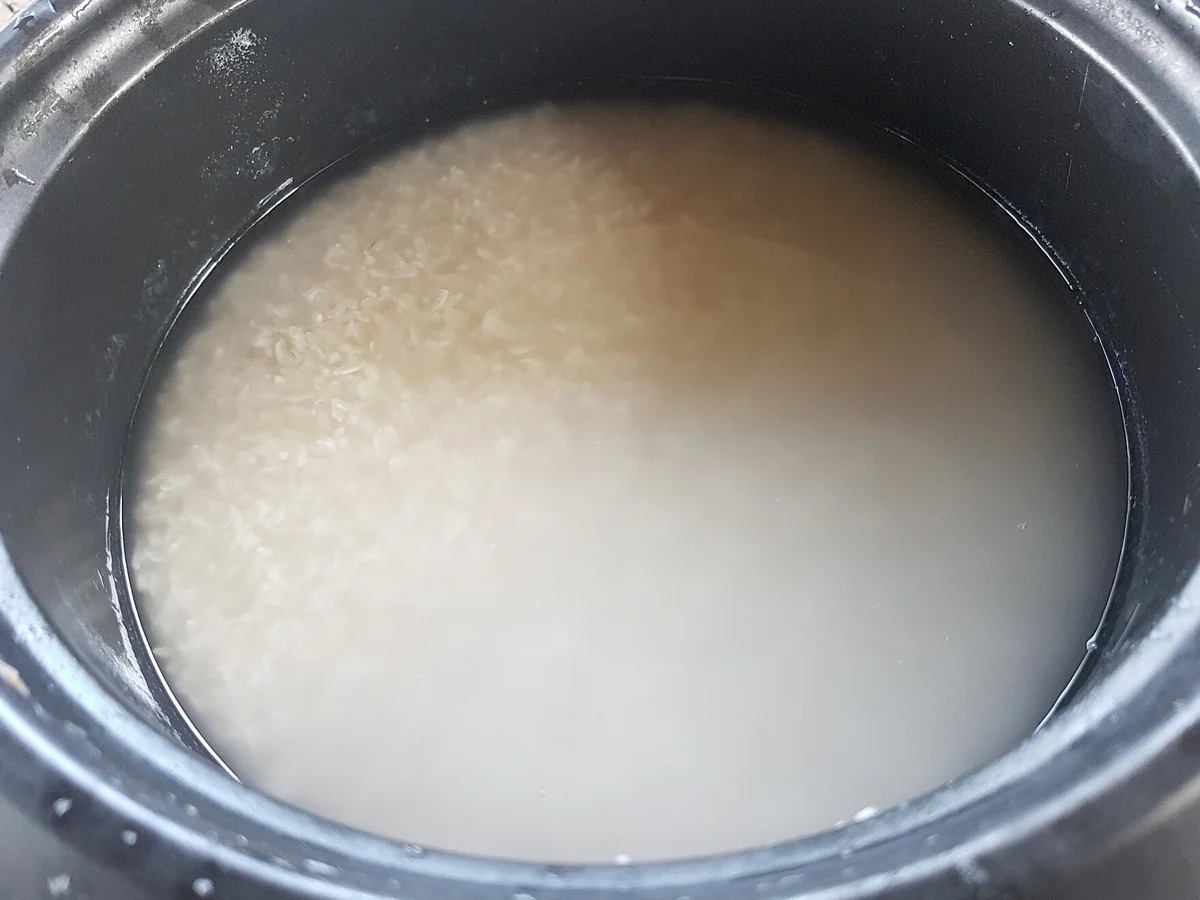
Rice soaking in water: the cloudy liquid is what people use as a rinse. Photo: Obsidian Soul, CC0, via Wikimedia Commons, cropped.
What the Evidence Says About Rice Water for Hair
Hair Growth: A Rice Bran Trial, Not a Rice Water Trial
The only human trial tested a rice bran extract, made with a lab process and applied to the scalp every day for 16 weeks in 50 people with pattern hair loss. Men gained hair density and thickness compared with placebo, and no side effects were reported.[1]
A 2025 review of non-prescription products placed rice bran among several ingredients with encouraging but limited evidence, and asked for larger, longer trials.[7] Neither paper involved rice water. We'd call the bran result interesting, and a long way from proof that a kitchen rinse does the same.
Strength, Shine and the Inositol Claim
Whatever rice water does, it does on the shaft. Rice extract is classed as a hair-conditioning ingredient in cosmetics, and hydrolysed rice protein is used as a conditioner too.[8] We found no test of homemade rice water on how hair feels, or on its strength or shine.
Does Rice Water Cause Protein Overload?
"Protein overload" is the online name for hair that turns stiff and straw-like after too much protein. No study has measured it after rice water use. If your hair feels harsher after a few rinses, stop; our hair porosity guide explains which hair reacts badly to protein.
Can Rice Water Grow Hair in 7 Days?
No. In one study of women's scalp hair, pigmented hairs grew 0.35 mm a day.[9] At that rate, 7 days add about 2.5 mm, rice water or not. The study's own figures by hair and site:
Hair measured
Growth per day
Pigmented, top of the head
0.34 mm
Pigmented, back of the head
0.37 mm
White, top of the head
0.37 mm
White, back of the head
0.40 mm
A before-and-after clip can't separate a rinse from lighting, styling and this normal growth. Our guides to how fast hair grows and regrowing hair in 3 weeks set out the real timeline. Keeping the length you grow is a separate problem, covered in our hair breakage entry.
Rice Water With Rosemary and Other Add-ins
Rosemary oil has one controlled trial in pattern hair loss, where it matched minoxidil 2% on hair density over 6 months[7], but nobody has tested it mixed into rice water. Our rosemary oil guide and oils for hair growth cover the oils; egg masks and other kitchen remedies are checked in how to thicken hair naturally.
Side Effects, Hair Loss and Where a Transplant Fits
Side Effects and Who Should Skip It
Rice-derived cosmetic ingredients are generally considered non-allergenic, and a safety panel judged them safe as used in cosmetics.[8] Reactions still happen:
Eczema-prone skin. Rice was one of the foods behind contact hives in adults who handled food at work, and most of them had atopic dermatitis or hand eczema.[10]
Fermented batches. They turn acidic and carry live microbes, so we'd dilute them and rinse them out.
Hair that stiffens. Stop if it feels harsher.
A freshly transplanted scalp. Follow your post-operative hair wash plan, and ask your medical team before adding anything to it.
Rice Water for Men
Men are the only group with a positive rice result, and it came from the bran extract, not the rinse. Nothing shows that rice water holds back a receding hairline. The approved medicines for pattern hair loss are topical minoxidil and oral finasteride.[7]
If Your Hair Is Thinning: Options With Stronger Evidence
Here is how a rinse compares with the options that have been tested in people. The last column is our own reading of the evidence.
Option
Human evidence in pattern hair loss
Our reading
Rice water rinse
None found
A cosmetic rinse
Rice bran extract on the scalp
One 16-week trial; men gained density
Interesting, not proven
Rosemary oil
One controlled trial; similar density gain to minoxidil 2%
Pattern hair loss is the most common reason for a transplant, but not everyone with it is a candidate. A transplant is the wrong answer for diffuse thinning without a pattern, scarring alopecia, loss that is still unstable or too slight, and for very young patients.[11]
Rice water plays no part in that decision. What decides it is a careful history and an examination of your scalp and donor areaGlossaryThe donor area is the back and sides of the head, where follicles resist DHT. An extracted follicle does not grow back in that spot, so extractions are spread out, and the donor supply is the limit of every plan. Open in the glossary →.
Frequently Asked Questions
How often should you use rice water on your hair?
No study has tested a schedule. Once a week as a final rinse is a cautious start; cut back if your hair stiffens or your scalp itches, and we'd dilute fermented water, which turns acidic. How often to shampoo at all is covered in our hair washing entry.
How long should you leave rice water in your hair?
A few minutes, then rinse. Nothing shows that longer contact works better, and fermented batches carry live bacteria.
Should you use rice water before or after shampoo?
After, on clean damp hair, as you would a conditioner. Rice extract is classed as a hair-conditioning ingredient in cosmetics.
Does rice water need to be refrigerated, and does it expire?
Yes, keep it cold: its nutrients let microbes multiply. No study sets a shelf life for hair use, so make small batches and use them within a few days.
Is rice water supposed to smell bad?
Fermented rice water should smell sour, because organic acids build up as it ferments. Throw it away if it smells rotten or grows mould.
Does rice water have protein?
No study we found has measured how much protein ends up in homemade rice water. Hydrolysed rice protein is used as a hair conditioner in cosmetics, and boiling draws starch into the water.
Is rice water good for hair and skin?
For skin, a cosmetic safety review notes that eczema lesions eased in people who bathed with a rice bran preparation. People with eczema-prone skin can still react to rice they handle, so test a small patch first.
Who Rice Water Suits, and Who Needs More Than a Rinse
Rice water is a cheap, low-stakes rinse with an honest ceiling: any benefit is cosmetic, and nothing shows it changes how much hair grows.
It suits you if you want a simple rinse, accept that any benefit is cosmetic and are happy to make it fresh.
Skip it if your skin is eczema-prone, your scalp is healing after surgery or your hair stiffens after a few uses.
Don't rely on it if your parting is widening or your hairline is moving back. Pattern hair loss starts in the follicle, out of a rinse's reach.
If you're seeing those signs, send three photos for a free hair analysis. The medical team will tell you whether it looks like pattern hair loss and whether medication or a transplant fits your case, with no obligation. You can also message us on WhatsApp.
About the Author
Written by: Nazmi Güldeş, Certified Trichologist. Nazmi Güldeş focuses on patient education around androgenetic alopecia, evaluating miniaturization through dermoscopy, and assessing candidates for medical treatments and hair transplants.
Editorial Policy & Trust
This entry was drafted with the help of AI writing tools and edited by our team, then medically reviewed by Dr. Teuku Adifitrian, Sp.BP-RE (Dr. Tompi) on 31 October 2026. AI is never used as a source: every study cited here was checked against PubMed on 31 October 2026. Key figures are marked with their source, and every source is listed at the end of this entry. Read how we work in our editorial policy.
3 questions
Test yourself
Check what you remember from this entry. Each answer links back to the section that explains it.
What did the only rice trial in pattern hair loss actually test?
It tested a 0.5% rice bran extract for 16 weeks in 50 people; men gained hair density and thickness. We found no trial of rice water itself. Read the section
At about 0.35 mm a day, how much does scalp hair grow in a week?
Pigmented scalp hairs grew 0.35 mm a day in one study, so a week adds about 2.5 mm, with or without rice water. Read the section
Who should be most careful with rice water?
Contact hives from handling rice have been reported, mostly in people with atopic dermatitis or hand eczema. Read the section
3Scientific evidenceStudy types, references and how to cite this entry
11sources
Evidence behind this entry: 11 publications indexed in PubMed (2004 to 2026): 4 reviews, 4 lab studies, 2 clinical studies and 1 randomized trial. 4 sources have free full text.
Randomized trialpeople assigned to treatments by chance
Reviewsummarises many studies
Clinical studya study in people without random groups
Lab studytested on cells or hair follicles in the lab
Choi JS, Park JB, Moon WS, et al. Safety and Efficacy of Rice Bran Supercritical CO2 Extract for Hair Growth in Androgenic Alopecia: A 16-Week Double-Blind Randomized Controlled Trial. Biological & Pharmaceutical Bulletin. 2015;38(12):1856-1863.Randomized trialPubMedDOI
Li Y, Wan X, Geng Y, et al. Inflammation-fibrosis coupling in androgenetic alopecia: evidence and mechanistic hypotheses for progressive hair follicle miniaturization. Frontiers in Immunology. 2026;17:1960477.ReviewPubMedDOIFree full text
Liu K, Zheng J, Wang X, et al. Effects of household cooking processes on mineral, vitamin B, and phytic acid contents and mineral bioaccessibility in rice. Food Chemistry. 2019;280:59-64.Lab studyPubMedDOI
Yi X, Yu W, Liu H, et al. Importance of both leached and residual starch molecular structures in determining cooked rice texture at different rice-to-water cooking ratios. International Journal of Biological Macromolecules. 2024;258(Pt 2):129040.Lab studyPubMedDOI
Lee EH, Jeong HM, Kim EA, et al. Development of Fermented Rice Water to Improve the Quality of Garaetteok, a Traditional Korean Rice Cake. Foods (Basel, Switzerland). 2023;12(3).Lab studyPubMedDOIFree full text
Chen Y, Chen H, Zhong Q, et al. Determination of Microbial Diversity and Community Composition in Unfermented and Fermented Washing Rice Water by High-Throughput Sequencing. Current Microbiology. 2021;78(5):1730-1740.Lab studyPubMedDOI
Gupta AK, Wang H, Wang T, et al. Do Non-Prescription Products Help in Managing Androgenic Alopecia?. Skin Appendage Disorders. 2025;11(3):270-281.ReviewPubMedDOIFree full text
Van Neste D. Thickness, medullation and growth rate of female scalp hair are subject to significant variation according to pigmentation and scalp location during ageing. European Journal of Dermatology. 2004;14(1):28-32.Clinical studyPubMed
Inomata N, Nagashima M, Hakuta A, et al. Food allergy preceded by contact urticaria due to the same food: involvement of epicutaneous sensitization in food allergy. Allergology International. 2015;64(1):73-78.Clinical studyPubMedDOI
True RH. Is Every Patient of Hair Loss a Candidate for Hair Transplant?-Deciding Surgical Candidacy in Pattern Hair Loss. Indian Journal of Plastic Surgery. 2021;54(4):435-440.ReviewPubMedDOIFree full text
Güldeş, N. (2026, October 31). Rice water for hair: Does it work, how to make it and who should skip it. Turkey Hair Center Hair Library. https://turkeyhaircenter.com/rice-water-for-hair/
@misc{guldes2026ricewaterforhair,
  author       = {Güldeş, Nazmi},
  title        = {Rice water for hair: Does it work, how to make it and who should skip it},
  howpublished = {Turkey Hair Center Hair Library},
  year         = {2026},
  month        = oct,
  url          = {https://turkeyhaircenter.com/rice-water-for-hair/},
  note         = {Last updated 31 October 2026}
}
TY  - ELEC
AU  - Güldeş, Nazmi
TI  - Rice water for hair: Does it work, how to make it and who should skip it
T2  - Turkey Hair Center Hair Library
PY  - 2026
DA  - 2026/10/31
UR  - https://turkeyhaircenter.com/rice-water-for-hair/
N1  - Last updated 31 October 2026
ER  -
Send three photos: front, top and sides. You get a technique recommendation, a graft range and a straight answer about what is achievable, before anyone talks about price.
Your details are with the team
A patient coordinator will get back to you shortly. If you would like to send your photos now, WhatsApp is the fastest way to do it.