Shampoo for Hair Loss: Does It Work, and Which Ingredients Help?
If you're hoping a shampoo for hair loss will stop your thinning, here's the honest answer: the best ones can calm dandruff and cut the shedding that comes with it, but none we found has been shown to stop pattern hair loss on its own. Think of a shampoo as a helper, not a treatment.
The label won't tell you which kind you're holding. One word on the bottle says a lot about the evidence behind it, and we'll show you how to read it, along with who paid for the studies you see quoted.
Does Shampoo for Hair Loss Work?
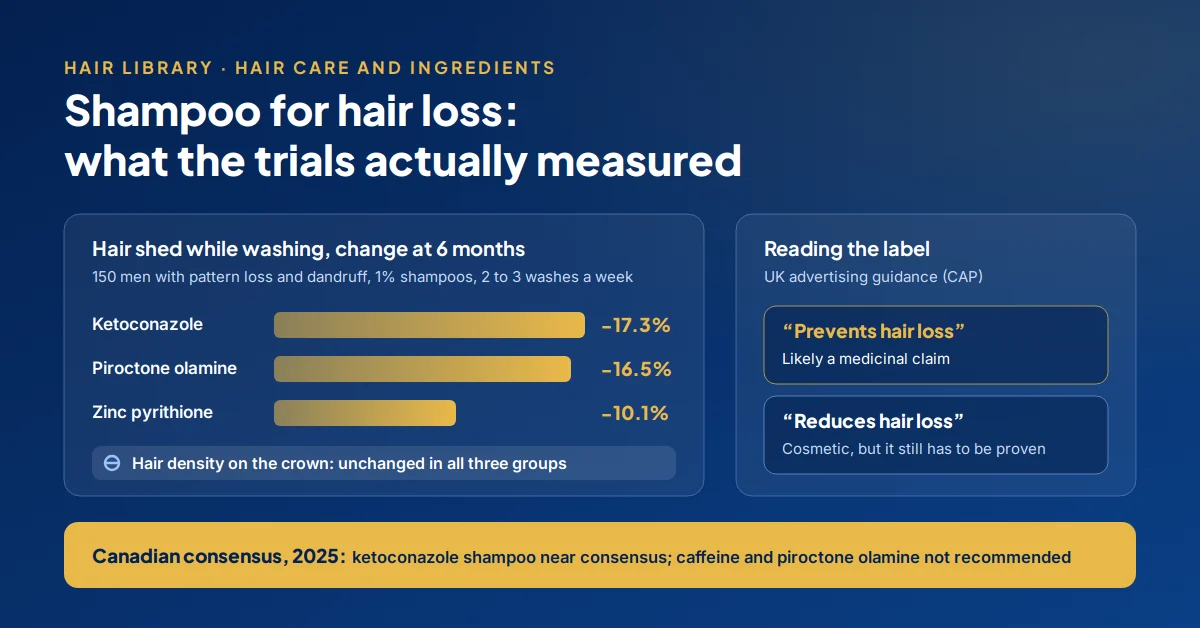
Partly. In men with dandruff and pattern hair loss, six months of an antidandruff shampoo cut shedding by 10% to 17%, but hair density didn't change. So a shampoo can help a flaky, shedding scalp. It isn't a substitute for medicines such as minoxidil or finasteride: no shampoo made a 2025 expert panel's list of recommended treatments.
It can calm dandruff and itch, and the shedding that comes with them.
It can add a small gain: a daily zinc pyrithione shampoo raised hair counts by slightly less than half as much as minoxidil 5% solution.
It can't replace the recommended treatments, which include finasteride, minoxidil and dutasteride. The panel put ketoconazole shampoo only in its "near consensus" group.
It can't fill in bald areas. For that, dermatologists may suggest a transplant when the cause is pattern hair loss.
Which Shampoo Ingredients Help With Hair Loss?
What each ingredient has shown in people, and who ran the best study we found. The last column is our verdict.
Ingredient
Best human evidence we found
Who ran it
Our verdict
Ketoconazole
6-month trial: shedding down 17%, density unchanged; a review found thicker hair shafts
University team
The best-studied; worth it if you have flakes
Piroctone olamine
Same trial: shedding down 16.5%
University team
Close to ketoconazole, but not recommended by the 2025 panel
Zinc pyrithione
26-week trial: hair count up, less than half the gain of minoxidil
Research company; funder not named in the abstract
A small, steady gain
Caffeine
6-month trial of a shampoo with caffeine and DMG-Na: fewer hairs in the pull test
Company-funded; company employees among the authors
Not recommended by the 2025 panel
Saw palmetto, rosemary, biotin
No shampoo trial found
None
Unproven in shampoo form
Ketoconazole
Ketoconazole has the most support. In the six-month trial it cut shedding by 17% and thickened the hair shaft, and a systematic review of five human studies also found thicker shafts. The reviewers called it a promising add-on or alternative and said randomized controlled trials are needed.
We'd use it for flakes or as an extra alongside proven treatment, not on its own. Our ketoconazole shampoo guide covers how often to use it.
Piroctone Olamine and Zinc Pyrithione
Both are antidandruff ingredients, and like ketoconazole they mainly work by holding back Malassezia yeast. In the six-month trial, piroctone olamine cut shedding almost as much as ketoconazole and thickened the hair shaft; zinc pyrithione cut shedding least and didn't thicken it.
Zinc pyrithione has its own trial. Used daily, it raised hair counts from week 9, by slightly less than half as much as minoxidil 5% solution, and held that gain to week 26.
Here the sources disagree. The 2025 panel listed piroctone olamine shampoo as not recommended, despite the trial result. We'd read that as "not enough good evidence yet", not as proof that it does nothing.
Caffeine and Adenosine
The largest caffeine shampoo trial we found was company-funded, and three of its authors were company employees. After six months of daily use, men on the caffeine and DMG-Na shampoo lost fewer hairs in a pull test than men on a placebo shampoo.
The trial that found caffeine no less effective than minoxidil 5% tested a 0.2% caffeine liquid for the scalp, not a shampoo. The 2025 panel listed both caffeine and adenosine as not recommended.
Saw Palmetto, Rosemary and Biotin
These turn up on "hair growth" labels, and we found no shampoo trial for any of them. Saw palmetto is sold as a DHT blocker, but we found no test of that claim in a shampoo.
The 2025 panel didn't recommend rosemary oil or topical herbal formulations; our rosemary shampoo section explains why the oil trial doesn't carry over. For biotin, see our guide to vitamins for hair loss.
Is There a Minoxidil Shampoo?
We found no published trial of one. In the zinc pyrithione trial, minoxidil 5% was a solution applied twice a day, and adding the shampoo on top gave no extra benefit. Our minoxidil entry covers the tested forms.
How to Read "Reduces Hair Fall" and "Prevents Hair Loss"
This is the word that tells you a lot. UK advertising guidance treats a claim that a product prevents or cures hair loss as likely medicinal, because hair growth is a body function. Claims to slow or reduce hair loss usually aren't medicinal, but the seller still has to prove them.
The UK regulator has upheld complaints against hair loss product ads, including one for a caffeine shampoo, because the evidence didn't hold up: one study had no control group, and another tested a different product. Before you buy, check four things on the label:
The active ingredient and its strength, such as ketoconazole 1% or zinc pyrithione 1%, the forms the trials used.
The wording of the claim. "Prevents" or "cures" hair loss is likely a medicinal claim; "reduces hair fall" is unlikely to be one and still needs evidence.
Whose study it is. A lab test of one ingredient, or a trial of another product, isn't proof for the bottle in your hand.
Fragrance and preservatives, if your scalp reacts easily; fragrance mix and the preservative MCI/MI are among the most often reported scalp allergens.
The same guidance says the ASA and CAP haven't seen evidence that any product can treat hair shedding, yet the six-month trial measured less shedding in men whose shedding came with dandruff. We'd say both are true: a shampoo can calm shedding that comes with a flaky scalp, and we found no trial showing it helps shedding from other causes.
Can Shampoo Cause Hair Loss or Breakage?
We found no clinical study showing that sulfates or other common shampoo cleansers make hair shed from the root. The documented problems are different:
Breakage. Shampoos, dyes and straighteners may strip lipids and protein from the hair fibre, and breakage is one possible side effect of misusing hair cosmetics. Our hair breakage entry shows how to tell breakage from shedding.
Allergy. In a review of 3,185 people with scalp contact allergy, shampoos were linked to 28% of cases, with itch and burning as typical signs. Our itchy scalp entry covers other causes of itch.
Can Dry Shampoo Cause Hair Loss?
The evidence here is thin. We found no clinical study that tested dry shampoo and hair loss, so there's no proof that it causes shedding, and none that heavy use is harmless.
What's documented is indirect: a review of cosmetics for people with hair loss notes that combining topical minoxidil with dry shampoo or co-wash may increase residue on the hair.
If your scalp itches or burns after a new one, stop: fragrance is a commonly reported scalp allergen. We'd use dry shampoo between washes, not instead of them.
Why You See More Hair in the Drain
The drain is where you notice shed hairs. In a wash test of 176 people, those without hair loss shed 27.9 hairs per daily wash on average, against 52.2 with pattern hair loss and 125.5 with telogen effluvium.
So some hair after every wash is normal, and hair in the drain after a switch doesn't by itself show the new shampoo caused it. Our guide to how much hair loss is normal shows how to count at home.
Shampoo Myths, Checked
"Caffeine shampoo works as well as minoxidil." The trial that compared caffeine with minoxidil 5% tested a caffeine liquid, not a shampoo.
"Sulfates make your hair fall out." We found no clinical study showing it.
"Clinically proven means the shampoo was tested." The proof may be for one ingredient in a lab, or for a different product.
Using a Hair Loss Shampoo: Situations and Surgery
How the Trials Used It
If you try one, copy what the trials did, since that's the schedule the results come from:
Antidandruff shampoos: 2 to 3 times a week for six months.
Zinc pyrithione: every day, with hair counts up from week 9.
Caffeine shampoo: every day for six months.
Expert note: Give a shampoo six months before you judge it, the length of most of these trials. Photograph your crown and parting on day one, in the same light and from the same angle, and compare at month 6. If the only change is less itching and flaking, that's still a result, just not regrowth.
Best Shampoo for Thinning Hair: Choose by Situation
No single shampoo is best for thinning hair. The right choice depends on what's behind the thinning:
Flakes or itch with shedding. An antidandruff shampoo is the best-studied choice. See scalp yeast infection.
Pattern thinning without flakes. A shampoo is an add-on at most; medicines come first. The trials above enrolled only men, so for women see female pattern hair loss.
Sudden shedding after a trigger. After a baby, a major illness, surgery or losing 20 pounds or more, hair may regrow on its own. We found no shampoo trial for this shedding. See postpartum hair loss and hair loss on GLP-1 medicines.
Shampoo Before and After a Hair Transplant
For pattern hair loss, a transplant can be an effective and permanent solution. It doesn't treat dandruff, and if your shedding follows a trigger, surgery is the wrong answer: that hair may regrow on its own.
After surgery, your team's washing protocol comes first, including when to start and which shampoo to use. See our guide to washing after a hair transplant.
Expert note: Bring the shampoo you use to your consultation, or a photo of its ingredient list. If it's medicated, ask whether to pause it before surgery and when to restart it, so you aren't guessing in the first week.
Frequently Asked Questions
Is ketoconazole or caffeine shampoo better for hair loss?
We found no head-to-head trial. Ketoconazole has a systematic review behind it and near-consensus support from the 2025 panel; caffeine's largest shampoo trial was company-funded, and the panel didn't recommend caffeine.
Why is my hair falling out after changing shampoo?
Rule out a reaction first: shampoos were linked to 28% of scalp contact allergy cases, with itch and burning as typical signs. Otherwise you may simply be noticing normal shedding: in a wash test, people without hair loss shed 27.9 hairs per daily wash on average.
How long does a hair loss shampoo take to work?
Most of the trials judged results at about six months. Zinc pyrithione raised hair counts from week 9, and the gain held through 26 weeks.
Does washing your hair every day cause hair loss?
We found no study linking the two. Even people without hair loss shed 27.9 hairs per daily wash on average in a wash test, so some hair in the drain is expected. Our guide to how often to wash your hair covers schedules by hair type.
Is sulfate-free shampoo better for thinning hair?
We found no trial showing it reduces hair loss. Shampoos may strip lipids and protein from the hair fibre, so a gentler routine is worth trying if breakage is your problem.
What conditioner should you use for hair loss?
We found no conditioner trial for hair loss, so choose one for how your hair feels. If your scalp itches or burns after a new one, stop: conditioners were linked to 22% of scalp contact allergy cases.
Who a Hair Loss Shampoo Suits, and Who Needs More
An antidandruff shampoo makes sense if flakes or itch come with your shedding, or as an add-on to proven treatment. On its own it hasn't been shown to hold back pattern hair loss.
It's also a small commitment: the antidandruff trial used a wash two to three times a week. The real cost is six months of patience before you can judge it. Your quick plan:
Check your scalp: flakes and itch point to an antidandruff shampoo.
Read the label for the active ingredient, its strength and the wording of the claim.
Use it the way the trials did, and take photos on day one.
Judge it at six months, and stop if your scalp itches or burns.
If thinning keeps progressing, ask a specialist about medicines or surgery.
If you'd like to plan your next step with a specialist, send three photos for a free hair analysis. The medical team will tell you whether it looks like pattern loss, shedding or a scalp problem, and whether a transplant is worth discussing, with no obligation. You can also message us on WhatsApp.
Sources and medical review
Piérard-Franchimont C, Goffin V, Henry F, et al. Nudging hair shedding by antidandruff shampoos. A comparison of 1% ketoconazole, 1% piroctone olamine and 1% zinc pyrithione formulations. International Journal of Cosmetic Science, 2002;24(5):249-256
Landells I, Chow E, Gupta AK, et al. A Canadian Consensus on Androgenetic Alopecia: Approach and Management. Journal of Cutaneous Medicine and Surgery, 2025;29(5_suppl):5S-14S
Fields JR, Vonu PM, Monir RL, et al. Topical ketoconazole for the treatment of androgenetic alopecia: A systematic review. Dermatologic Therapy, 2020;33(1):e13202
Trüeb RM. Shampoos: ingredients, efficacy and adverse effects. Journal Der Deutschen Dermatologischen Gesellschaft = Journal of the German Society of Dermatology, 2007;5(5):356-365
Berger RS, Fu JL, Smiles KA, et al. The effects of minoxidil, 1% pyrithione zinc and a combination of both on hair density: a randomized controlled trial. The British Journal of Dermatology, 2003;149(2):354-362
Celleno L, Bussoletti C, Tolaini MV, et al. A Novel Approach Against Male Pattern Hair Loss With Topical Dimethylglycine Sodium Salt (DMG-Na) and Caffeine: Efficacy of a 24-Week, Double-Blind, Randomized, Placebo-Controlled Trial. Journal of Cosmetic Dermatology, 2025;24(8):e70390
Dhurat R, Chitallia J, May TW, et al. An Open-Label Randomized Multicenter Study Assessing the Noninferiority of a Caffeine-Based Topical Liquid 0.2% versus Minoxidil 5% Solution in Male Androgenetic Alopecia. Skin Pharmacology and Physiology, 2017;30(6):298-305
Committee of Advertising Practice. Hair: Hair loss. AdviceOnline guidance on the UK Code of Non-broadcast Advertising. ASA and CAP, updated 5 October 2026
Pham CT, Juhasz M, Lin J, et al. Allergic Contact Dermatitis of the Scalp Associated With Scalp Applied Products: A Systematic Review of Topical Allergens. Dermatitis, 2022;33(4):235-248
Dias MFRG, Loures AF, Ekelem C. Hair Cosmetics for the Hair Loss Patient. Indian Journal of Plastic Surgery, 2021;54(4):507-513
Li X, Wang X, Wang C, et al. Hair Shedding Evaluation for Alopecia: A Refined Wash Test. Clinical, Cosmetic and Investigational Dermatology, 2022;15:117-126
Send three photos: front, top and sides. You get a technique recommendation, a graft range and a straight answer about what is achievable, before anyone talks about price.
Your details are with the team
A patient coordinator will get back to you shortly. If you would like to send your photos now, WhatsApp is the fastest way to do it.