Scalp Psoriasis: Symptoms, Hair Loss and Treatment
How scalp psoriasis looks, how it differs from dandruff and seborrheic dermatitis, what each treatment step does, whether your hair grows back, and when a transplant can be planned.
12sources
12in PubMed
12min read
Written by Nazmi Güldeş, Certified Trichologist · Medically reviewed by Dr. Teuku Adifitrian, Sp.BP-RE (Dr. Tompi), Plastic, Reconstructive and Aesthetic Surgeon · Last reviewed 31 October 2026
Reading level
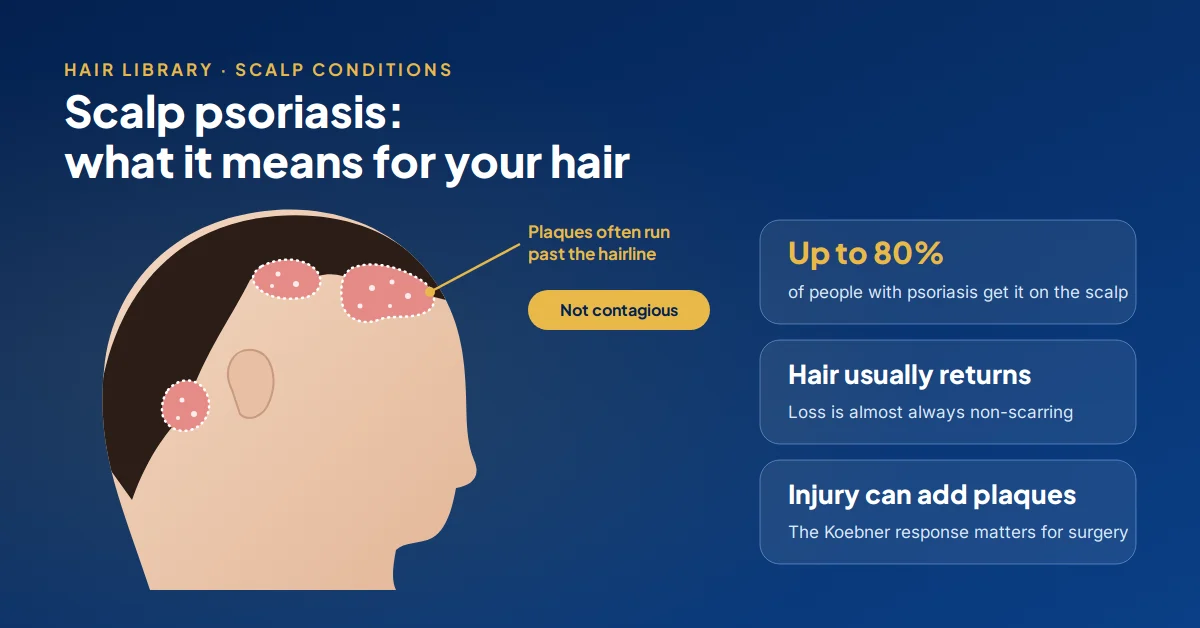
Scalp psoriasis is psoriasis on the scalp: red, sharply edged plaques under silver-white scale that often run past the hairline and often itch. It is a long-term immune condition, not an infection, so you cannot catch it or pass it on. There is no cure, but the right treatment can clear the scalp, and the hair loss it causes is almost always temporary.
Hair loss is one of the main worries, and it is also what decides whether and when a transplant makes sense. We start with how to tell psoriasis from dandruff.
1Quick answerThe short answer, in a few sentences
What Is Scalp Psoriasis?
Scalp psoriasis is the same immune skin disease as psoriasis elsewhere, showing on the scalp as sharp-edged plaques with silvery scale. Approximately 80% of people with psoriasis get it there.[1] It is not contagious, it is long-term, and a strong steroid lotion, gel or shampoo is the usual first treatment.
Because hair covers the plaques, the scalp is one of the harder places to treat. That is why the form of a treatment, such as a shampoo, gel or lotion, matters as well as the drug in it.
2Complete guideFrom symptoms and treatment to hair loss and surgery
Scalp Psoriasis Symptoms, Causes and Look-Alikes
What Scalp Psoriasis Looks Like
The plaques have sharp edges and often cross the natural hairline, unlike the blurred redness of seborrheic dermatitis.[2] Signs to look for:
Silver-white scale on red, raised skin
Itch, which can be intense
Plaques past the hairline onto the skin next to it
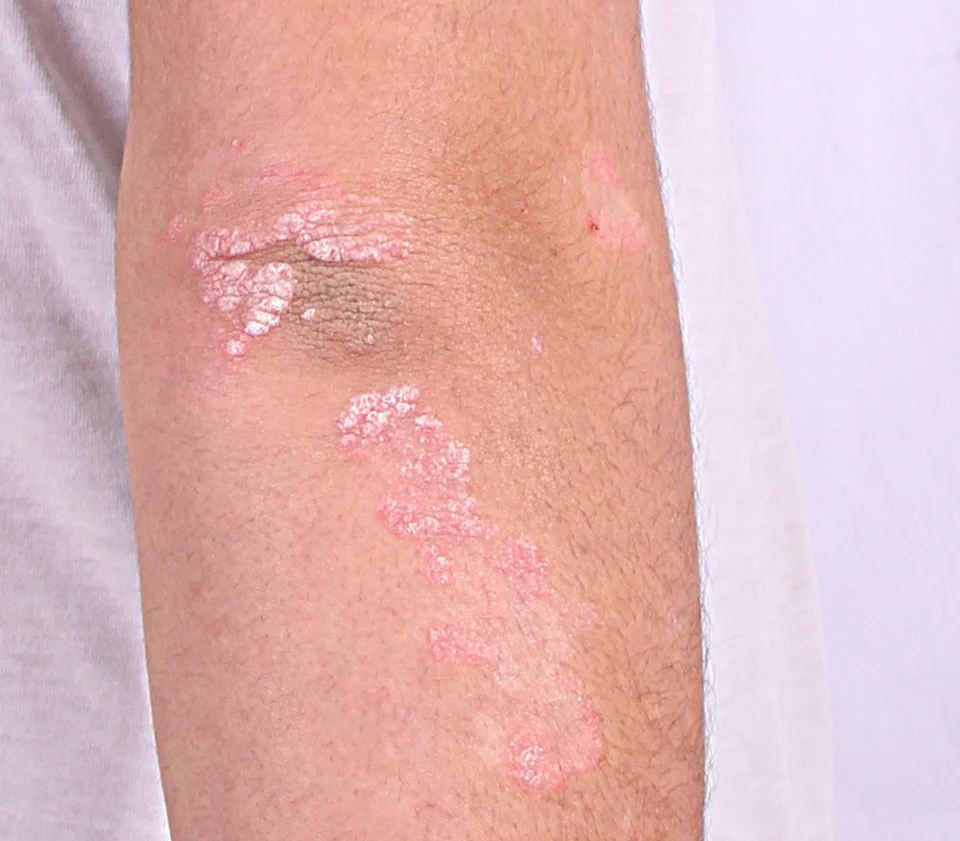
Plaques elsewhere, most typically on the elbows, knees and lower back, which a doctor will check too
Plaque psoriasis on the elbow, a site doctors check when the scalp is scaly. Photo: Jacopo188, CC BY-SA 3.0, via Wikimedia Commons, cropped.
What Causes Scalp Psoriasis?
Psoriasis comes from a mix of inherited and outside factors. People with a family history are more likely to get it. Stress, infections and some medicines can set it off or make it worse, and smoking and obesity raise the risk.[3]
On the skin itself, injury is a known trigger. Scratching, cuts, chemical irritation and infections can raise new plaques at the injured spot, an effect called the Koebner response.[4] If your scalp itches without clear plaques, our itchy scalp entry covers the other causes.
Scalp Psoriasis vs Dandruff, Seborrheic Dermatitis and Ringworm
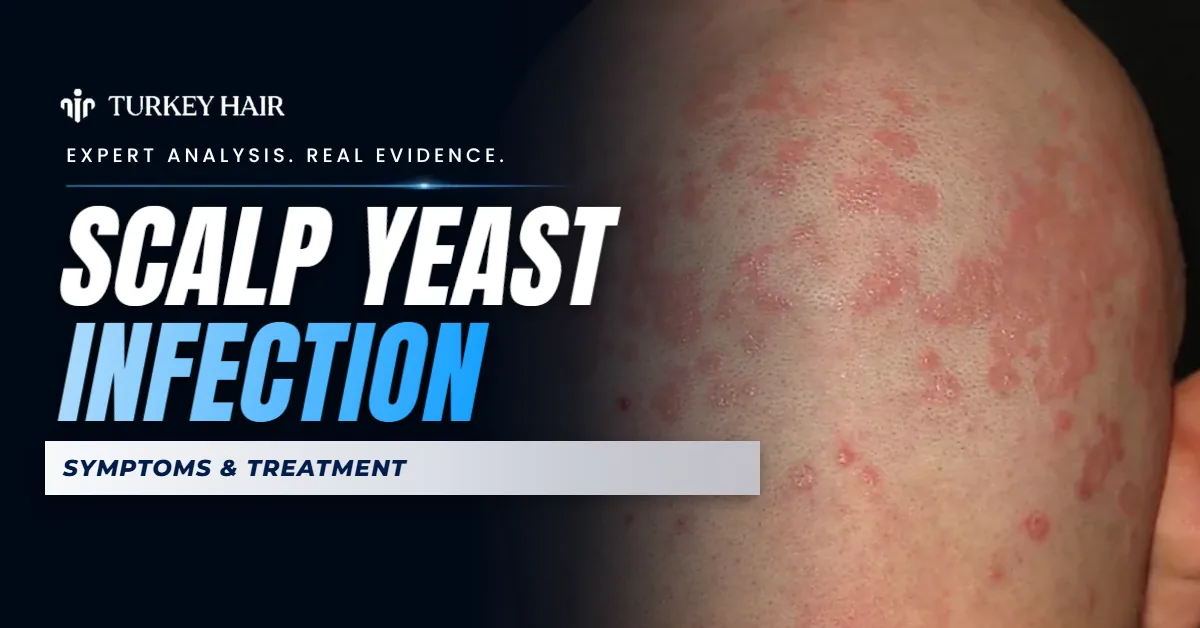
Seborrheic dermatitisGlossarySeborrheic dermatitis causes an itchy, flaky, scaly rash on oily areas such as the scalp. It is the Malassezia-linked condition most people mean by a scalp yeast infection. Open in the glossary → is the other common scaly scalp condition, and the two can overlap. Dandruff sits at the mild end of the same spectrum as seborrheic dermatitis.[5] The "first step" column is our own summary.
Condition
What you see
What sets it apart
Usual first step
Scalp psoriasis
What you see
Sharp-edged plaques with silver-white scale, often across the hairline
What sets it apart
Red dots and twisted red loops under a magnifier
Usual first step
A strong topical steroid
Seborrheic dermatitis
What you see
Blurred, dark-red patches with yellowish, greasy scale
What sets it apart
Thin branching vessels; diffuse hair loss is more frequent
Responds to treatments similar to those for seborrheic dermatitis
Ringworm (tinea capitis)
What you see
A fungal infection of scalp and hair, mostly in children
What sets it apart
Contagious, and a fungal infection rather than an immune one
Usual first step
Antifungal tablets, since creams alone are not enough[6]
How Doctors Confirm It
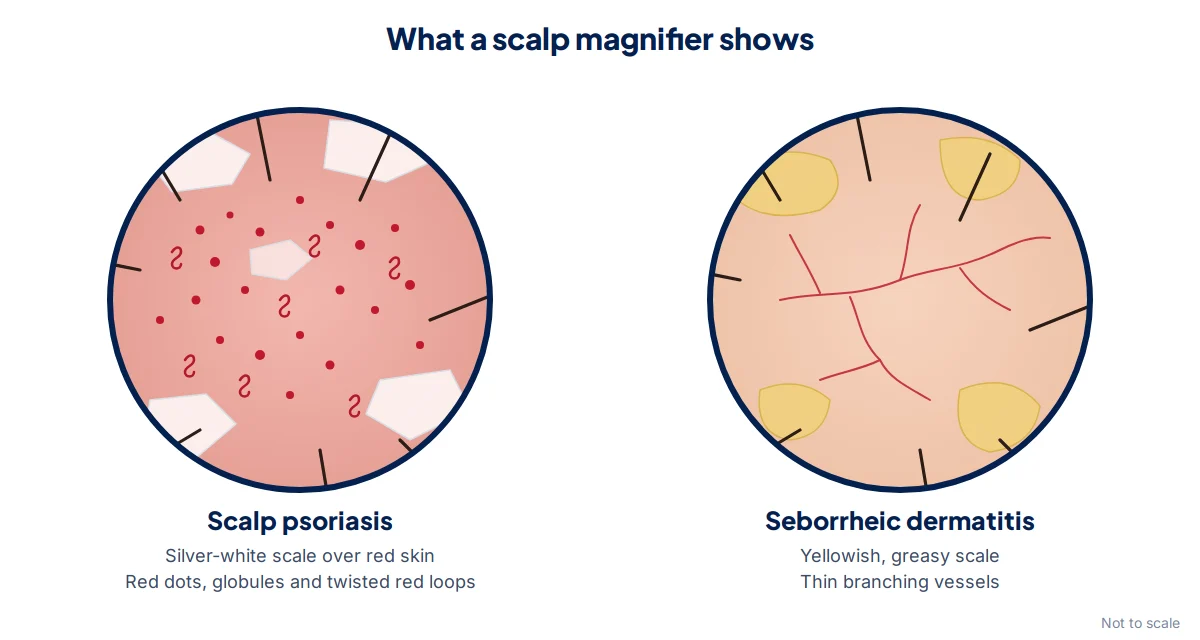
An examination plus trichoscopy, a magnified look at the scalp, is often enough; when it is not, a biopsy usually settles it.[7] The vessels and the scale both help: psoriasis shows regular red dots and twisted red loops under silver-white scale, while seborrheic dermatitis shows thin branching vessels under yellowish scale.
What a scalp magnifier shows in each condition. Not to scale. Illustration: Turkey Hair Center.
Scalp Psoriasis in Children, Men and Darker Skin
Children. Psoriasis in children can be hard to tell from eczema, and scalp ringworm, which mostly affects children, can look similar. A scaly patch on a child's scalp that does not settle deserves a doctor's look.
Men. If your hairline or crown is thinning in a pattern, ask about pattern hair loss too, since most people with scalp psoriasis do not lose hair. Pattern loss has its own cause, covered in DHT and hair loss.
Darker skin and textured hair. Hair texture and hair care practices change how scalp psoriasis looks and how it is managed.[8] Tell your dermatologist how often you wash and what you put on your hair, so the treatment fits your routine.
Hair Loss and Treatment for Scalp Psoriasis
Does Scalp Psoriasis Cause Hair Loss?
It can, but most people with scalp psoriasis do not lose hair. When they do, it is usually shedding called telogen effluvium, often in the areas with plaques, and it is almost always non-scarring and reversible.[9] A German review calls hair loss in psoriasis rare and notes that treatments can also cause it.[2]
The practical message: if your hair thins over the plaques, it usually regrows once the psoriasis is treated successfully. Scratching itchy plaques is one cause of that shedding, another reason to leave them alone.
Some psoriasis medicines can trigger hair loss as well, including TNF-alpha inhibitors and IL-17 blockers. If thinning starts after a new medicine, tell your dermatologist rather than stopping it yourself.
Scalp Psoriasis Treatment, Step by Step
Treatment moves up a ladder, from creams and shampoos to tablets and injections. This table compares the main options; the last column is our own summary of the evidence.
Option
When it fits
Evidence, in short
Strong steroid lotion, gel or shampoo
When it fits
First line for most people
Evidence, in short
Moderate-quality evidence: steroids cleared more scalps than vitamin D alone
Steroid plus vitamin D (calcipotriol with betamethasone)
When it fits
To clear the scalp and to keep it clear
Evidence, in short
Moderate-quality evidence of only a small gain over a steroid alone
Scale softener (keratolytic) with a steroid
When it fits
Severe scaling
Evidence, in short
Backed by expert consensus
Tablets and injections, such as methotrexate, ciclosporin and biologics
When it fits
Severe disease, or when it harms your quality of life
Evidence, in short
Guselkumab, a biologic, cleared or almost cleared most scalps in a recent trial
The Cochrane review of 59 trials found that steroids beat vitamin D alone, and that adding vitamin D to a steroid gave only a small extra benefit. Most of those trials lasted under six months, so long-term evidence is thin.[10]
Spanish dermatologists agreed on high-potency steroids as the first step, the combination for starting and maintaining treatment, and IL-17 or IL-23 blockers as their preferred systemic treatments for severe cases.[1] None of these cures psoriasis, which is why long-term treatment is part of the plan.
Lifting Scale and Caring for Your Hair
For heavy scaling, the Spanish consensus backs a scale softener alongside the steroid. Day to day, a few habits protect both the skin and the hair:
Do not pick or scratch the scale off. Injury can raise new plaques.
Use mild hair and skin products, and keep to the treatment plan even when the scalp looks better.
Take care with haircuts, shaving and bleach. Nicks and chemical irritation can both trigger the Koebner response, so avoid them while plaques are active.
Keep scalp products off your face unless your doctor says otherwise, because facial skin is more sensitive to them.
Scalp Psoriasis and Hair Transplant Surgery
Can You Have a Hair Transplant With Scalp Psoriasis?
We found no trials of hair transplantation in people with psoriasis, so this section rests on how psoriatic skin reacts to injury. A transplant moves follicles; it does not treat psoriasis. Here is our reading of who it suits:
A transplant may suit you if:
your thinning is pattern hair loss, not hair lost over plaques
your psoriasis has been under control on treatment
a dermatologist has examined your whole scalp before surgery
It is the wrong answer if:
the hair loss comes from the psoriasis itself, since that hair usually regrows once the plaques settle
plaques are active on your scalp right now
no one has yet diagnosed why your hair is thinning
The Koebner Response: Why Timing Matters
In psoriasis, injury to healthy skin can raise new plaques at the injured spot, and surgery counts as injury. A transplant takes follicles from the back of the head and implants them, roots and all, in the thinning area.[11] That means small wounds in the donor areaGlossaryThe donor area is the back and sides of the head, where follicles resist DHT. An extracted follicle does not grow back in that spot, so extractions are spread out, and the donor supply is the limit of every plan. Open in the glossary → and many more where the graftsGlossaryA graft is a follicular unit taken from the donor area and placed in the thinning area. It holds one to four hairs, rarely more, so 2,000 grafts is roughly 3,600 to 4,600 hairs. Open in the glossary → go.
Disease activity matters. After laser hair removal in 99 people with skin diseases, psoriasis included, flares were linked to active disease and to treating the affected area, and the authors advise waiting until the disease is controlled.[12]
Before and After Surgery
The order we would follow, built from the sources above:
Get the scalp under control with your dermatologist first.
At the consultation, have the whole scalp checked with dermoscopy. Doctors who saw inflammatory scalp disease appear after transplants recommend this routine check.
Watch the donor and graft areas for new plaques, and show any to your dermatologist early.
For shedding in the first weeks, known as shock lossGlossaryShock loss is a temporary shedding phase after a hair transplant, triggered by surgical stress to the scalp and typically starting 2 to 4 weeks after the procedure. The follicles remain healthy beneath the skin, and new growth resumes within 4 to 6 months. Open in the glossary →, see shock loss after a hair transplant.
Frequently Asked Questions
Is scalp psoriasis contagious?
No. Psoriasis is an immune disease, not an infection, so you cannot catch it or pass it on. Scalp ringworm, which can look similar, is contagious.
Can scalp psoriasis be cured?
There is no cure yet. Treatment can still clear the scalp: on guselkumab, 68.4% of trial participants with skin of color had a clear or almost clear scalp at week 16, against 11.5% on placebo.[8]
Does scalp psoriasis ever go away?
It can clear with treatment, but psoriasis is long-term and its course varies, from occasional flare-ups to constant activity. That is why maintenance treatment is part of the plan to keep the scalp clear.
Is scalp psoriasis an autoimmune disease?
Yes. It is described as a chronic autoimmune disease, driven mainly by the IL-23 and IL-17 pathway of the immune system.[3]
Is scalp psoriasis genetic?
Partly. It comes from a mix of inherited and environmental factors, and people with a family history are more likely to get it.
Can scalp psoriasis spread to the face?
It can. Plaques often run past the hairline onto nearby skin. Facial skin is more sensitive to scalp treatments, so ask before using one there.
Can hair dye cause scalp psoriasis?
We found no study showing that it does. Contact dermatitis, a skin reaction to something that touches it, looks different under a magnifier, with yellow ooze and mixed vessels. Chemical irritation is a Koebner trigger, though, so a dye that irritates your scalp is best avoided while plaques are active.
Treat the Scalp First, Then Weigh a Transplant
Scalp psoriasis is a long-term condition for a dermatologist to manage, and the hair it takes usually returns as plaques settle. A transplant does not suit active psoriasis or hair lost to it. It can suit pattern hair loss once the scalp has been calm, planned with the Koebner response in mind. We explain how trichologists and dermatologists differ in what is a trichologist.
Not sure whether your thinning is psoriasis or pattern hair loss? Send three photos for a free hair analysis. The medical team will tell you which it looks like and whether to see a dermatologist first. You can also message us on WhatsApp.
About the Author
Written by: Nazmi Güldeş, Certified Trichologist. Nazmi Güldeş focuses on patient education around androgenetic alopecia, evaluating miniaturization through dermoscopy, and assessing candidates for medical treatments and hair transplants.
Editorial Policy & Trust
This entry was medically reviewed by Dr. Teuku Adifitrian, Sp.BP-RE (Dr. Tompi) on 31 October 2026. Every study cited here was checked against PubMed on 31 October 2026. Key figures are marked with their source, and every source is listed at the end of this entry. Read how we work in our editorial policy.
3 questions
Test yourself
Check what you remember from this entry. Each answer links back to the section that explains it.
Which trichoscopy sign points to scalp psoriasis rather than seborrheic dermatitis?
Regular red dots and twisted red loops are typical of psoriasis; thin branching vessels and yellowish scale point to seborrheic dermatitis. Read the section
Does hair lost to scalp psoriasis usually grow back?
Reviews describe hair loss in psoriasis as almost always non-scarring and reversible; scarring is rare. Read the section
Why does timing matter for a hair transplant in someone with psoriasis?
Through the Koebner response, incisions and other injuries can raise new plaques, and complications after skin procedures were linked to active disease. Read the section
3Scientific evidenceStudy types, references and how to cite this entry
12sources
Evidence behind this entry: 12 publications indexed in PubMed (2015 to 2026): 6 reviews, 2 guidelines, 1 randomized trial, 1 systematic review, 1 case report and 1 clinical study. 6 sources have free full text.
Randomized trialpeople assigned to treatments by chance
Reviewsummarises many studies
Clinical studya study in people without random groups
Guideline or labela professional body, or the official drug label
González Cantero Á, Ferrán M, Pérez Barrio S, et al. Management of scalp psoriasis: Updated treatment recommendations from a Delphi consensus of 53 dermatologists from AEDV Psoriasis Working Group. Actas Dermo-Sifiliograficas. 2026.GuidelinePubMedDOI
Sticherling M. [Psoriasis capitis and seborrhoic eczema of scalp diseases]. Der Hautarzt; Zeitschrift Fur Dermatologie, Venerologie, Und Verwandte Gebiete. 2017;68(6):457-465.ReviewPubMedDOI
Chakith M R S, Pradeep S, Gangadhar M, et al. Advancements in understanding and treating psoriasis: a comprehensive review of pathophysiology, diagnosis, and therapeutic approaches. PeerJ. 2025;13:e19325.ReviewPubMedDOIFree full text
Zhang X, Lei L, Jiang L, et al. Characteristics and pathogenesis of Koebner phenomenon. Experimental Dermatology. 2023;32(4):310-323.ReviewPubMedDOI
Borda LJ, Wikramanayake TC. Seborrheic Dermatitis and Dandruff: A Comprehensive Review. Journal of Clinical and Investigative Dermatology. 2015;3(2).ReviewPubMedDOIFree full text
Mayser P, Abeck D, Bosshard PP, et al. Consensus-based Guideline on tinea capitis. Journal Der Deutschen Dermatologischen Gesellschaft = Journal of the German Society of Dermatology. 2026;24(10):e1510-e1522.GuidelinePubMedDOIFree full text
Waśkiel-Burnat A, Czuwara J, Blicharz L, et al. Differential diagnosis of red scalp: the importance of trichoscopy. Clinical and Experimental Dermatology. 2024;49(9):961-968.ReviewPubMedDOI
McMichael A, Shahriari M, Stein Gold L, et al. Guselkumab for Moderate to Severe Scalp Psoriasis Across All Skin Tones: Cohort B of the VISIBLE Randomized Clinical Trial. JAMA Dermatology. 2025;161(9):912-922.Randomized trialPubMedDOIFree full text
Pourani MR, Khajeamiri Y, Abdollahimajd F, et al. Psoriasis and Alopecia: Unveiling the Links. Dermatology Practical & Conceptual. 2025;15(4).ReviewPubMedDOIFree full text
Schlager JG, Rosumeck S, Werner RN, et al. Topical treatments for scalp psoriasis. The Cochrane Database of Systematic Reviews. 2016;2(2):CD009687.Systematic reviewPubMedDOIFree full text
Saad S, Cavelier-Balloy B, Smadja J, et al. Inflammatory complications after hair transplantation: Report of 10 cases. Journal of Cosmetic Dermatology. 2022;21(11):5938-5941.Case reportPubMedDOI
Pezhdam P, AliAsgari M, Sadat Ansari M, et al. Safety of using laser for hair removal in patients with skin diseases: a retrospective study. Journal of Cosmetic and Laser Therapy. 2024;26(1-4):31-35.Clinical studyPubMedDOI
Güldeş, N. (2026, October 31). Scalp psoriasis: Symptoms, hair loss and treatment. Turkey Hair Center Hair Library. https://turkeyhaircenter.com/scalp-psoriasis/
@misc{guldes2026scalppsoriasis,
  author       = {Güldeş, Nazmi},
  title        = {Scalp psoriasis: Symptoms, hair loss and treatment},
  howpublished = {Turkey Hair Center Hair Library},
  year         = {2026},
  month        = oct,
  url          = {https://turkeyhaircenter.com/scalp-psoriasis/},
  note         = {Last updated 31 October 2026}
}
TY  - ELEC
AU  - Güldeş, Nazmi
TI  - Scalp psoriasis: Symptoms, hair loss and treatment
T2  - Turkey Hair Center Hair Library
PY  - 2026
DA  - 2026/10/31
UR  - https://turkeyhaircenter.com/scalp-psoriasis/
N1  - Last updated 31 October 2026
ER  -
Talk to our hair team on a free video call, in your language. You receive a written plan with your technique, estimated grafts and all-inclusive price. If a hair transplant isn't right for you, we tell you honestly.
Your information is 100% confidential.
Real People Real Support
Send your photos on WhatsApp
Front, top and both sides, reviewed by the medical team.