Itchy Scalp: Causes, Relief and the Link to Hair Loss
What makes a scalp itch, from dandruff and product allergies to lice and irritated nerves, how to tell the causes apart, and when an itch points to hair loss.
12sources
11in PubMed
11min read
Written by Nazmi Güldeş, Certified Trichologist · Medically reviewed by Dr. Teuku Adifitrian, Sp.BP-RE (Dr. Tompi), Plastic, Reconstructive and Aesthetic Surgeon · Last reviewed 31 October 2026
Reading level
Itchy scalp is most often caused by dandruff or its stronger form, seborrheic dermatitis, and an anti-dandruff shampoo is the first thing to try. When that does not help, the cause may be something else: a product you react to, psoriasis, a fungal infection, head lice, or nerves that itch with nothing to see.
What your scalp looks like is the best clue. Itch that comes with patchy hair loss is the one to take to a doctor.
1Quick answerThe short answer, in a few sentences
What Causes an Itchy Scalp?
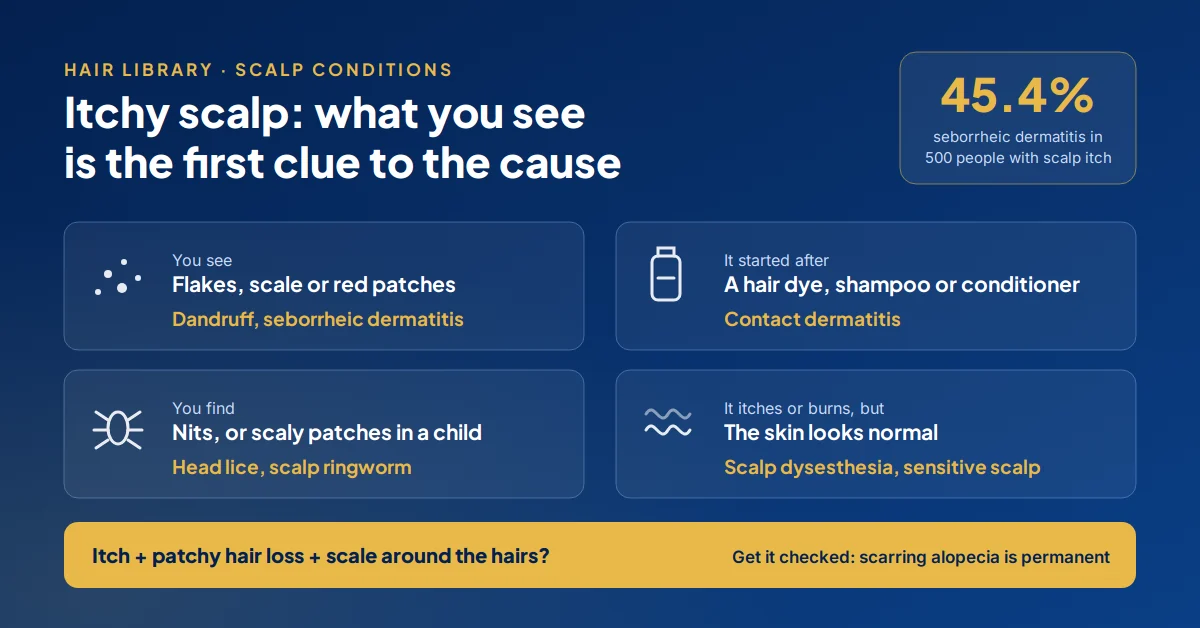
The commonest cause of an itchy scalp is seborrheic dermatitis, the stronger form of dandruff, which explained 45.4% of 500 cases in one hospital study.[1] Other causes are psoriasis, a reaction to a hair product, scalp ringworm, head lice and irritated nerves. What you can see on the scalp, and whether hair is falling out, narrows it down.
2Complete guideFrom flakes and lice to hair loss and transplants
Itchy Scalp Causes and How to Tell Them Apart
Start with what you can see, then find the closest row. The last two columns are our own summary of the sources on this page.
What you notice
Likely cause
Your first move
What to expect
White flakes, mild itch, no redness
Likely cause
Dandruff
Your first move
An anti-dandruff shampoo for up to 4 weeks
What to expect
Long-term, but not harmful
Red, scaly patches, sometimes on the face too
Likely cause
Seborrheic dermatitis
Your first move
Anti-dandruff shampoo; see a GP if it spreads
What to expect
Long-term, like dandruff but stronger
Silvery scale on red, crusty, sore patches
Likely cause
Scalp psoriasis
Your first move
See a doctor
What to expect
Needs psoriasis treatment
Itch or rash after a new dye, shampoo or conditioner
Likely cause
Contact dermatitis
Your first move
Stop the product; ask about a patch test
What to expect
A patch test can name what to avoid
A red or silvery rash, sometimes with patchy hair loss, often in a child
Likely cause
Scalp ringworm (tinea capitis)
Your first move
See a doctor
What to expect
Needs antifungal tablets, not shampoo alone
An itchy scalp, with nits or living lice on the hairs
Likely cause
Head lice
Your first move
A lice lotion with wet combing
What to expect
Close contacts need checking and treating too
Itch or burning on normal-looking skin
Likely cause
Scalp dysesthesia or sensitive scalp
Your first move
See a dermatologist
What to expect
Treatment depends on the cause
Itch with patchy hair loss and scale around the hairs
Likely cause
Lichen planopilaris or frontal fibrosing alopecia
Your first move
See a dermatologist soon
What to expect
Scarring: lost hair does not grow back
Dandruff and Seborrheic Dermatitis
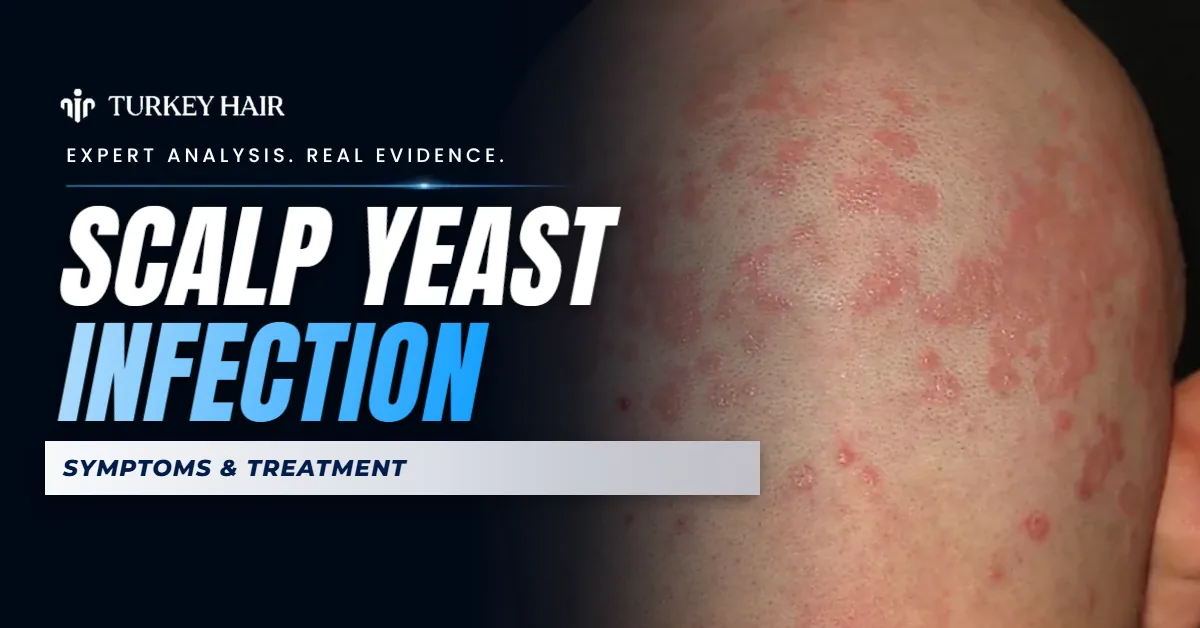
Dandruff is flaking and itch without visible inflammation. Seborrheic dermatitisGlossarySeborrheic dermatitis causes an itchy, flaky, scaly rash on oily areas such as the scalp. It is the Malassezia-linked condition most people mean by a scalp yeast infection. Open in the glossary → is the stronger form, with red, scaly, often inflamed patches, and both are linked to Malassezia, a yeast that normally lives on the skin.[2]
Dandruff is not caused by poor hygiene, but it shows more when hair is not washed regularly, and stress and cold weather can make it worse. For a shampoo, look for ketoconazole, coal tar or salicylic acid on the label.[3] Our guides to scalp yeast infection and ketoconazole shampoo compare the options.
Scalp Psoriasis
Psoriasis came next as a skin cause in the same study. It tends to give silvery scale on red, crusty patches that can be sore. When it is hard to tell from seborrheic dermatitis, a doctor can examine the scalp and decide. Our scalp psoriasis entry covers treatment and hair loss.
Reactions to Hair Dye and Other Products
Hair dye is the product most often behind an allergic scalp reaction, followed by shampoos and conditioners. The commonest allergen found on patch testing is p-phenylenediamine (PPD), and itch and burning are typical.[4]
If the itch started soon after a new product, stop using it and keep the label. A patch test can then name the ingredient, so you know what to avoid next time.
Scalp Ringworm and Head Lice
Scalp ringworm (tinea capitis) is a fungal infection that mostly affects children. Shampoo or cream alone is generally not enough, so treatment adds antifungal tablets, and people around an infected child may need treating too, even without symptoms.[5]
With head lice, an itchy scalp is the main sign, and finding living nits confirms it. Treatment is a lice lotion with wet combing using a fine-toothed comb, and everyone in close contact should be checked and treated.[6]
Itching With Nothing to See: Nerves and a Sensitive Scalp
When the scalp itches or burns but looks normal, the name is scalp dysesthesia. It can come from damaged or oversensitive nerves, for example from neck (cervical spine) problems or diabetes, or from psychological causes, and it is more common in older people, women, people with diabetes and people with a psychiatric history.[7]
A sensitive scalp is a close relative: itch, burning or trichodyniaGlossaryTrichodynia is pain, burning, tingling or soreness of the scalp in people who are losing hair. It is common in telogen effluvium and pattern hair loss. Open in the glossary → on skin that looks normal or slightly red, which stress or products can set off.[8] Pain is covered in scalp pain and hair loss.
Women, Men, Children and Afro-Textured Hair
Women. Itch on normal-looking skin is more common in women, and hair dye is the commonest product allergy, which matters if you colour your hair often.
Men. If you use minoxidil for pattern hair loss, the lotion itself can cause itch. After a transplant, itch that starts months later deserves a check. Both are covered below.
Children. Think of head lice and scalp ringworm first. Both pass between children and need their own treatment, not an anti-dandruff shampoo.
Afro-textured hair and braids. If you wash less often to protect a style, dandruff may show more between washes. If the itch starts with a new install, think of the products used with it. For hair loss from tight styles, see traction alopecia.
How to Relieve an Itchy Scalp
Relief starts with removing whatever aggravates the itch, then treating the condition behind it.[9] This four-week plan is how we would put that into practice:
Day 1: stop anything new that came just before the itch: a dye, shampoo, conditioner or styling product.
Days 1 to 28: wash regularly with one anti-dandruff shampoo, and give it the full four weeks.
Every day: if hot water seems to make the itch worse, rinse with cool water. A cold compress may also help, and in scarring alopecia, heat, sweating and hot water made itch worse while cold water often helped.
Every day: scratch less. Scratching damages the skin and leaves sores of its own.
Week 4: if the itch and flakes have not improved, see a GP. Go sooner if you notice any of the warning signs at the end of this page.
Myths That Keep the Itch Going
"Dandruff means you don't wash enough." Poor hygiene does not cause it, though skipped washes make it show more.
"You can catch dandruff." You cannot. Head lice and ringworm, by contrast, do spread between people.
"Any anti-dandruff shampoo fixes an itchy scalp." Ringworm needs tablets, lice need a lice treatment, and nerve itch needs neither.
"If nothing shows, nothing is wrong." Scalp dysesthesia is a real condition, often linked to damaged or oversensitive nerves, even though the skin looks normal.
Itchy Scalp and Hair Loss: What the Link Is
Does an Itchy Scalp Mean Hair Growth?
No. Doctors group scalp itch into skin disease, nerve problems, illness elsewhere in the body and psychological causes, and new growth is not among them. If your scalp itches while you are losing hair, look for the cause rather than taking it as a good sign.
When Itching Comes With Hair Loss
Itch and thinning can turn up together: a sensitive scalp often coincides with hair loss. Other kinds of hair loss have their own entries, such as telogen effluvium and alopecia areata.
The itch that matters most comes with scarring hair loss. In 61 people with lichen planopilaris or frontal fibrosing alopecia, 73.8% had scalp itch, and it went with scaling around the hairs.[10] These conditions destroy the follicle and leave scar tissue, so the hair they take does not come back.
Itching From Minoxidil
Topical minoxidilGlossaryMinoxidil is an established medication for certain types of hair loss. It is a drug, not a hair oil, and the FDA-approved label says not to use it for sudden or patchy hair loss. Open in the glossary → is usually well tolerated, but some people develop an itchy allergic rash. When patch testing finds the cause, it is usually minoxidil itself, and propylene glycol, a common base, comes next.[11]
That is why the review advises patch testing minoxidil and propylene glycol separately. Our minoxidil entry compares the forms.
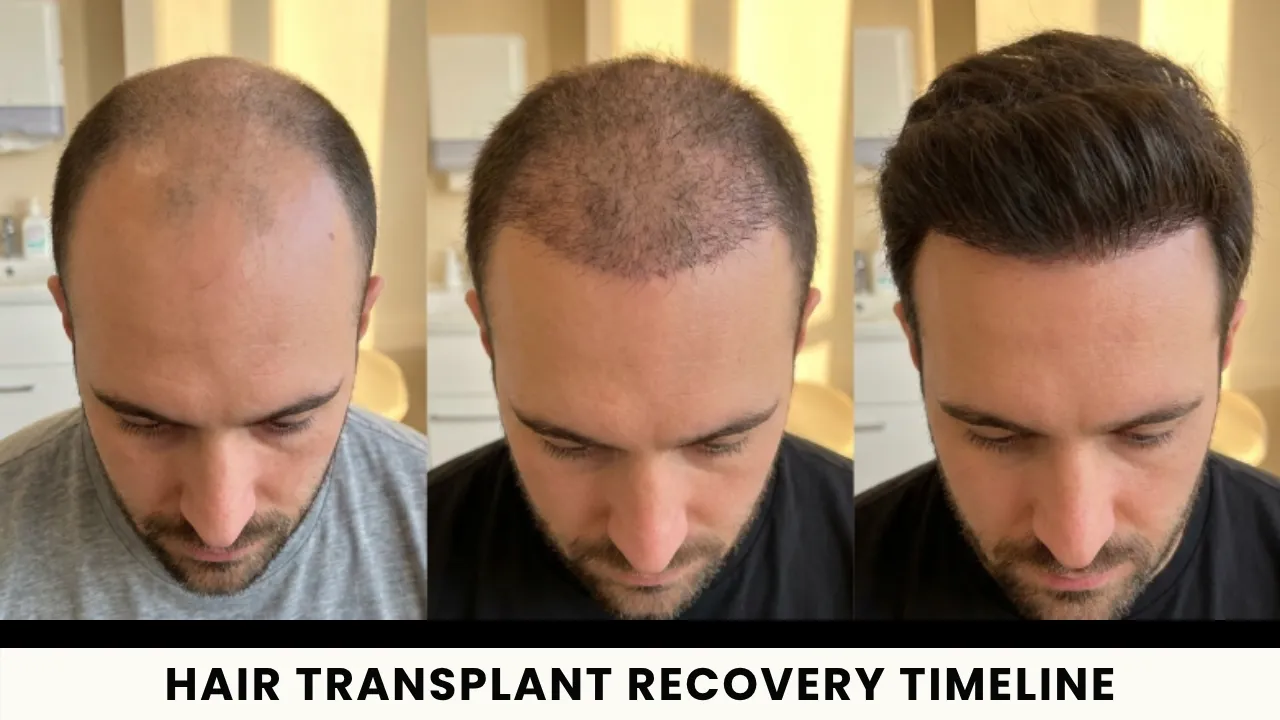
Itch that starts months later deserves a check. In 17 people diagnosed with lichen planopilaris 4 to 36 months after a transplant, all referred because growth was disappointing, itching was the commonest symptom.[12]
Can a Hair Transplant Fix an Itchy Scalp?
No. A transplant moves hair; it does not treat dandruff, psoriasis, lice or nerve itch. Surgery has even been linked to new trouble: lichen planopilaris has been diagnosed after transplants, and the small wounds made to place the grafts may play a part. Get the scalp diagnosed and settled first.
Frequently Asked Questions
Why does my scalp itch when there is no dandruff?
Itch without flakes can come from irritated nerves, a sensitive scalp, a product reaction or head lice. Check for nits, and think back to any new product.
Can stress cause an itchy scalp?
It can set it off. Stress is a known trigger for a sensitive scalp, and it can make dandruff worse.
Is an itchy scalp contagious?
Only some causes are. Head lice and scalp ringworm pass between people, which is why close contacts are checked and treated. Dandruff cannot be caught.
Why does my scalp itch after washing my hair?
Check the products first, because shampoos and conditioners are among the commonest causes of scalp contact allergy. A sensitive scalp also reacts to products, and in some scalp conditions hot water makes itch worse.
Is an itchy scalp a symptom of menopause?
Itch on normal-looking skin, called scalp dysesthesia, is more common in women and in older people, so it is worth considering in midlife. If it began around menopause with nothing to see, mention it to your doctor.
Can an itchy scalp be a sign of diabetes?
Sometimes. Diabetes explained 8.2% of 500 cases of scalp itch in one study[1], and nerve damage from diabetes is one route to scalp dysesthesia.
When to See a Doctor About an Itchy Scalp
Dandruff, the commonest cause, is not usually serious and can be treated at home. Give an anti-dandruff shampoo up to 4 weeks, and if the itch and flakes have not improved, see a doctor, who can check for another skin condition behind them.[3]
See a doctor sooner if you notice any of these:
Bald patches or patchy thinning with the itch. They can point to ringworm or a scarring condition.
Scaly patches in a child. Scalp ringworm needs prescription antifungal tablets.
A very itchy, red or swollen scalp, or flaky patches spreading to your face or body.
Open or crusted sores from scratching. With head lice, scratched skin can pick up a bacterial infection.
Lice that survive correct treatment. Other treatments, some on prescription, are then used.
A transplant treats hair loss, not itch. If your itch comes with thinning and you are not sure why, send three photos for a free hair analysis. The medical team will tell you whether it looks like pattern hair loss or a scalp condition to sort out first. You can also message us on WhatsApp.
About the Author
Written by: Nazmi Güldeş, Certified Trichologist. Nazmi Güldeş focuses on patient education around androgenetic alopecia, evaluating miniaturization through dermoscopy, and assessing candidates for medical treatments and hair transplants.
Editorial Policy & Trust
This entry was medically reviewed by Dr. Teuku Adifitrian, Sp.BP-RE (Dr. Tompi) on 31 October 2026. Every study cited here was checked against PubMed on 31 October 2026. Key figures are marked with their source, and every source is listed at the end of this entry. Read how we work in our editorial policy.
3 questions
Test yourself
Check what you remember from this entry. Each answer links back to the section that explains it.
Which condition explained the most cases among 500 people seen for scalp itch?
Seborrheic dermatitis explained 45.4% of cases and psoriasis 10.6%. Read the section
Does an itchy scalp mean your hair is growing back?
Scalp itch is grouped by skin disease, nerves, illness elsewhere and psychological factors. New hair growth is not one of them. Read the section
In 17 people with lichen planopilaris after a transplant, when did it appear?
It appeared 4 to 36 months after the transplant, and itching was the most common symptom. Read the section
3Scientific evidenceStudy types, references and how to cite this entry
12sources
Evidence behind this entry: 11 publications indexed in PubMed (2012 to 2026): 5 reviews, 3 clinical studies, 2 systematic reviews and 1 guideline. Plus . 5 sources have free full text.
Reviewsummarises many studies
Clinical studya study in people without random groups
Guideline or labela professional body, or the official drug label
Varshney A, Dsouza P, Rastogi P, et al. Study of Clinico-demography and Impact on Quality of Life of Patients with Scalp Pruritus. Indian Dermatology Online Journal. 2026;17(3):361-366.Clinical studyPubMedDOIFree full text
Gupta AK, Landells I, Talukder M, et al. Understanding the Scalp: Dandruff and Seborrheic Dermatitis. Journal of Cutaneous Medicine and Surgery. 2025;29(5_suppl):20S-26S.ReviewPubMedDOI
NHS. Dandruff. NHS website, health A to Z.GuidelineSource page
Pham CT, Juhasz M, Lin J, et al. Allergic Contact Dermatitis of the Scalp Associated With Scalp Applied Products: A Systematic Review of Topical Allergens. Dermatitis. 2022;33(4):235-248.Systematic reviewPubMedDOI
Mayser P, Abeck D, Bosshard PP, et al. Consensus-based Guideline on tinea capitis. Journal Der Deutschen Dermatologischen Gesellschaft = Journal of the German Society of Dermatology. 2026;24(10):e1510-e1522.GuidelinePubMedDOIFree full text
Apet R, Prakash L, Shewale KH, et al. Treatment Modalities of Pediculosis Capitis: A Narrative Review. Cureus. 2023;15(9):e45028.ReviewPubMedDOIFree full text
Ju T, Vander Does A, Yosipovitch G. Scalp dysesthesia: a neuropathic phenomenon. Journal of the European Academy of Dermatology and Venereology. 2022;36(6):790-796.ReviewPubMedDOI
Guerra-Tapia A, González-Guerra E. Sensitive Scalp: Diagnosis and Practical Management. Actas Dermo-Sifiliograficas. 2023;114(2):141-146.ReviewPubMedDOI
Rattanakaemakorn P, Suchonwanit P. Scalp Pruritus: Review of the Pathogenesis, Diagnosis, and Management. BioMed Research International. 2019;2019:1268430.ReviewPubMedDOIFree full text
Kołcz K, Krawczyk-Wołoszyn K, Reich A, et al. Pruritus in Lichen Planopilaris and Frontal Fibrosing Alopecia-Clinical Characteristics and Dermoscopic Correlations. Journal of Clinical Medicine. 2024;13(16).Clinical studyPubMedDOIFree full text
Kiratiwongwan R, Boonchai W, Kanokrungsee S. Allergic Contact Dermatitis to Topical Preparations Containing Minoxidil: A Systematic Review and Individual Participant Data Meta-Analysis. Dermatitis. 2025;36(3):200-206.Systematic reviewPubMedDOI
Donovan J. Lichen planopilaris after hair transplantation: report of 17 cases. Dermatologic Surgery. 2012;38(12):1998-2004.Clinical studyPubMedDOI
Güldeş, N. (2026, October 31). Itchy scalp: Causes, relief and the link to hair loss. Turkey Hair Center Hair Library. https://turkeyhaircenter.com/itchy-scalp/
@misc{guldes2026itchyscalp,
  author       = {Güldeş, Nazmi},
  title        = {Itchy scalp: Causes, relief and the link to hair loss},
  howpublished = {Turkey Hair Center Hair Library},
  year         = {2026},
  month        = oct,
  url          = {https://turkeyhaircenter.com/itchy-scalp/},
  note         = {Last updated 31 October 2026}
}
TY  - ELEC
AU  - Güldeş, Nazmi
TI  - Itchy scalp: Causes, relief and the link to hair loss
T2  - Turkey Hair Center Hair Library
PY  - 2026
DA  - 2026/10/31
UR  - https://turkeyhaircenter.com/itchy-scalp/
N1  - Last updated 31 October 2026
ER  -
Talk to our hair team on a free video call, in your language. You receive a written plan with your technique, estimated grafts and all-inclusive price. If a hair transplant isn't right for you, we tell you honestly.
Your information is 100% confidential.
Real People Real Support
Send your photos on WhatsApp
Front, top and both sides, reviewed by the medical team.