
Entry of the Day
Hair Loss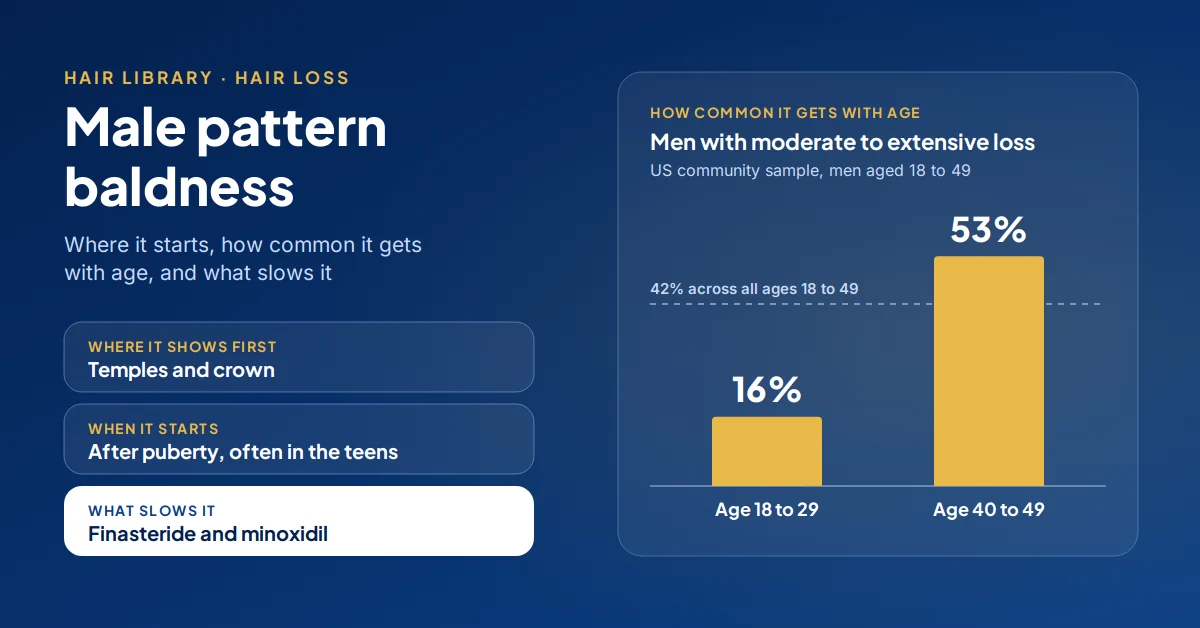
Male Pattern Baldness
Why male pattern baldness happens, the age it usually starts, how to tell it from a mature hairline or shedding, and what medicines and a transplant can and cannot do.
Read the full entryRandom entry
Hair Library · The Hair Encyclopedia
Hair science in plain English: reference entries on hair biology, hair loss, scalp health, treatments, hair care and hair transplantation. Written from published research, linked to PubMed and medically reviewed.
One entry, five quick facts and one picture. New every day.
Why male pattern baldness happens, the age it usually starts, how to tell it from a mature hairline or shedding, and what medicines and a transplant can and cannot do.
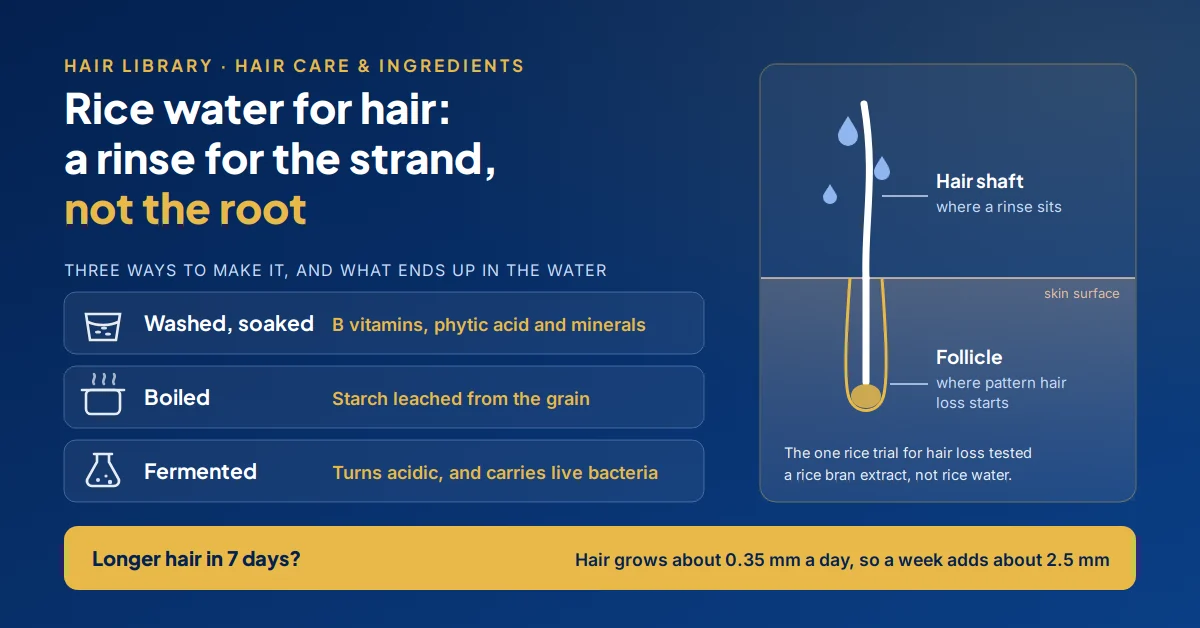 Rice Water for HairPublished 31 Oct 2026 · Hair Care & Ingredients
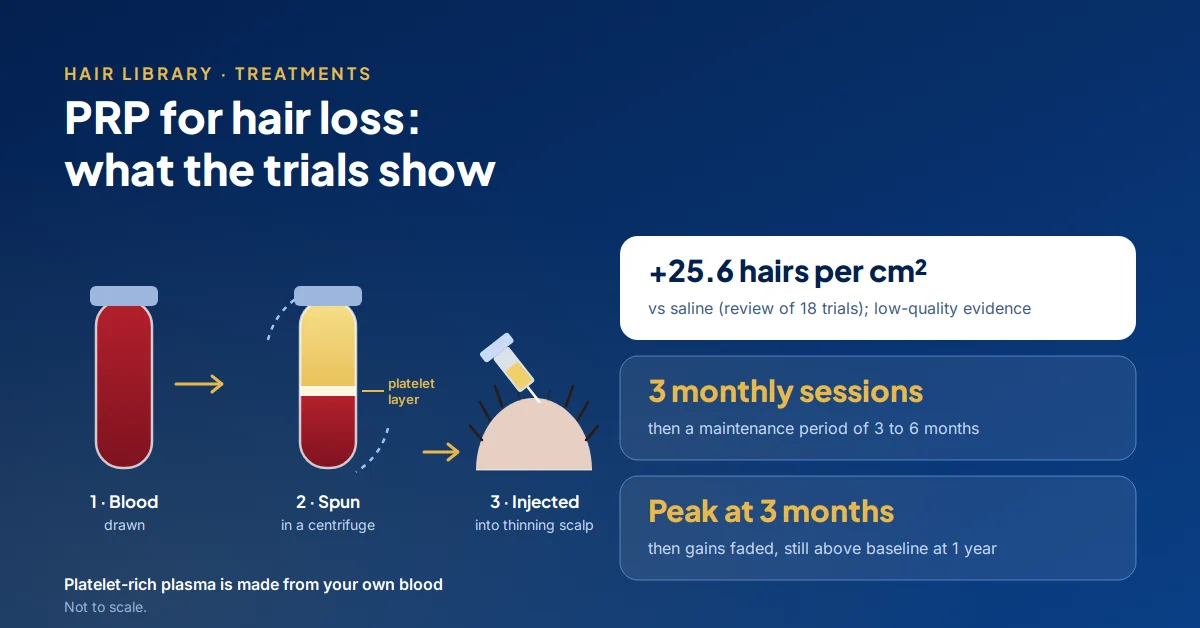 PRP for Hair LossPublished 31 Oct 2026 · Hair Loss TreatmentsMale Pattern BaldnessPublished 31 Oct 2026 · Hair Loss
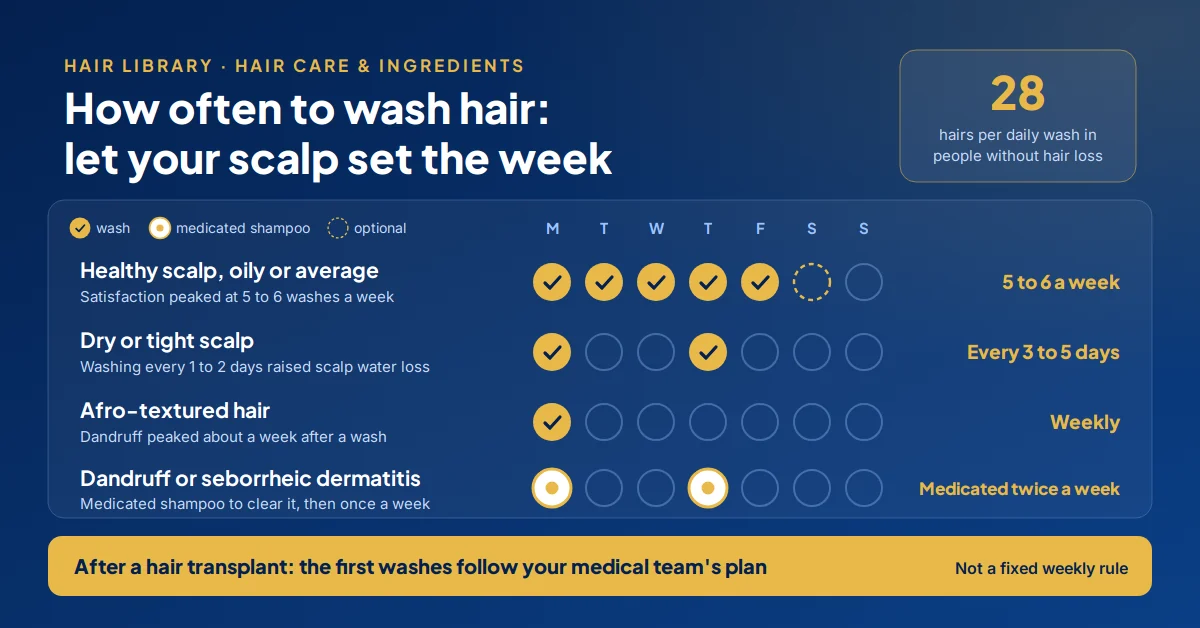 How Often to Wash HairPublished 31 Oct 2026 · Hair Care & Ingredients
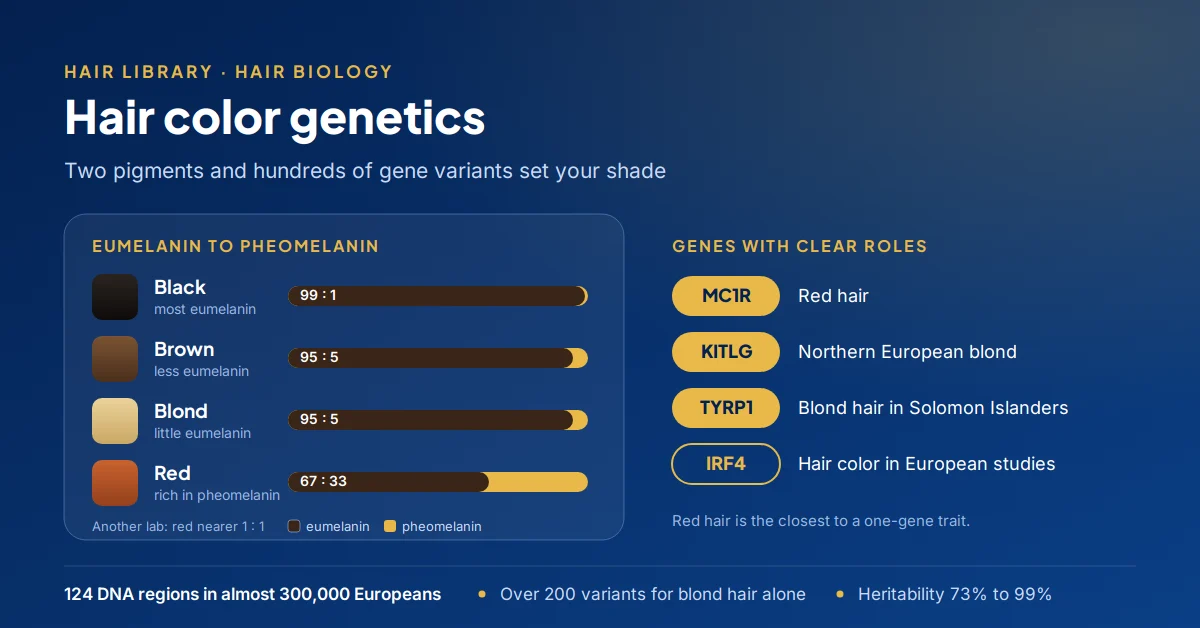 Hair Color GeneticsPublished 31 Oct 2026 · Hair Biology
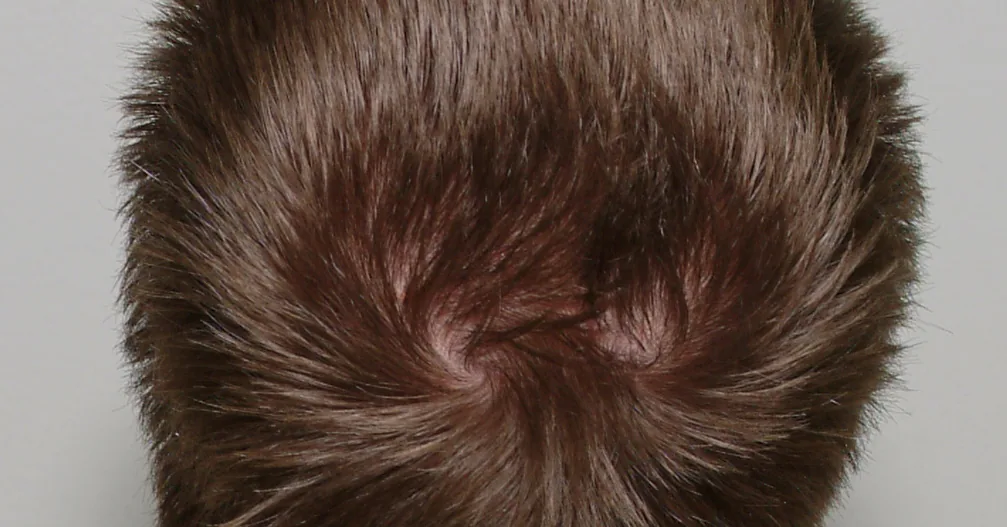
The basics every entry builds on, in one place.
Hair is a thread of keratin made by a living follicle in the skin. The shaft you see is no longer alive, so it cannot repair itself; growth, thickness and colour are decided in the follicle below. Each follicle runs its own cycle of growth, rest and shedding, so you lose some hairs every day but never all at once.
Every figure on this page comes from an entry in the library, where you will find the studies behind it. For the words themselves, see the hair glossary.
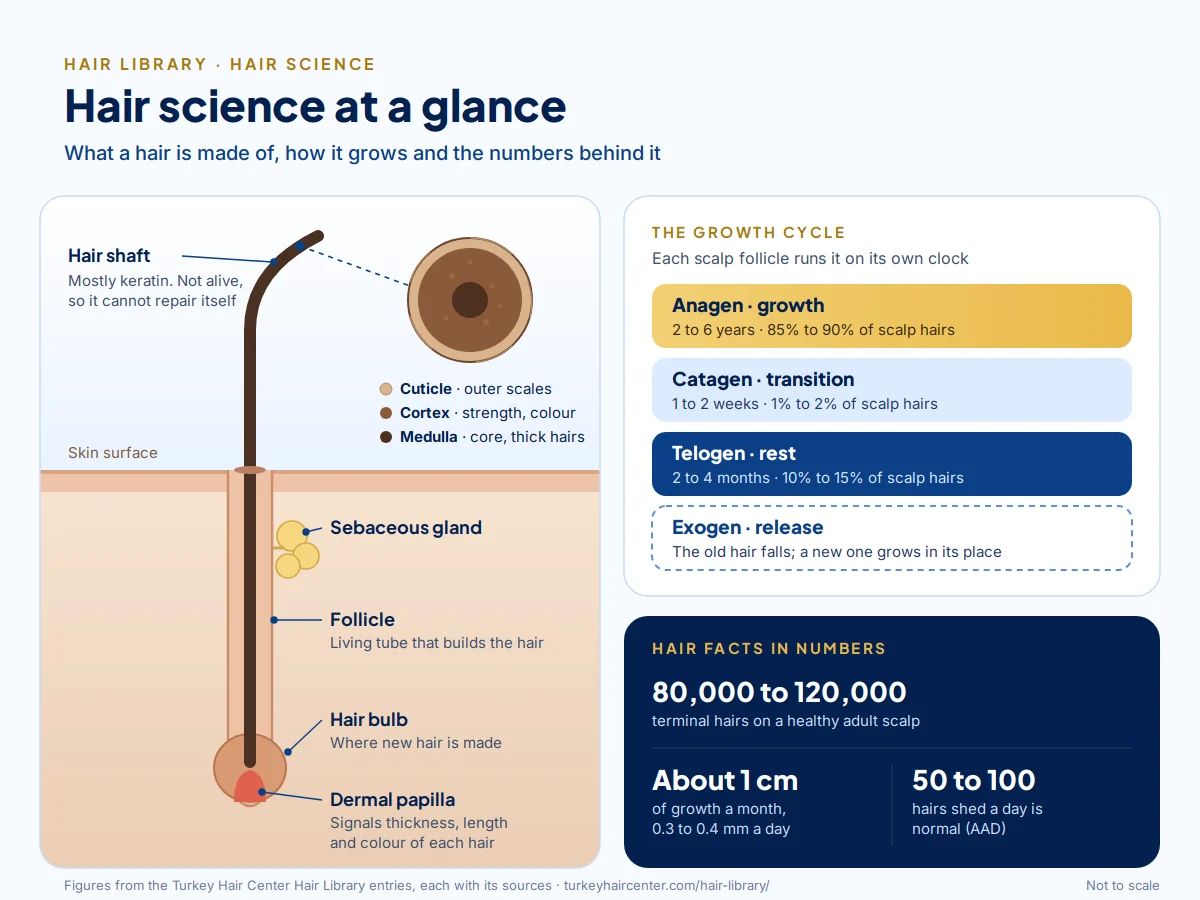
| Fact | The short answer | Full entry |
|---|---|---|
| What hair is made of | Mostly keratin, a tough structural protein, in three layers: the cuticle outside, the cortex in the middle and, in thicker hairs, a central medulla | |
| Hairs on an adult scalp | Roughly 80,000 to 120,000 terminal hairs, the thick pigmented hairs you can see and count | |
| How fast hair grows | About 0.3 to 0.4 mm a day: roughly 1 cm a month and about 12 cm a year | |
| The growth cycle | Anagen (growth) 2 to 6 years, catagen 1 to 2 weeks, telogen (rest) 2 to 4 months; 85% to 90% of scalp hairs are growing at any one time | |
| Normal daily shedding | 50 to 100 hairs a day, according to the American Academy of Dermatology | |
| Where colour comes from | Two melanin pigments made in the follicle: dark eumelanin and reddish pheomelanin | |
| Why hair turns gray | With age, the pigment cells in each follicle (melanocytes) make less melanin; genes set most of the timing | |
| Fine hair and thick hair | Soft vellus hair and thick terminal hair can grow from the same follicle, which can switch in both directions | |
| Hair types | Twelve patterns from 1A to 4C: straight, wavy, curly and coily, each split into A, B and C | |
| After a hair transplant | Transplanted hairs usually shed in the first weeks while the follicles stay alive under the skin; new growth begins around months 3 to 4 |
Three reading paths through the encyclopedia. Start with the one that fits you.
For patients: the essentials, in plain words.
For professionals: biology, evidence and complications.
For everyone: hair types, products and what the evidence says.
From the biology of a single follicle to hair care, treatments and hair transplantation.
How hair is built, how it grows and why it changes colour.
View all 9 entries →From 1A straight to 4C coily, porosity and curl patterns.
View all 7 entries →Patterns, causes and stages of hair loss, including hair loss linked to hormones and medicines.
View all 20 entries →Pain, bumps, pimples and infections of the scalp, and when to see a doctor.
View all 6 entries →What the research says about medicines and therapies for hair loss.
View all 12 entries →Oils, shampoos, serums, supplements and the ingredients inside them.
View all 12 entries →Every technique, how grafts are planned, recovery and safety.
A category opens once it has at least three entries. Next: Hair Genetics · Hair Technology · Hair Regeneration.
Each question has a full, referenced answer in the library.
Every term answered in a few sentences, with a link to the full entry when there is more to know.
The dermal papilla is a cluster of cells at the centre of the hair bulb. It signals the bulb and helps decide how thick, how long and what colour each hair grows.
Full entry: Hair Bulb Anatomy →A graft is a follicular unit taken from the donor area and placed in the thinning area. It holds one to four hairs, rarely more, so 2,000 grafts is roughly 3,600 to 4,600 hairs.
Full entry: How Many Grafts Do I Need? →Shock loss is a temporary shedding phase after a hair transplant, triggered by surgical stress to the scalp and typically starting 2 to 4 weeks after the procedure. The follicles remain healthy beneath the skin, and new growth resumes within 4 to 6 months.
Full entry: Shock Loss →The Norwood scale is the classification most doctors use for male pattern hair loss. It describes the usual ways the loss moves, stage by stage, from Norwood 1 to Norwood 7.
Full entry: Norwood Scale: Stages 1–7 →Find your stage, your hair type and a typical graft range.
New studies, summarized in plain language, with a link to the original paper. Each summary is medically reviewed.
Lists complete follicular unit extraction and avoiding transection, cutting through the follicle, as key preventive measures in FUE.
Describes the main parts of the hair bulb and states that the dermal papilla controls the growth, shape, size and colour of hair.
Short answers to the questions people search most, each linked to the full entry.
Looking for celebrity hair journeys, patient stories or news? They live on our Blog. The Hair Library holds reference entries only, so every topic has one home.
Talk to our hair team on a free video call, in your language. You receive a written plan with your technique, estimated grafts and all-inclusive price. If a hair transplant isn't right for you, we tell you honestly.
Your information is 100% confidential.